July is officially World Watercolor Month!

Art blogger Charlie O’Shields has launched an interesting initiative declaring July to be World Watercolor Month!
In the spirit of Inktober or National Novel Month (NaNoWriMo), Charlie is issuing a call to all artists to dive into watercolor. Consider posting your work using the #WorldWatercolorMonth hashtag, and possibly take on his challenge of 31 watercolors in 31 days.
Read more about getting involved, and how to participate in a charity fundraiser to bring kids art supplies.
Drawing the Drawing Robot Drawing
The other day I was sketching at the C2 Conference here in Montreal, and found myself drawing while simultaneously contemplating the death of work in our upcoming automation based economy, and the role of artists after the singularity.
(If you believe in either of those theories).
C2 is a place where you might find yourself believing all that stuff after a few lectures :)
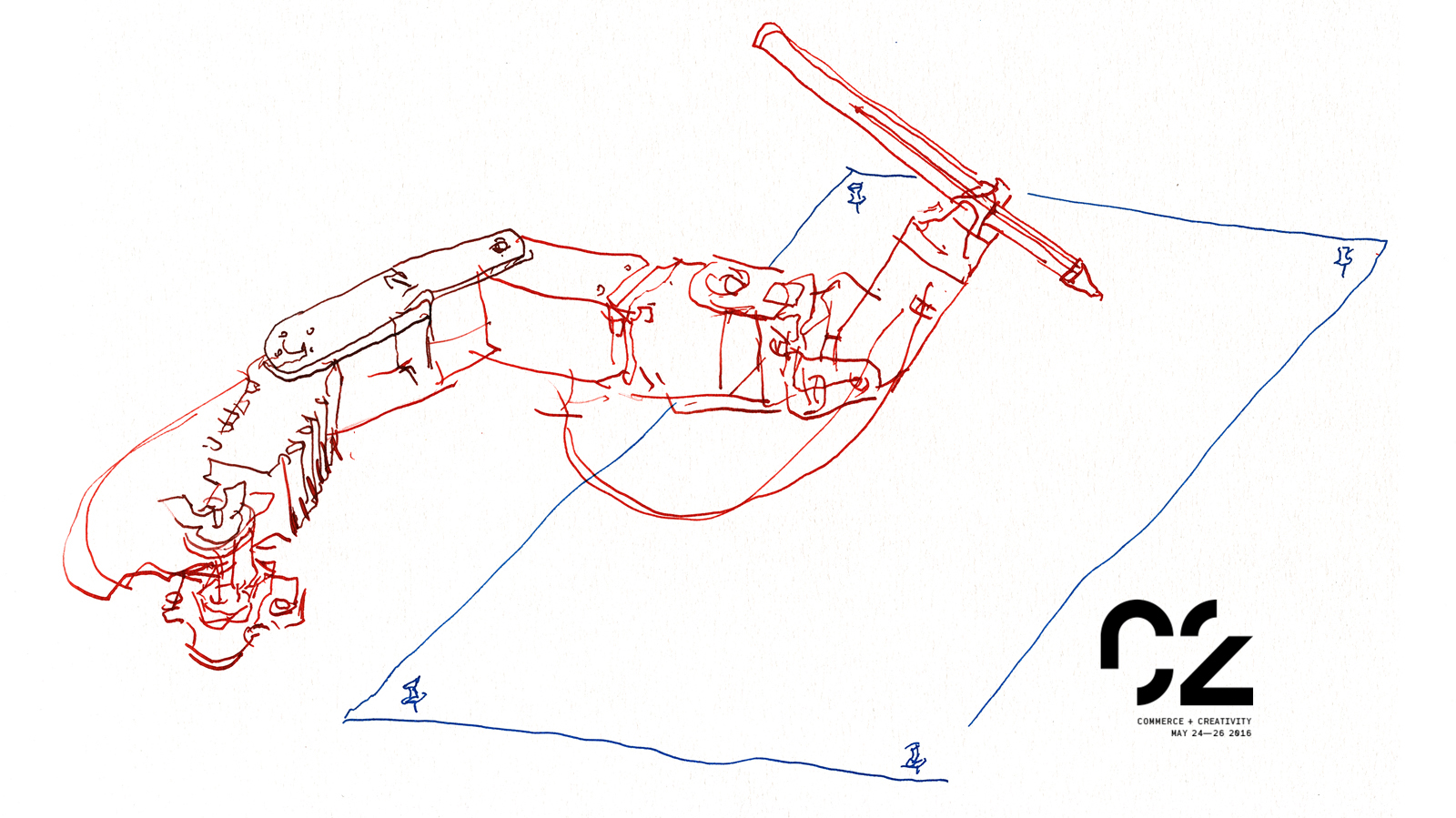
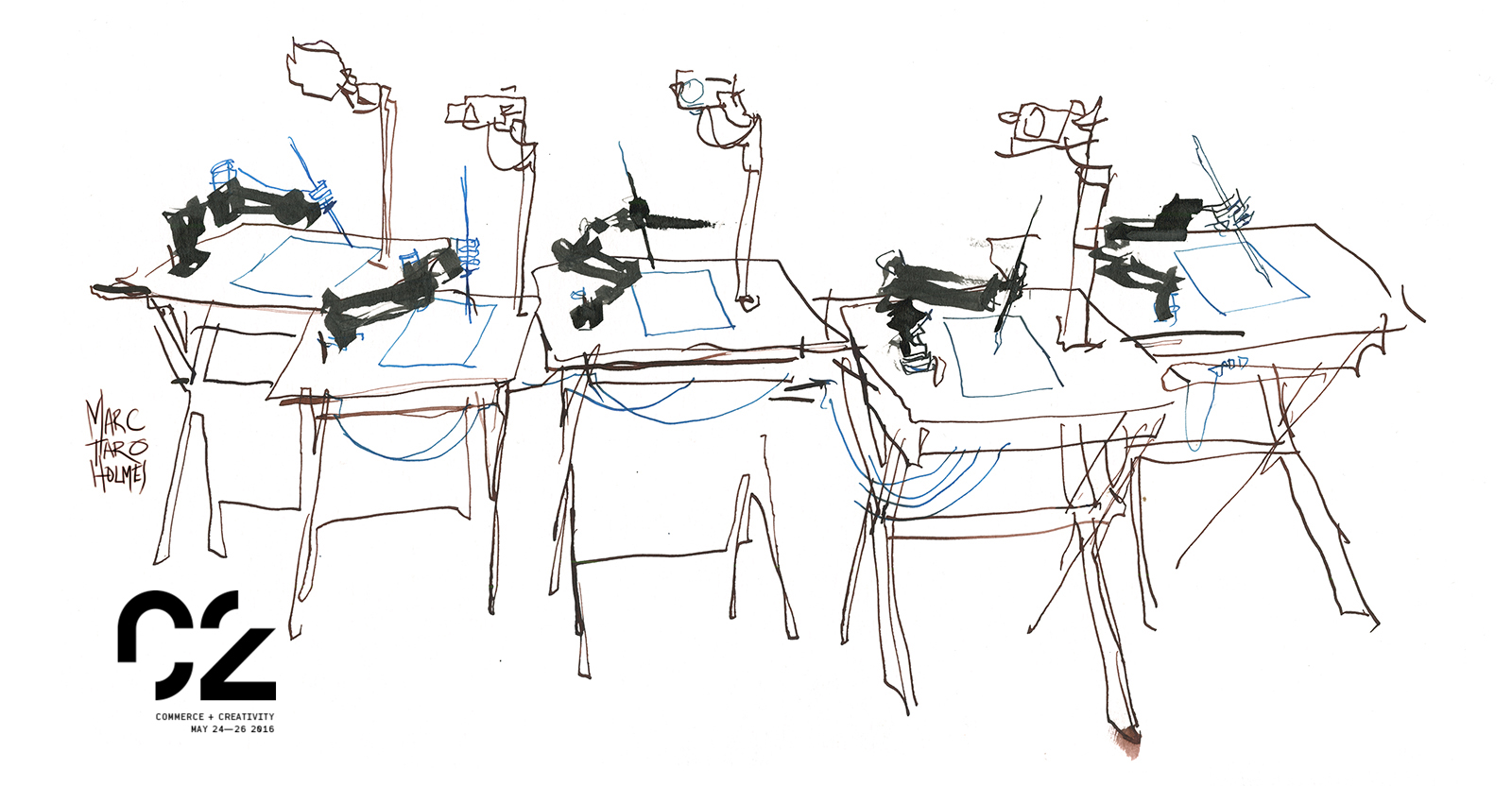
 What I was actually doing, while thinking these deep thoughts, was drawing a gang of drawing robots, while they were drawing a live human model.
An odd feeling for sure!
These small robot arms are built and programmed by artist Patrick Tresset.
Each robot has a camera “eye” and some techno wizardry in its processor brain that converts the values the camera sees into densities of pen marks. The results are actually fairly similar to what human artists do – since of course these robots were programmed by an artist who knows how to draw.
When I passed by, the group of about a half dozen arms were part way through their drawings, so I quickly pulled out my own sketching material to see if I could beat them to the punch.
I was only drawing for a few short minutes, but in that time a number of hilarious things happened.
First, I was in such a rush to beat the robots that I spilled some ink on the gallery floor. I’m in the habit of flicking dirty brushes onto the ground when I paint outside – and in my rush I did it without thinking. Luckily it was a polished concrete floor – so I could just casually drop a bit of paper towel and stand on it while I drew, mopping secretly.
Immediately after, I was digging in my bag for a pen nib or something, and I cut my finger. Painfully jamming a hangnail on the edge of a drawing board and ending up leaking blood down my finger tip while juggling multiple wet ink drawings.
I could see the half dozen robot arms working relentlessly while I fumbled.
They would never need a break. Never get distracted, never cut their fingers, never spill their ink.
There is no way to avoid seeing the obvious parallels in the larger global economy. This is what all those auto plant workers or deep sea welders, or the fabled John Henry must have felt like.
But I’m an artist – I was so sure this didn’t apply to me! Supposedly I am the one thing that cannot be replaced by a machine – and here I am being forced to confront my human frailty in this one sided drawing contest with a bunch of mechanical back scratchers bolted onto grade school desks.
But then, as I was turning the corner in my imaginary sketching race, well ahead of the sluggish robot team, I was congratulating myself on starting late and finishing early – totally owning those wind up toys – when I noticed a bit of programmatic theater.
The robot cameras were actually bobbing their heads, like an artist does.
Looking down at the paper then up to the human subject, then down again at the paper. A gesture any artist will recognize from life drawing class.
It was then I realized the true (terrible) nature of the situation.
There is no way the robots were actually analyzing their drawings visually. That would simply take too much artificial intelligence. I am techy enough to know this could not be the case here. It has to be a simple one-shot image analysis algorithm.
That means the camera head-bob was programmed in to make it *look* like the arms were thinking about the drawing.
In fact – the entire process of the pens scratching away while the model tried not to fidget? That was mummery. A puppet show designed to entertain the humans. Look how cute the robot overlords are!
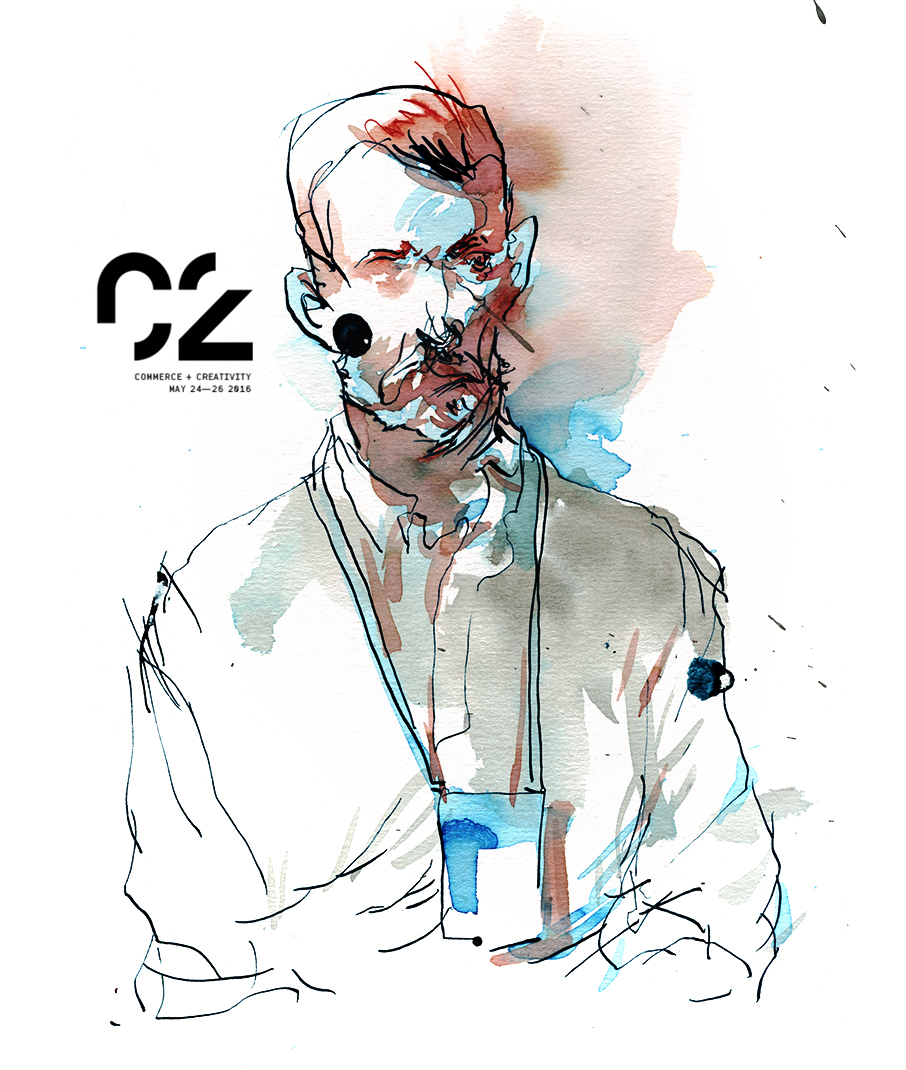
The human didn’t have to hold still! He could have walked away at any time! The robots only need a single glance to capture the likeness of our model (Mr. John Farquhar-Smith of FLUX). (I’m not sure he wasn’t a ringer working for the robots).
In fact – the robots don’t need time to do these drawings at all!
They could have executed them in a blur of motion, so fast they melted the ball point pens. They could have extruded the final drawing as a single stamped shape in a millisecond. They could probably have 3D printed a clone of John’s DNA in the time it took me to figure out how badly I was actually losing this race.
This fantasy that I was speeding past the machines was just a bit of re-assurance Mr. Tresset is trying to allow me. A bit of salve to my ego. I might have walked away thinking – those robots will never replace me! I’ve chosen the one path that is future proof.
But instead, I’ve walked away knowing – it’s only a matter of time until making imagery by hand is a Luddites’ pastime. A poet’s licence.
Eventually, all of us will have to consider what automation means to us. And I suppose, we’ll have to decide how much we care.
For now I can see the humor in it all. But I wonder what I’ll really be thinking in the next decade? It’s going to be interesting times ahead!
~m
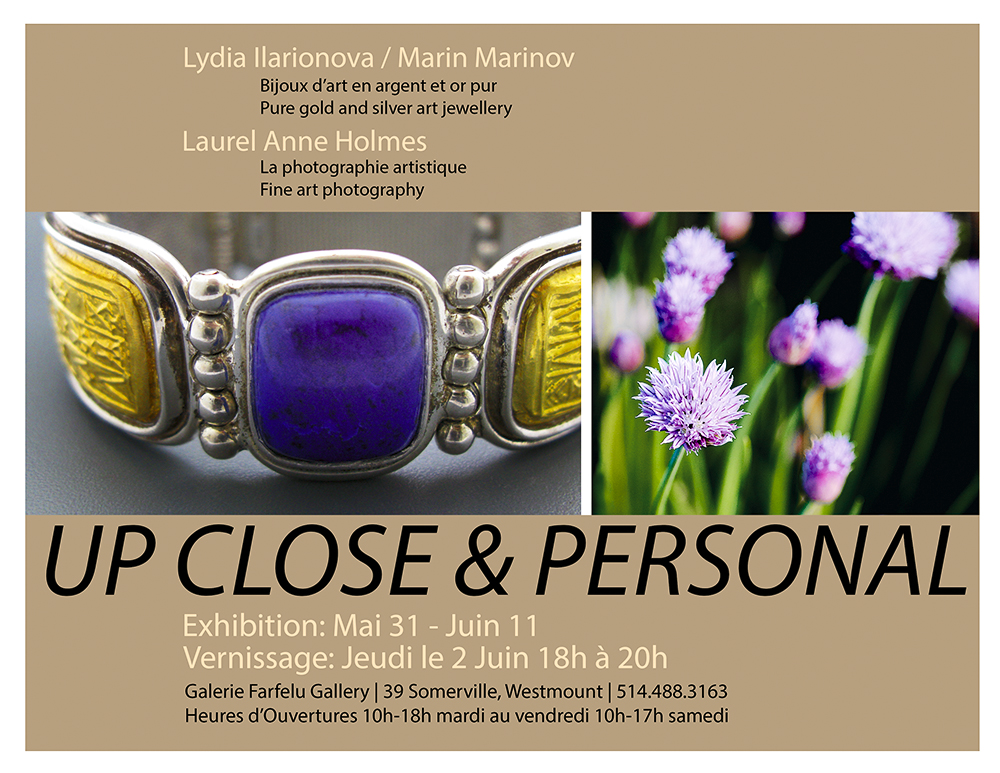
 Exciting news: If you’re in Montreal next week, Laurel Holmes has a small exhibition of macro photography up at Galerie Farfelu. (39 Somerville, Westmount).
She’ll be showing alongside recent gold and silver jewelry by Lydia Ilarionova and Marin Marino.
The show is up till June 11, and the opening night vernissage is June 2 from 6-8pm. See you there!

This morning we’ve posted big step-by-step article up on the Artist Network TV blog. Every so often we do a follow up to the series of drawing videos I did last year. One of our four video demos is on drawing panoramas – so I wanted to expand on what I show on camera with some new ideas about progressive pen weights and colored line.
Head on over to Artist network, and you’ll find my in-depth article on colored ink and dipping pens.
I talk mostly about a strategy of working your thinnest lines first, building up to blocking in shadow shape with a big-wide calligraphy nib. It’s a fun technique! You get to see your drawing resolve before your eyes, like a picture coming into focus. Plus there’s a lot of what is great about a watercolor painting – but with the more graphic colors of liquid ink straight from the bottle.


Head on over for the full Step-by-Step demo, gear list and more! ~m


I’m always talking about using negative space when painting. (Say for instance, this example). I often call it The Three Big Shapes: Sky, Ground, Subject.
In this short video, watercolor sketcher Anne-Laure Jacquart gives you a *perfect* example of cutting a negative shape.
You’ll see her deftly cut her subject out of the sky and ground in only a few moments work. She makes it look easy!
This is exactly the kind of direct drawing with the brush that makes watercolor the ultimate travel sketching medium.
And – just a reminder – Anne-Laure is the sketcher who is replacing me as the lead sketcher on our planned travel sketching workshop to India.
I hope if you’ve ever wanted to travel and paint in such an exotic location, you’ll consider signing up with her! There’s only 15 total spaces <update: Only 8 spaces left as of May 17 > in the group, so don’t hesitate to get in touch. (Click here for more information on India in Feb 2017).
Video on Location: The Alvor Demo
This just in: During this back alley demonstration painting in Alvor, sketcher Anne-Laure Jacquart was able to get quite a good recording oft my painting in progress.
She’s cut together a 12 minute video, showing it from pretty much start to finish – (skipping the boring drawing part at the beginning :) – even managing some great close up shots of brushwork in action.
Impressive what she’s captured looking over my shoulder!
The other day USK Montreal was out for the first of our Montreal Monument sketching meetups. This time out we were at Place du Canada, right next to Marie Reine du Monde cathedral.


I knew we’d have a big turn out. Spring is here! And it seems like every 4th Sunday we get more people. So I planned to be talking to a lot of people and generally not paying too much attention to my drawing. Just making little sketches and having fun. 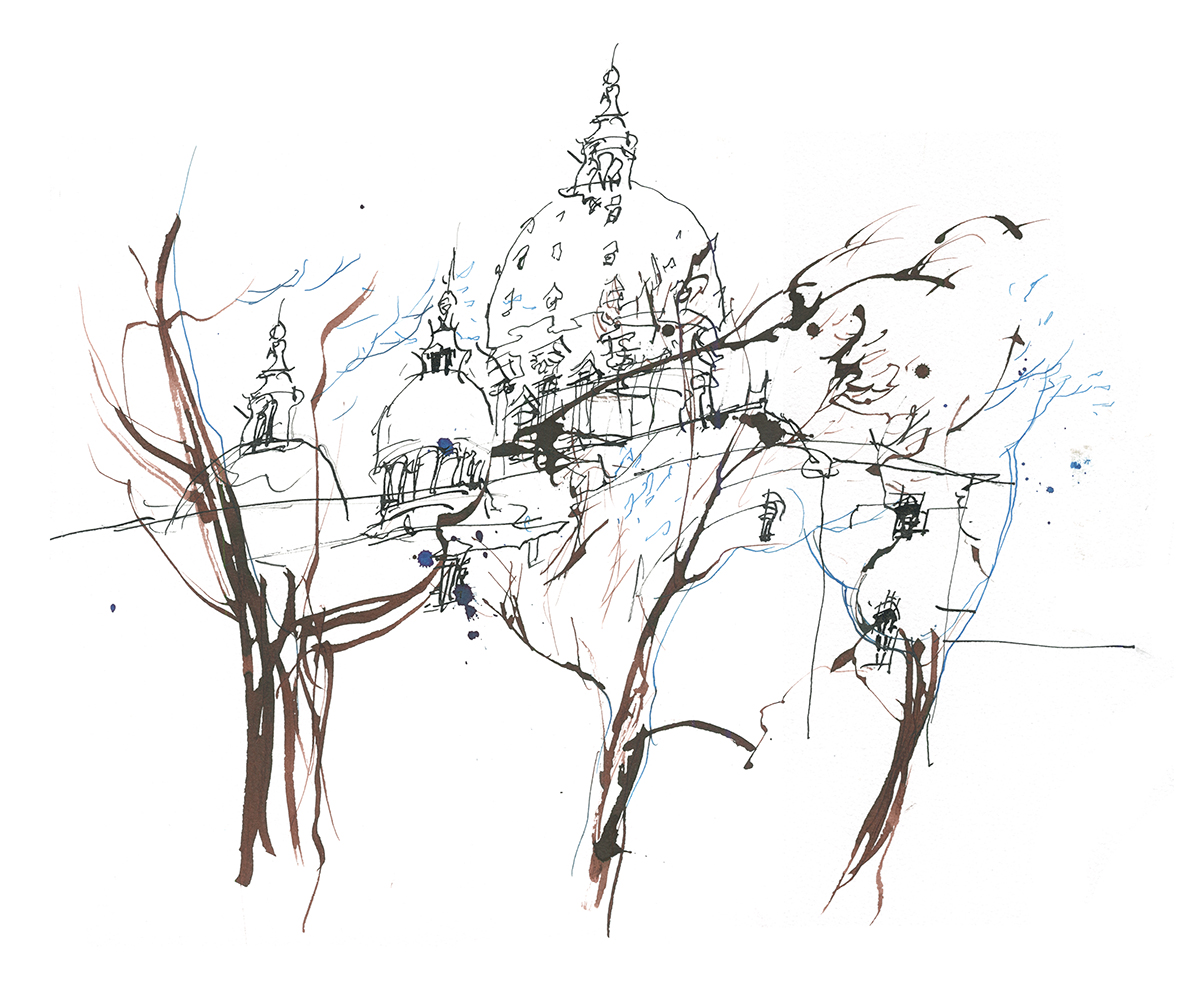 I ended up getting about 15 sketches? Something like that. Some of them quite wild. Many done in 5 minutes or less.
These are sketched with dipping pen nibs and either Higgins Sepia or R&K Blue Mare. I was drawing in two ring bound Canson Mixed Media pads. Why two pads? So I could leave one to dry while I drew in the other.
Here’s the final result, combining ten sketches: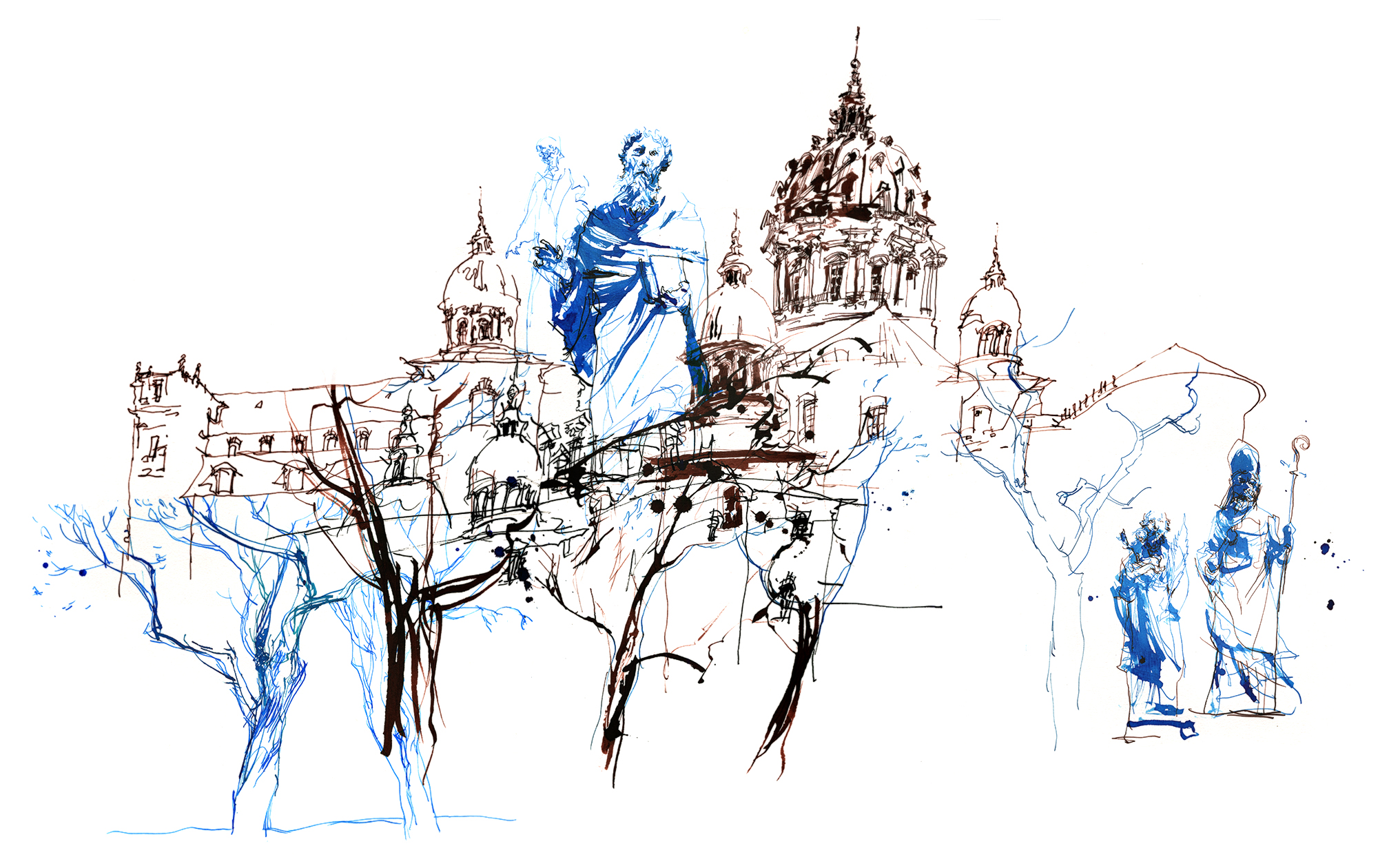
I didn’t have a strict plan, but I knew as long as I got enough coverage everything would work out. That’s the beauty of this method. No single sketch matters. Just go crazy and get lots of drawings.
I’ve been recommending this trick for a while – but haven’t actually played with it recently. I think the last time was in the warm-up for my Craftsy.com class Sketching People in Motion, for which I did this big one at the Corning Museum of Glass. It also comes in handy for illustration projects, and courtroom sketching.
To do the collage, you just scan all your individual sketches separately, then assemble them in one large file in Photoshop. Each scan on its own layer, set to the blend mode Darken. That way they’ll overlap whatever is underneath, and you can mess around re-positioning them as many times as you like.
The only thing to watch out for is making that the scanned paper is pure white – so you don’t accumulate a grey haze of paper tone after five layers of Darken.
Sometimes I’ll print the resulting collage back out and paint over top, but this one was just for fun so it’ll stay a drawing.
Let me know if you give this process a try. Send me some pics if you get a good one. Have fun with it :)
~m

I’ve done a little Q&A with Charlie O’Shields at Doodlewash.com where we chat about how I came to urban sketching, and a drawing exercise I’m working on called Three Times Fast. Click on over to find out more :)
~m
Sketching Algarve : the Coastal Towns
Though I thoroughly enjoyed the days painting the rocky coastline, there were also plenty of towns and villages to explore in the Algarve. From our home base in Alvor, we’d head out every few days on a bus trip to nearby Portimão or Sagres, or go inland to Silvas and Monchique. Each ‘travel day’ we’d try a different guided painting exercise in the morning and explore in smaller groups in the afternoon.
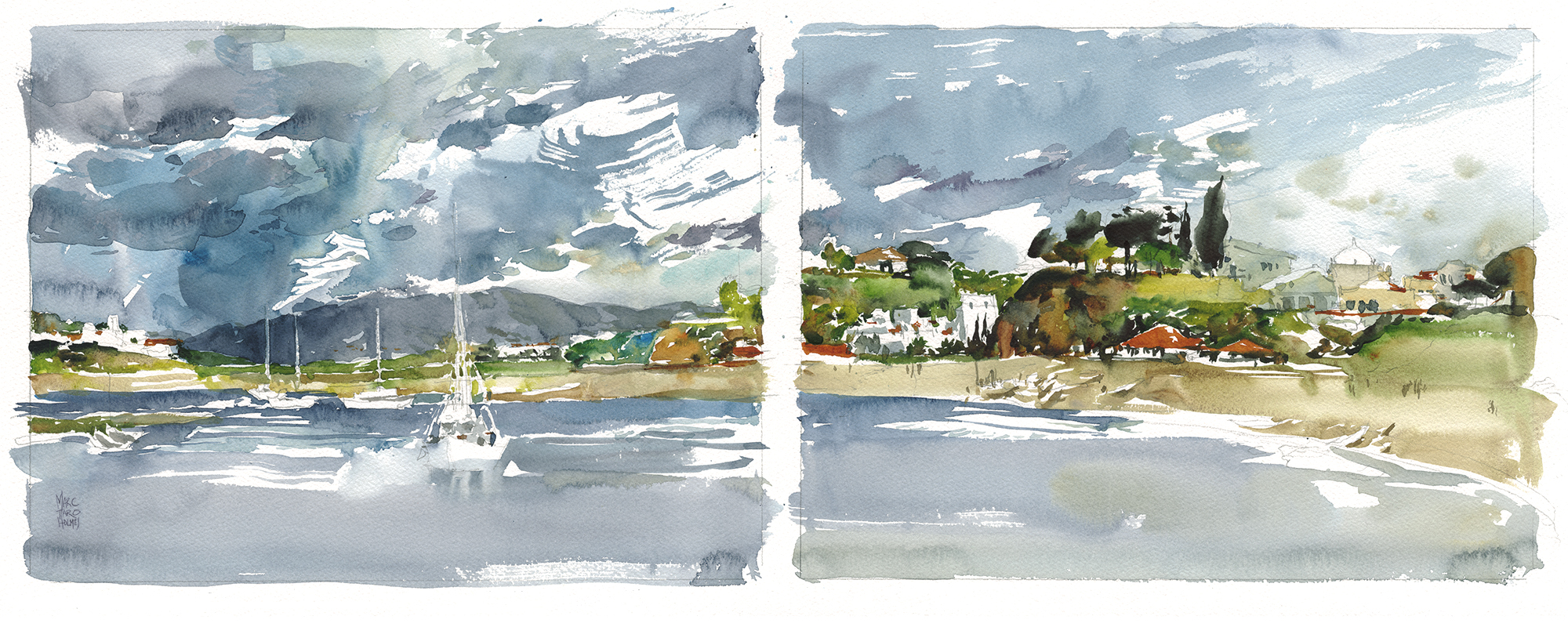
Some of the days I’d do a longer demo like this one above. This 11×30″ diptych is a view of Alvor harbor seen looking back from the boardwalk on the salt flats.
Lately I’m doing a kind of classroom demo I call a “paint-along”. I’ll show how I’d break down a scene with the drawing, then help out as people try it themselves. After they’ve had a chance to draw their own, we go back to watch my painting process. As people get the hang of it, they can return to their own pieces and apply the ideas. I might repeat that step again at the end, calling them back to see a demo of the final touches of dark, before people are getting there in their own work.
I like this method as it allows for people to digest the steps – applying the ideas immediately instead of trying to remember the whole process start to finish. Plus it seems more fun for people – as compared to watching me paint for an hour without a break.
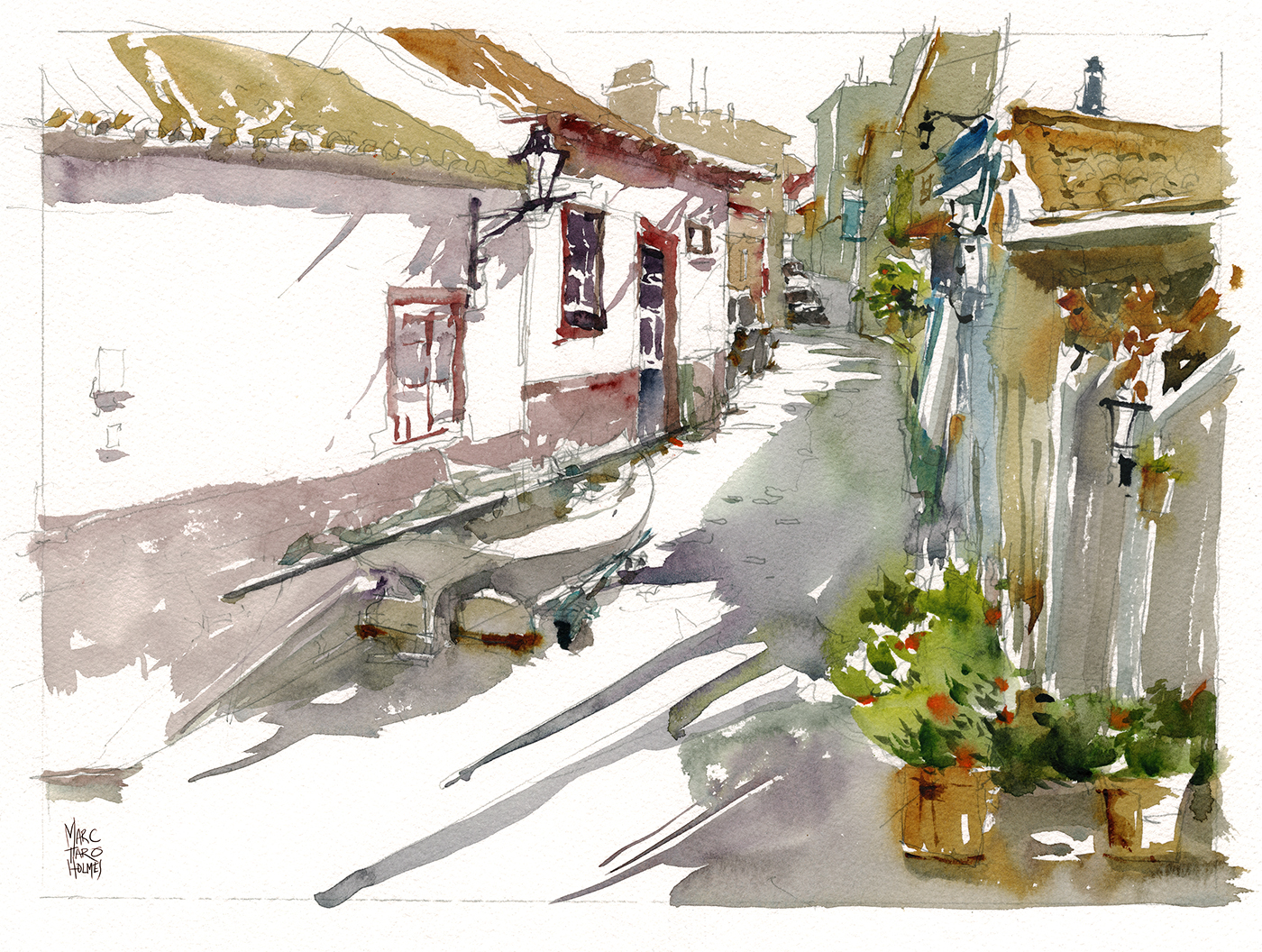
On another day in Alvor the Australians from USK:Melbourne asked me to show how I’d handle this narrow street view.
It ended up being kind of an overly long demo – I did a lot of drawing to carefully explain things – but then ended up simplifying it down to just a bunch of brushstrokes on the right hand side. My main goal was to start at the tiny gap in the distance and build the perspective of the narrow lane – making sure to get that small sailboat well in frame. I liked the idea of people parallel parking their boats in the back alley. That’s a slice of life that we don’t have at home.
Note how I use the highest contrast and brightest color to draw focus onto the red and white plaster house at center left. Those black and white windows are the strongest light-on-dark contrast. I softened the value of red painted trim as it vanishes out of the lit foreground (because of course it was the same bright red everywhere in reality) – but that helps keep the attention in the mid ground. This supports the way all the composition lines are pointing you down the alley. (See this old concept – Gradient of Interest).
So – it might have been a long drawn out demo – but it gave one of us time to sell her version of the drawing to the man who owns the sail boat. Meanwhile another artist who’d gone off on her own sold one page of sketches to two separate shop owners. They both wanted the original but she wouldn’t sell, so they settled for prints – and were willing to pay in advance to have her send them back when she got home.
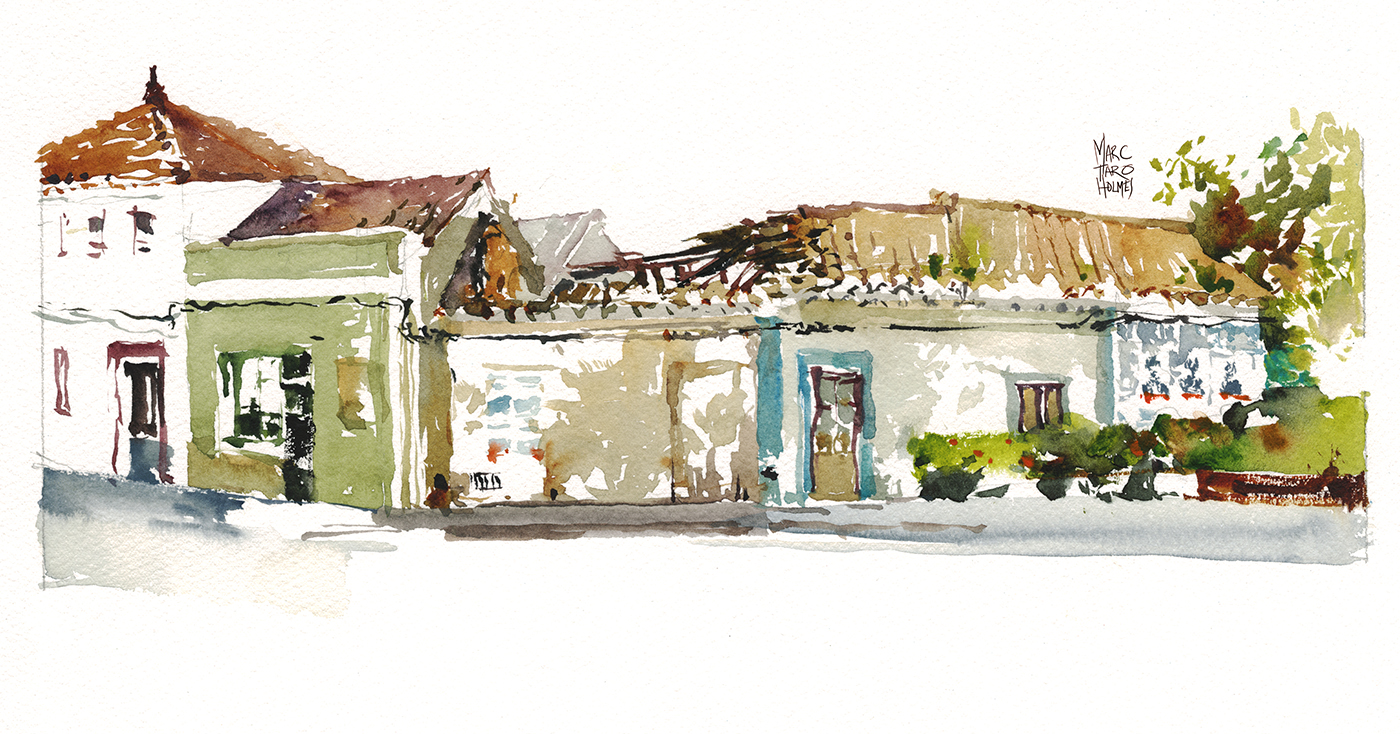
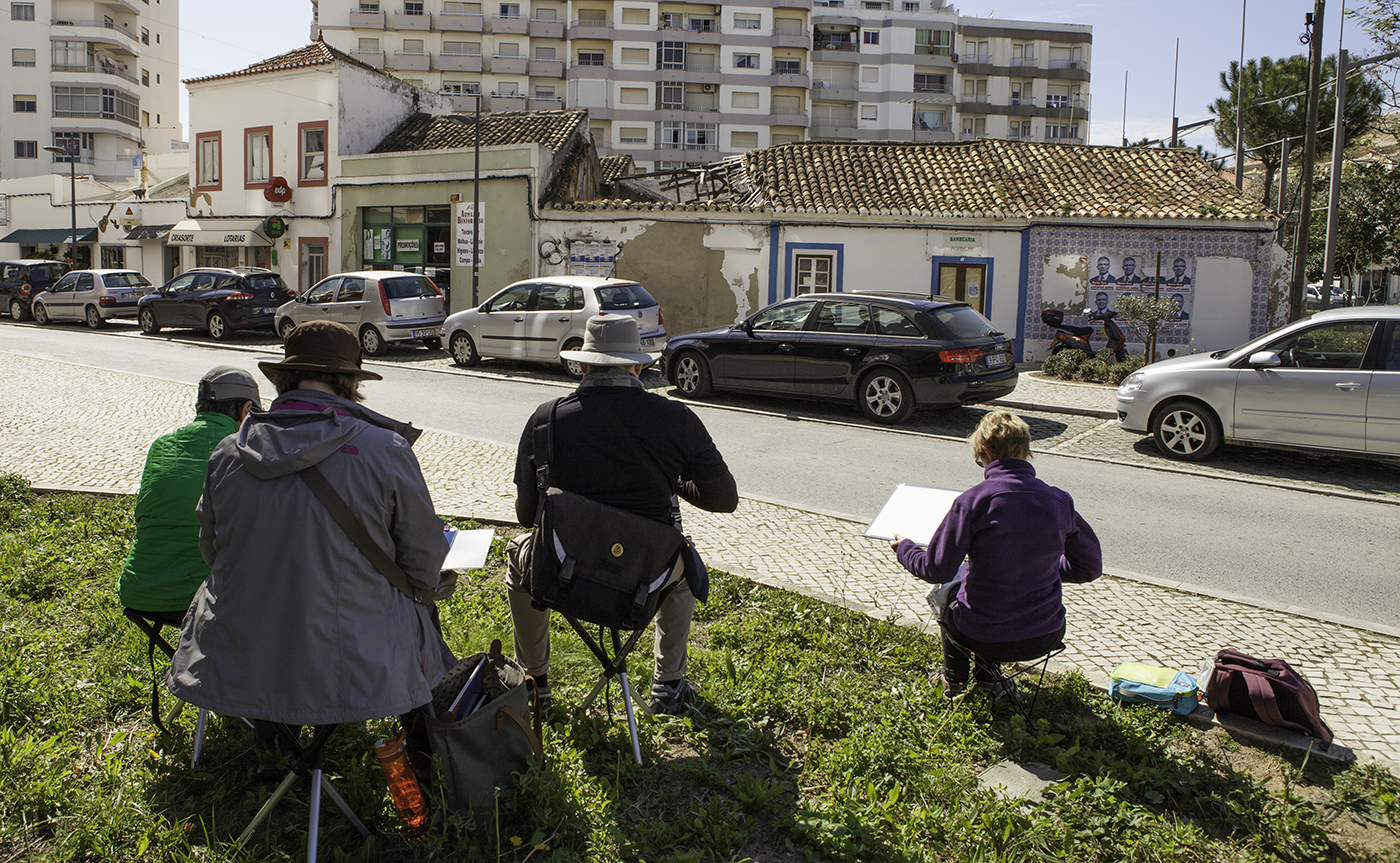
This spot is kitty-corner from the city hall in Portimão. I thought this fallen roof was more interesting than the official looking edifice. That, and I wanted to capture the irony of this run down block covered in old political campaign posters.
Painting these two sketches made me think back to the town of Paraty Brazil. We’d seen the Portuguese marble mosaic sidewalks show up in Macau, and now made the connection with the colorful plaster houses in Brazil. Real evidence the Portuguese once sailed the whole world.
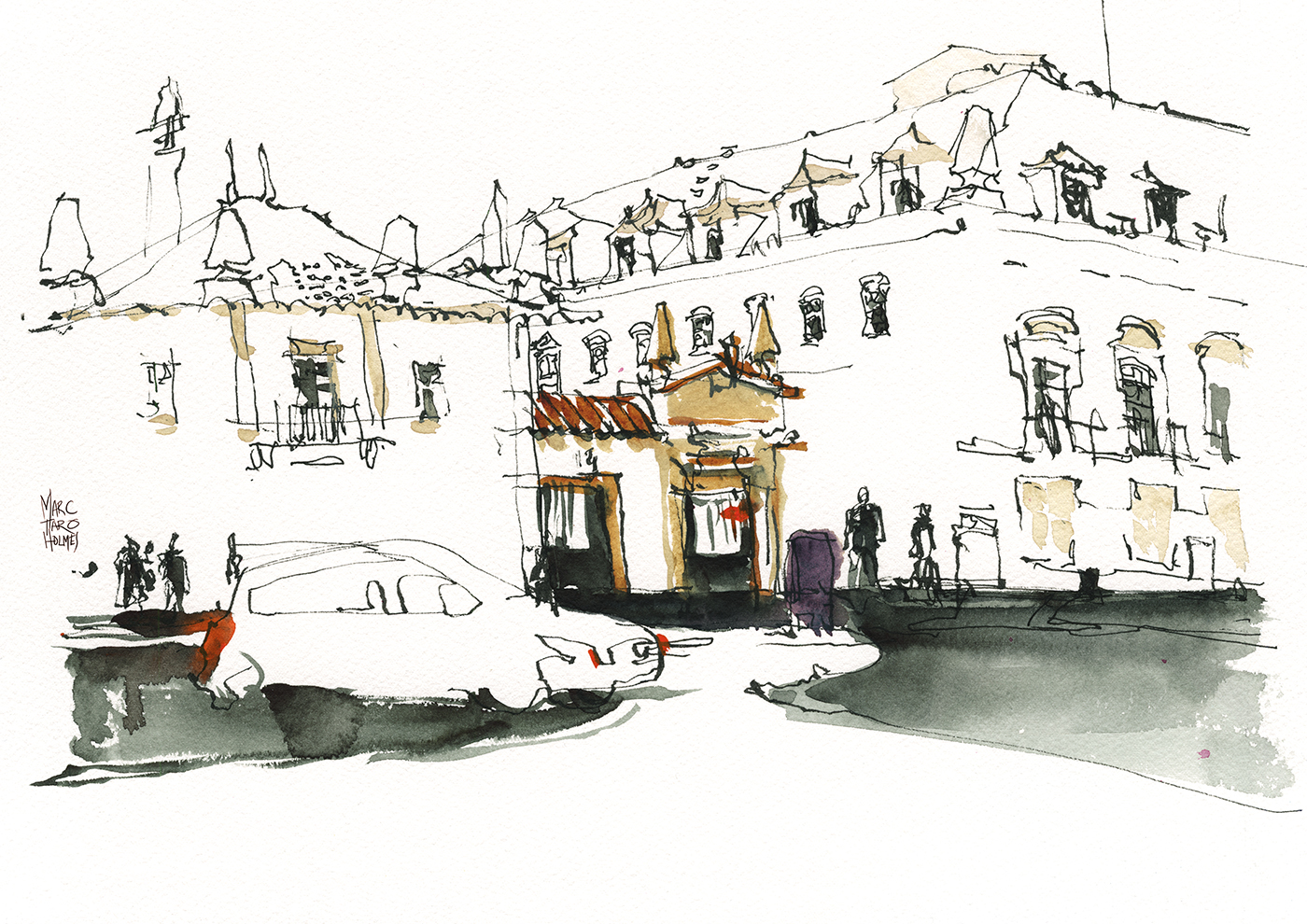
When it came to the city hall itself, I still avoided the issue – finding the parking entrance more interesting than the building itself. Ran out of time too after a false start, so this ended up being a 15 min single line sketch to wind up that day.
As the days went by, we collected something from every town we visited in the area:
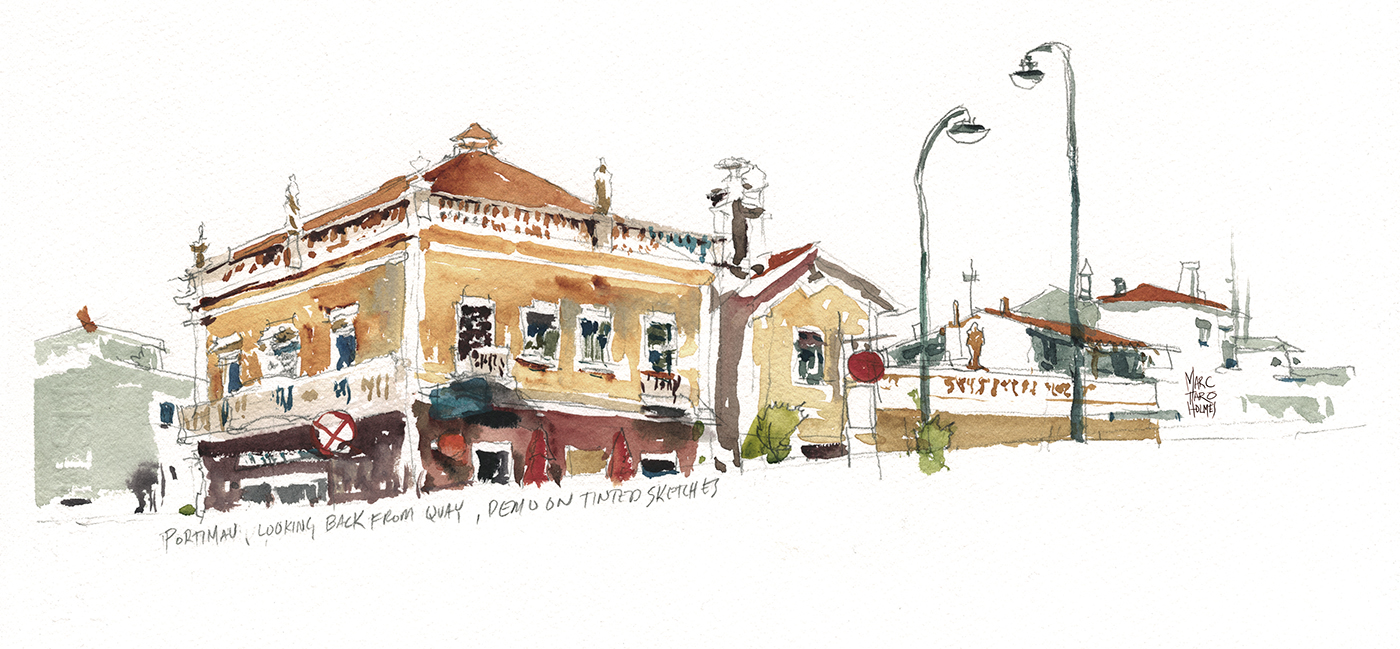
Just an ordinary block of buildings in Portimão. This kind of typical shop feels a bit like Italy, but with the little white balustrade along the roofline, it has its own Portuguese style. These were up behind a freeway on-ramp, and I liked the natural ground line it made by leaving that ugly-but-practical modernization out.
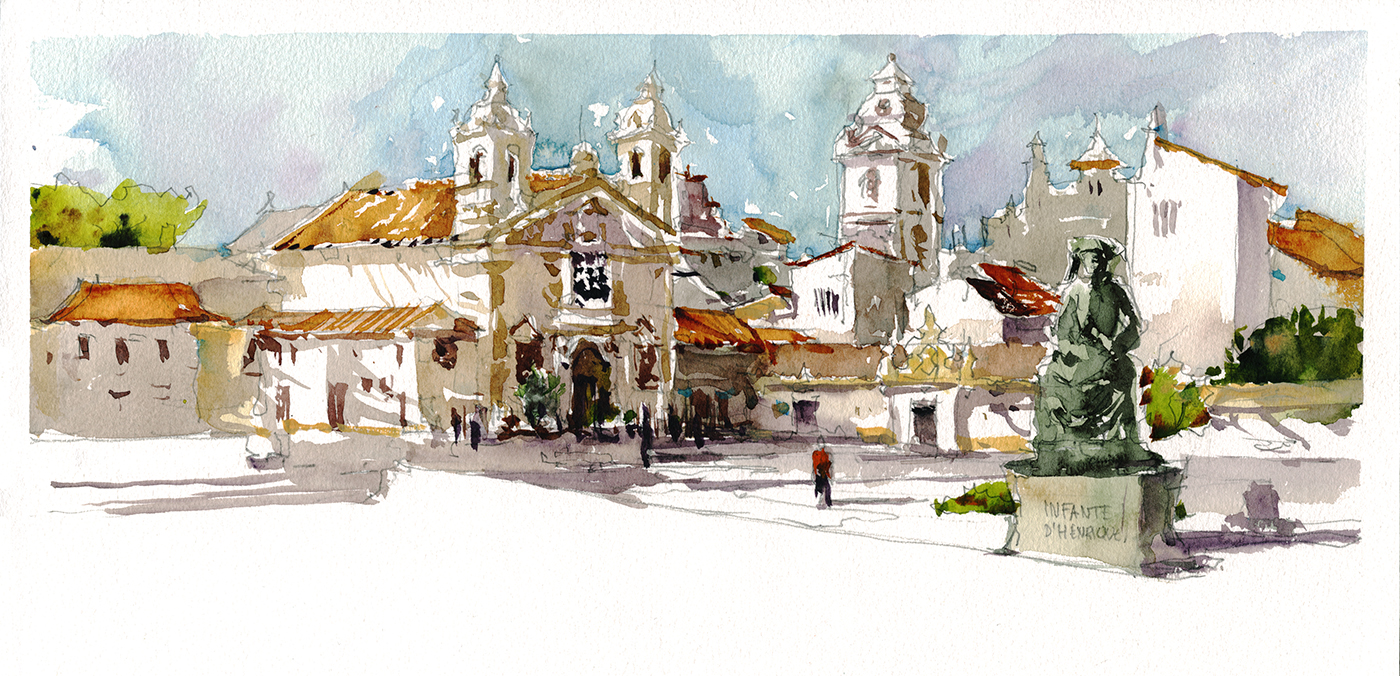
This square in Lagos features the Igreja de Santa Maria. This is supposed to be the site of an old slave market. I originally intended to make something grim and moody to convey a sense of the history here – but when we arrived, the place has been so completely changed – all white and sparkling in the sun – it’s hard to imagine that dark side of history ever happened.
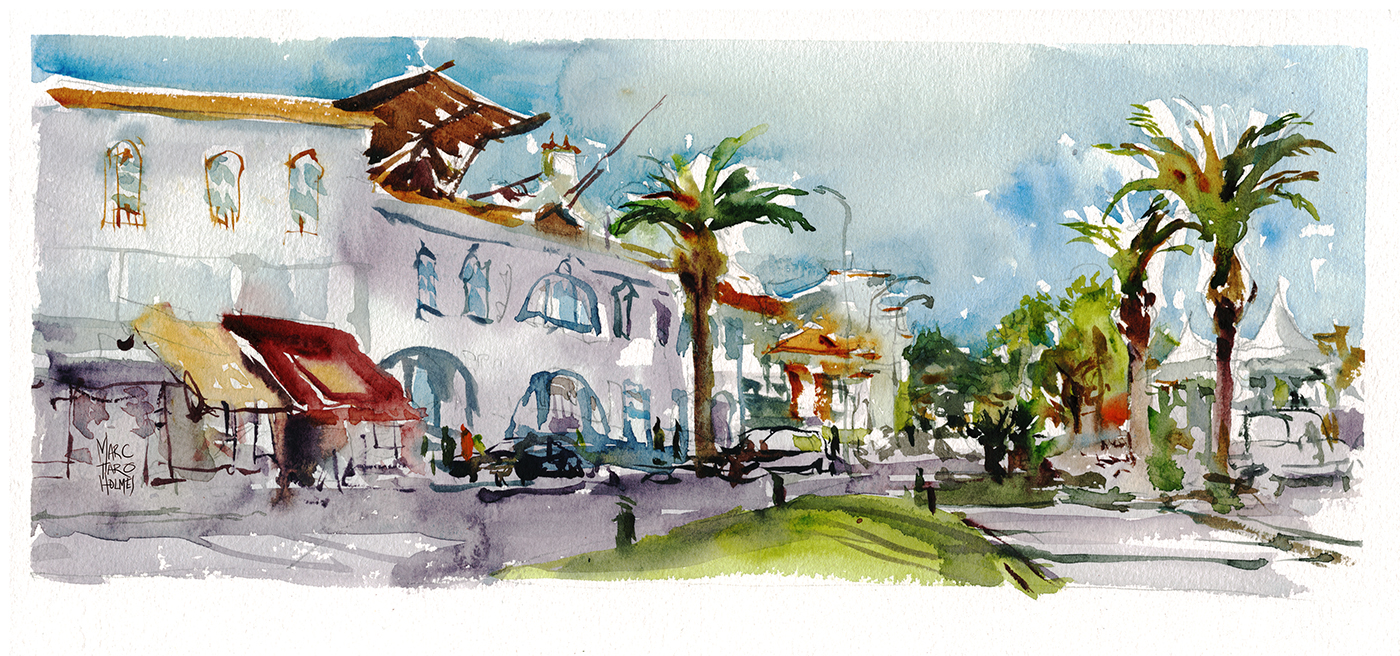
The Mercado Municipal in Lagos. This was one just for fun at the very end of the day. Immediately to our left is a taxi stand, which was our ticket home. If you go the other way, reverse to where we’re looking, you’ll get out to the Ponta da Piedade in about 30 minutes of scenic walking, or of course a short drive.
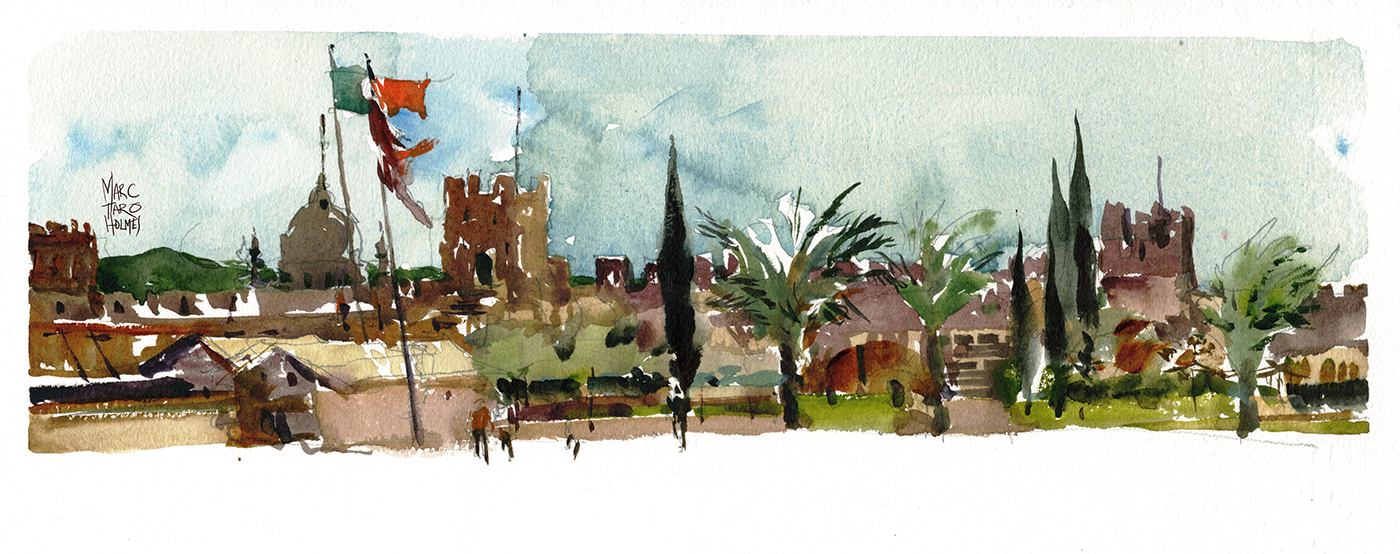
Inside the medieval castle at Silvas. Coincidentally while we were there USK Algarve was having an exhibition in the art gallery on site. Great motivation for our class of sketchers!
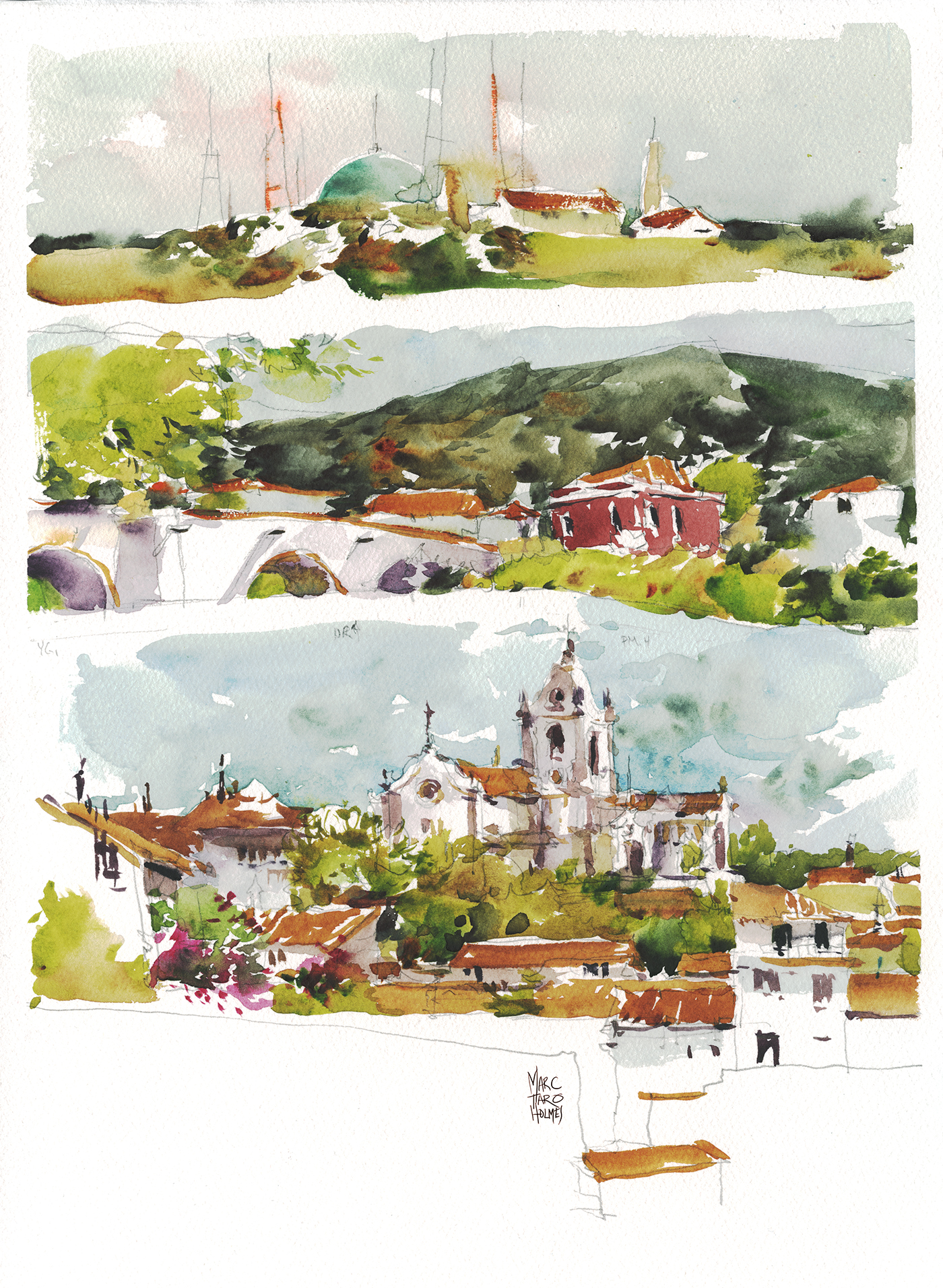
This final page starts at Fóia – the highest point of the Algarve, just above Monchique, then back down to Silves, where we got off the bus at this old bridge – then raced up to the cathedral to sketch it before we had to be back on the bus. Not the best way to be a sketch tourist – but this is the reality of travel – sometimes you have to draw fast, or not a all.
My favorite on this last page of sketches is the strange one at the top with the green dome.
I didn’t expect this, but Fóia is of course capped with radio antennas, cell towers and this space station looking dome that might be radar? I don’t know. It was so cloudy when we arrived, we only stayed a few minutes – this was the only thing to see from here. So that’s the oddest sketch – but it’s neat to be surprised sometimes.
Painting the Sea: Rocks and Water in the Algarve
 We’ve just returned from our 11 day painting workshop in the Algarve Portugal. There’s of course a wealth of things to see in the area. Much of it is pastoral landscape with picturesque towns and fishing villages. For me – a kid from the Alberta prairies – it was the beach that held the most opportunity.

Since people will ask – these sketches are 1/4 sheet, so approx. 11×15″, and the most important colors are Buff Titanium and Goethite for sand and Indigo, Turquoise and Viridian for the sea and sky.
I used Cobalt Teal Blue in Florida but I was told (by the Queen of Color Jane Blundell) how to make a more complex effect with Buff Titanium added to any cool blue or green.
For the warm colors of the rocks I went to the famous Buff Titanium again, plus Quin Gold, Trans Red Oxide and Raw Umber Violet.
So the take away is – get Buff Titanium! It’s incredibly useful as a pastelizer and opacifier. (Someone can tell me if there’s real watercolor terms for those two words?)
People are always saying ‘I don’t have that color, what is that for?’ – so there you go. It’s for everything that has a dusty yellow to warm white pastel tone. Also comes in handy for trees, concrete, even fleshtones sometimes.
 When you have a tremendous location like this, the paintings seem to make themselves. I love the elemental simplicity of rocks and water. It’s almost abstract. It seems like there’s an infinite number of compositions with the ever changing colors of the sea.

These are sketched at the far end of Alvor Beach at a small section they call Prainha. There really aren’t very many rocks here, but it was right near our home base, 30-40 min walk from the harbor, so perfect for a quick day trip to the beach.
They’re building a boardwalk all the way out here, so it will be even easier next year. Today, you can walk along the highway, or do what we did the second time and take a cab to the Restaurant Atlantida – they have the prime spot at the very end of the beach. I suspect it’s a popular choice for a sunset dinner.


If you come on foot by beach, you can get cut off by tides, so you might need to go up the cliff. There’s only one staircase in the area, which is easy to find. The main challenge at the seaside is breaking down the patterns of moving water.
Seeing zones or ‘stripes’ of color where you can see depth changes, interpreted as horizontal bands of green or blue. I think you can see three or four horizontal passages of dark-to-light, blue-to-green in this one above? It’s of course not that simple in reality – but you can make some judgement calls and simplify it into these bands. I worked fast to lay them while edges were still wet. Just don’t stop in the middle. Paint all the water in one go, and plan ahead not to run out of your water-color puddle in the middle of the page.


As well, I found I had to go back and restate the darkest blue on the horizon with more intense pigment at the very end. (After the first pass was dry).
And of course, note the reserved white of the sea foam. Those gaps are things you’ll have to try and allow to happen as you’re gliding across with sea-blue-green.
Another odd bit is the colors of wet sand – I found that hard to guess at – or the eddies of sand kicked up into the waves. These are perfect places to charge in the extremely sedimentary color DS Goethite.

At different times of day the water bounces back different colors. In the early morning, or a rainy day, it’s almost black in the foreground – reversing the normal sea-green foreground to dark blue horizon.
This one is from the Ponta da Piedade in Lagos. I highly recommend this spot – the best place for rock arches and intersecting lagoons.
In the very early morning, when the water is calm, they do stand up paddle surfing tours. It was just two of us and 10 or 12 of them out there at sunrise.
I only did one full-on painting here. I don’t know what I was thinking! But you could go back over and over and not run out of things to paint at this spot. If you do only one rocky point – this was the best I found. Locals might have better suggestions – let me know in the comments!

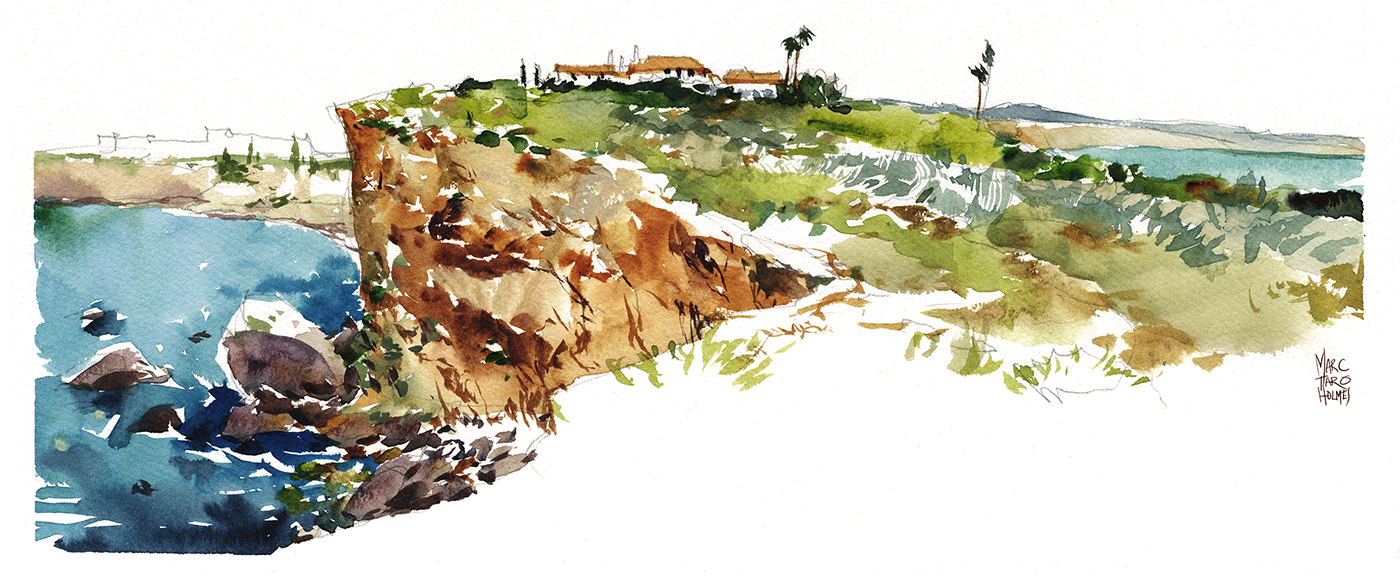
I noticed a lot of local sketchers using long horizontal panoramic books. It makes sense – the land here is perfect for them. There’s a 6×12″ watercolor block by Fluid paper that would be ideal for these long, low red-orange cliffs leading out to sea.
Here’s the last two of these we did at a day out with the USK Algarve group. They were kind enough to host a session where we could meet a group of local sketchers.If you’re visiting the area, check out their blog in case they have an event on.

This sketch above with a very simple long low yellow building you can barely see? – the one looking like a stick of butter in the sun? That’s the fort at Sagres. It’s a great spot with views all around it. We did both of these sketches, parking at the nearby Pousada Do Infante and looking back at the point.
Next up: sketching the towns: Alvor, Portimao, Sagres, Silvas. Stay tuned for more from Algarve!


 Citizen Sketcher