Painting Demo: Leafy Tree Canopies

One thing about living in a four season climate – you get to rotate through your colors! Montreal has two distinct red/brown seasons. Fall of course can be beautiful, and very early spring has a red-brown look that can be calm and restful in its own way. But when the leaves first burst out on the scene, they are a special kind of green/gold.
I’ve had to go and get another color: DS Green Gold (PY150/PY3/PG36). In the past I’ve based my green foliage mixes on Sap Green, but I find lately it’s too dull for these fresh spring greens.
I’m still following my own advice of course and injecting color variation (<click over for a more complete demo) into wet areas as I go, so there are no boring passages. I think of it as having a ‘home color’ which I’m adjusting with every stroke to be slightly towards its neighbors or its complements.

Of course there is the grey winter season as well. This is a bit of a romantic color scheme based on blue grey, using DS Perylene Green (PBk31). A favorite color I really couldn’t live without when it comes to pine trees.

To be honest, most of the time the winters here are really an overcast brown, rather than the prettified snowy blue.
In this case you just mix some dirt using a bit of everything. Quin Gold Deep and Ultramarine Blue, or some Bloodstone Genuine and Raw Umber Violet, 0r whatever random pigment is accumulated in the corner of your palette. Perhaps in winter it would be good to add Sepia to my color choices?
With leafless trees, you can see how point work is the main issue. Taking your time and drawing twigs. This is when the sharp sable quills earn their high salary.
Though I’ve done a few clusters with an improvised ‘rake’ – that is, a sable brush splayed out like your fingers spread wide. (You just mash the brush into your palette and twist it to splay it out). Just use the very tips of the resulting fan to get parallel strokes.
Another important trick, is not to worry about connecting every twig to the trunk. Some of them can just be a cloud of floating marks.
When you look at a distant leafless tree, you get an impression of branches. You can’t really see specific twigs – (once you move down from actual branches of course). So I think about the muscularity and the rhythm of the main branches – and then I surround them with a kind of loose net of mark making.
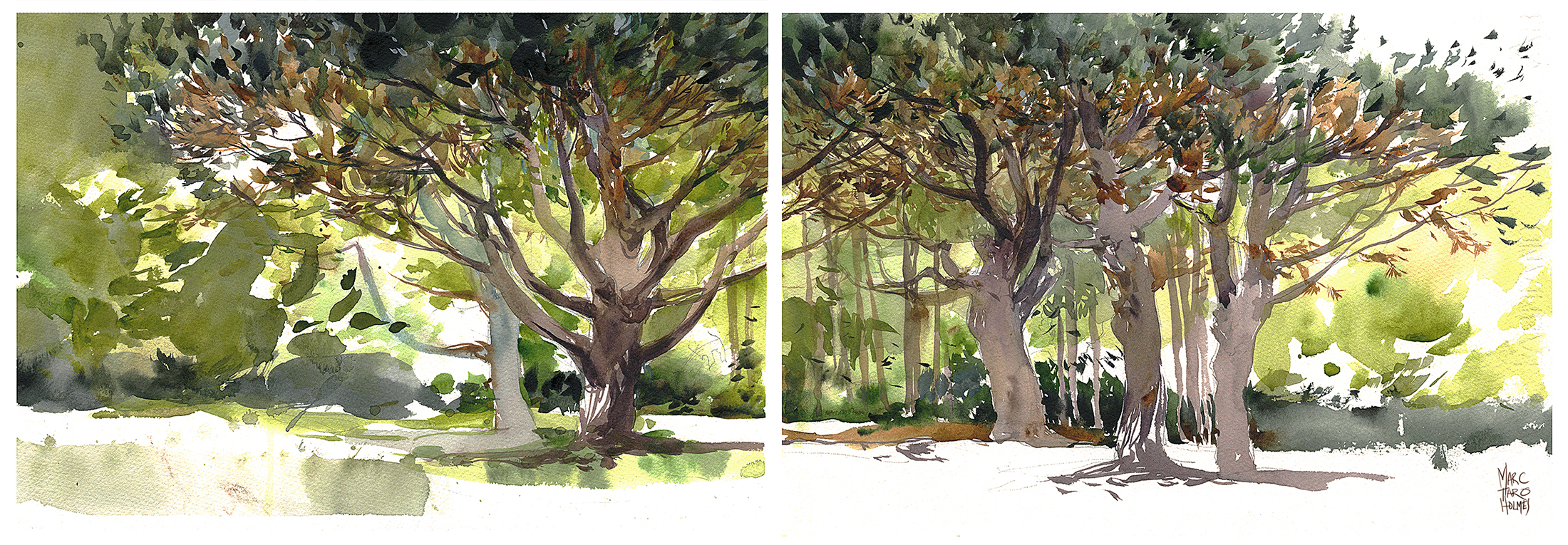
That’s what I wanted to talk about today – the idea of painting foliage with broken brush strokes.
I am *usually* trying to make solid shapes. A human figure, or a shape like a sky, or the roof of a building – this might be done in a single solid wash. One wet puddle that goes on in a continuous motion with no gaps. Or at least, with carefully placed gaps. Well, the trunks of the trees are examples of this solidity.
But for leafy foliage on the other hand – I might use a net of small strokes. Little dabs, like what the impressionists called broken brush strokes. I have seen Stapleton Kearns use the term ‘colored rice‘. Many small dashes and dots and placed brush points that accumulate into a cloud.

So I might start with a drawing of the tree trunks, then make a pale, cloudy green background that will show through where want it later.
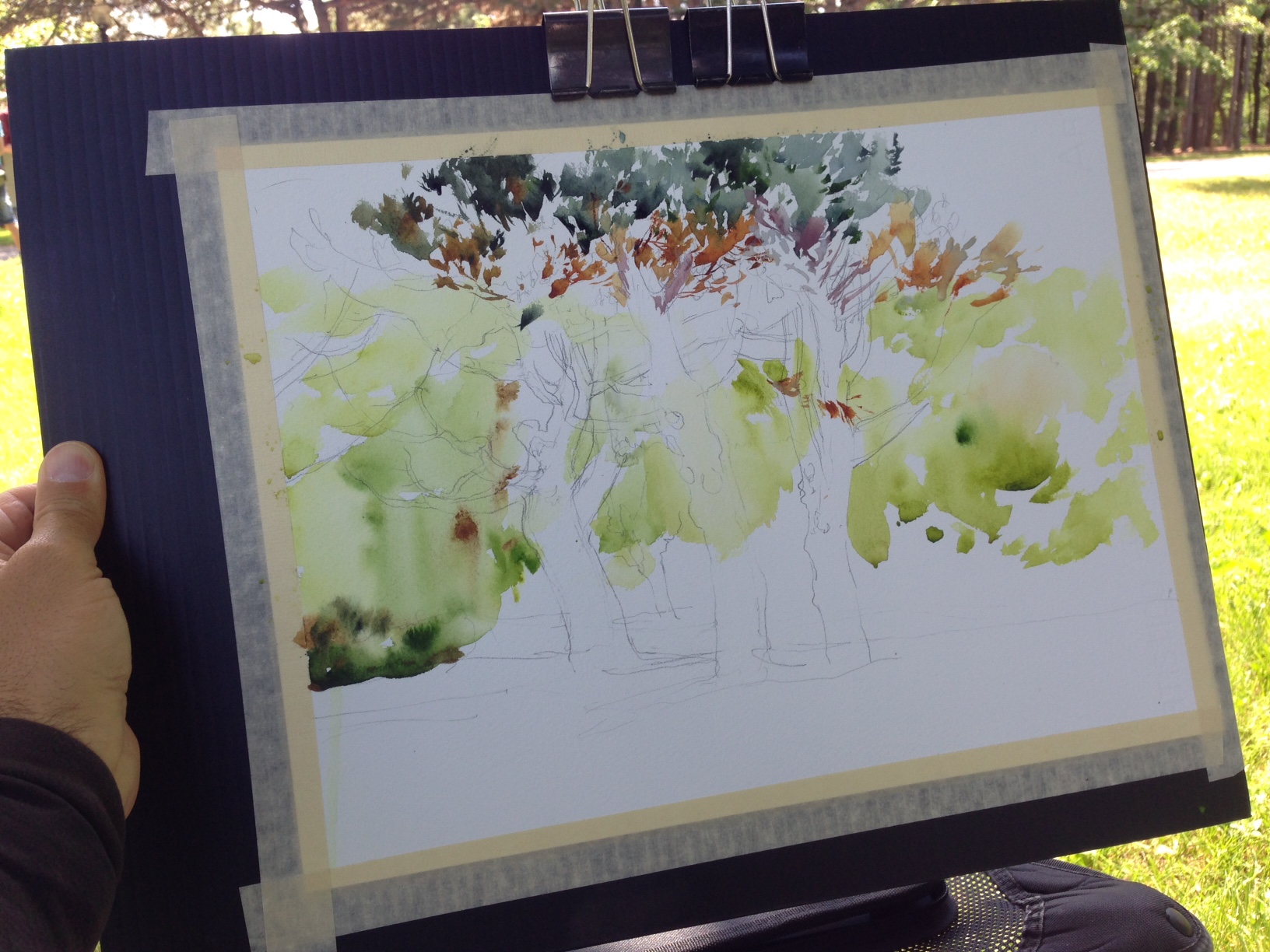
Then I begin building the tree canopy with these dabs of color. Placing them next to each other, like small tiles in a mosaic. I let a few of them touch so the colors intermingle. You want to work with fairly rich paint so you are putting enough pigment down in these touches.
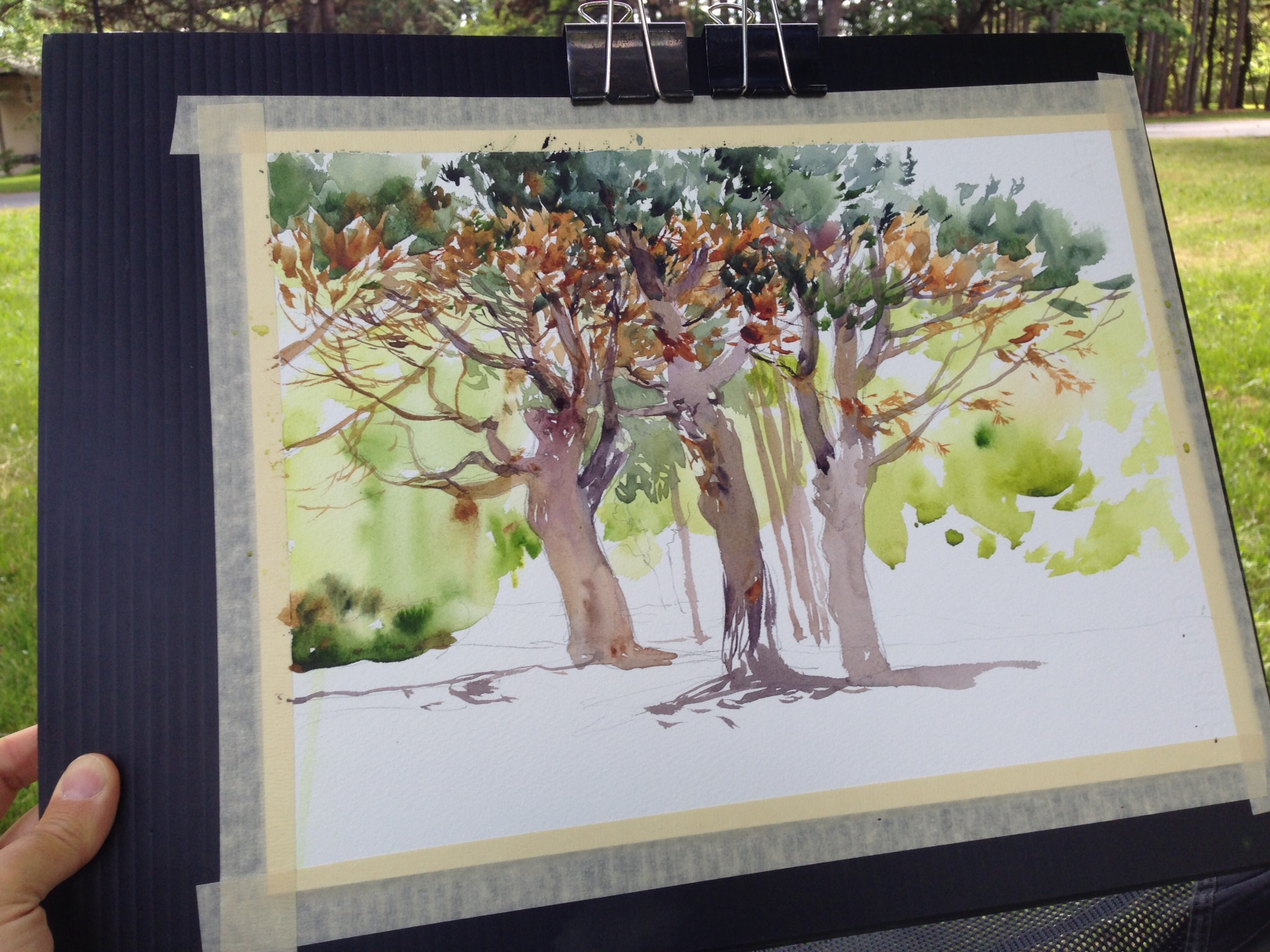
After enough of these dabs, your tree trunks have been clothed with foliage!
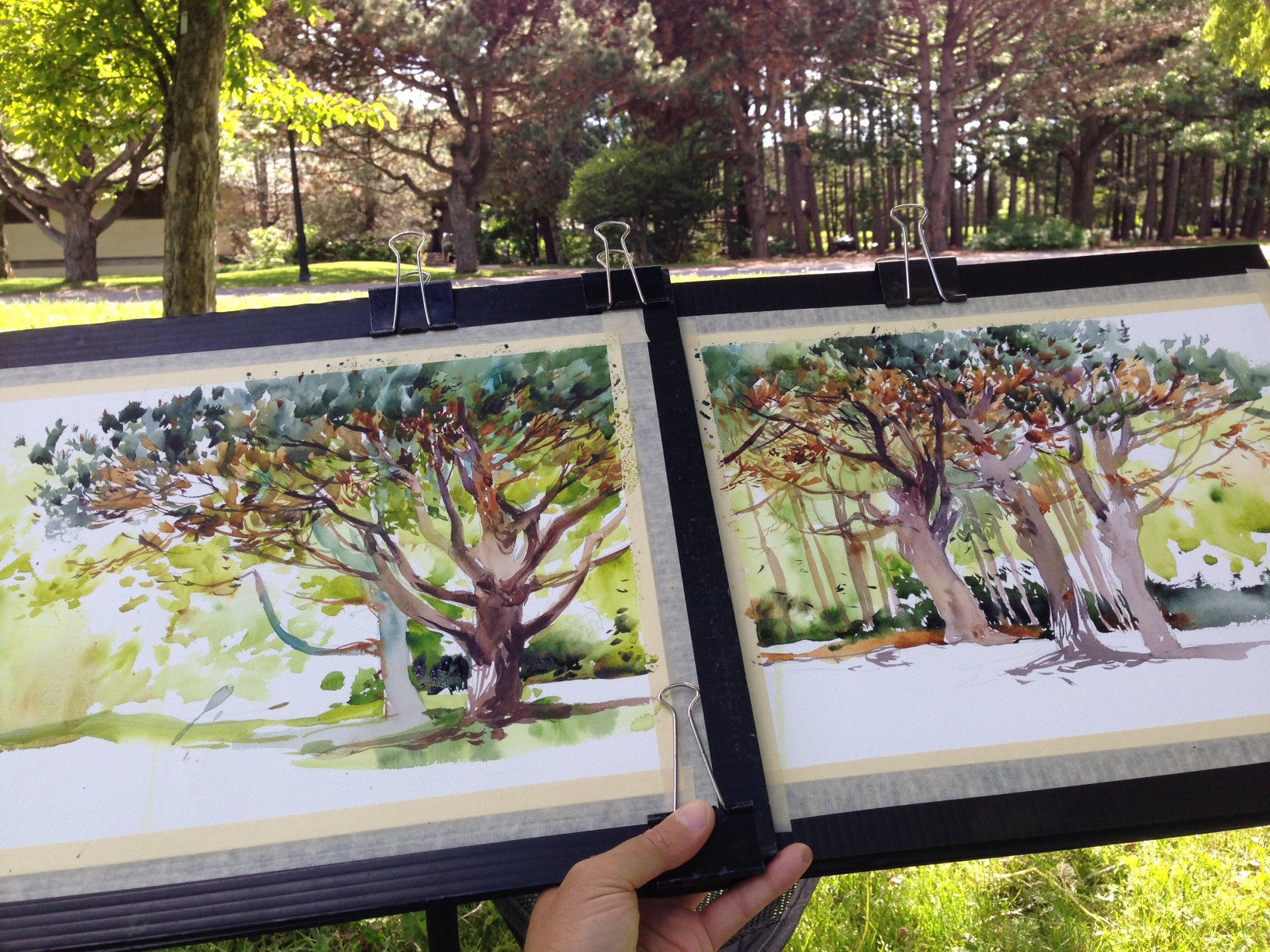
I think this is a kind of painting best suited to a beautiful day in the park. This is not for rushing around getting multiple sketches in a day. I suppose you could sketch the trunks, and finish the foliage at home (if you run out of time). But I was painting these from a very comfortable Adirondack chair under a shade tree in Montreal’s botanical garden. So I was perfectly willing to spend a lazy afternoon enjoying myself!
Hopefully this summer you’ll get a few beautiful days like this for your own sketching!
~m
Book Review: The Painted Girls, Cathy Marie Buchanan
I’ve recently finished reading The Painted Girls by Canadian author Cathy Marie Buchanan. (2012, available in paperback, hardcover or ebook).
I realize I’m a little late to the game, as it’s been available for a good while now. But nonetheless, some of you out there might not have gotten around to it either.


The Painted Girls on Amazon.com | Amazon.ca
The novel is historical fiction set in Paris around 1880, told from the alternating points of view of two sisters.
Marie, age 15 who is a student striving for a position as a dancer at the opera, and Antoinette, 19, who is already washed out as a ballerina, working as a walk-on extra and desperately avoiding her alcoholic mother’s career as a laundress.
As an aside, Ms. Buchanan has been chastised on various book review sites for the names Marie and Antoinette being too cute for credibility – however this bit is a true fact, not the author’s choice, so any tut-tuts should be aimed at the girls’ mother.
( Sketches after Degas )
Being an artist myself, I was initially brought to the book by Marie’s story.
As a “petit rat” – a student of ballet from ages 10 to 15, the young Marie is pushing herself to the limits of her growing body, attempting to rise to the physical demands of the upcoming examinations – hoping for promotion to the stage, and the steady wage it will earn.
Every calorie she can beg, borrow or have filched by Antoinette, is crucial to her success. Naturally the stipend allowed dancers is not sufficient for a girl without family, so she works early mornings kneading dough in a bakery to save the strength in her legs for the days training.
Her focused drive to master the demands of the ballet earns her the eye of artist Edgar Degas, who was well known to haunt the opera school, sketching in classes and rehearsals, obsessively drawing the girls in their awkward postures of exhaustion.
He is involved in a search for a new modern mode of drawing that is aggressively stripped of romance. Nothing idealized, only reality laid bare. I found Marie’s story the best part of the book’s historic recreation. We experience the obstacle course laid out before these aspiring dancing girls. The unflinching standards of performance, dress, and decorum that serve as a sieve, filtering out all but the most ruthlessly determined and privileged.
Marie is only able to advance by selfish dedication to art, and the opportunity to earn a small wage modelling nude for the 50 year old Degas.
The girl’s never very deep innocence is peeled off bit by bit as Degas’ drawings of her developing body become sought after by ardent collectors.
Meanwhile her success as a dancer becomes a two-edged sword. Elevation inside the opera putting greater and greater demand on her to pay for tutors, purchase silk slippers and tarlatan skirts.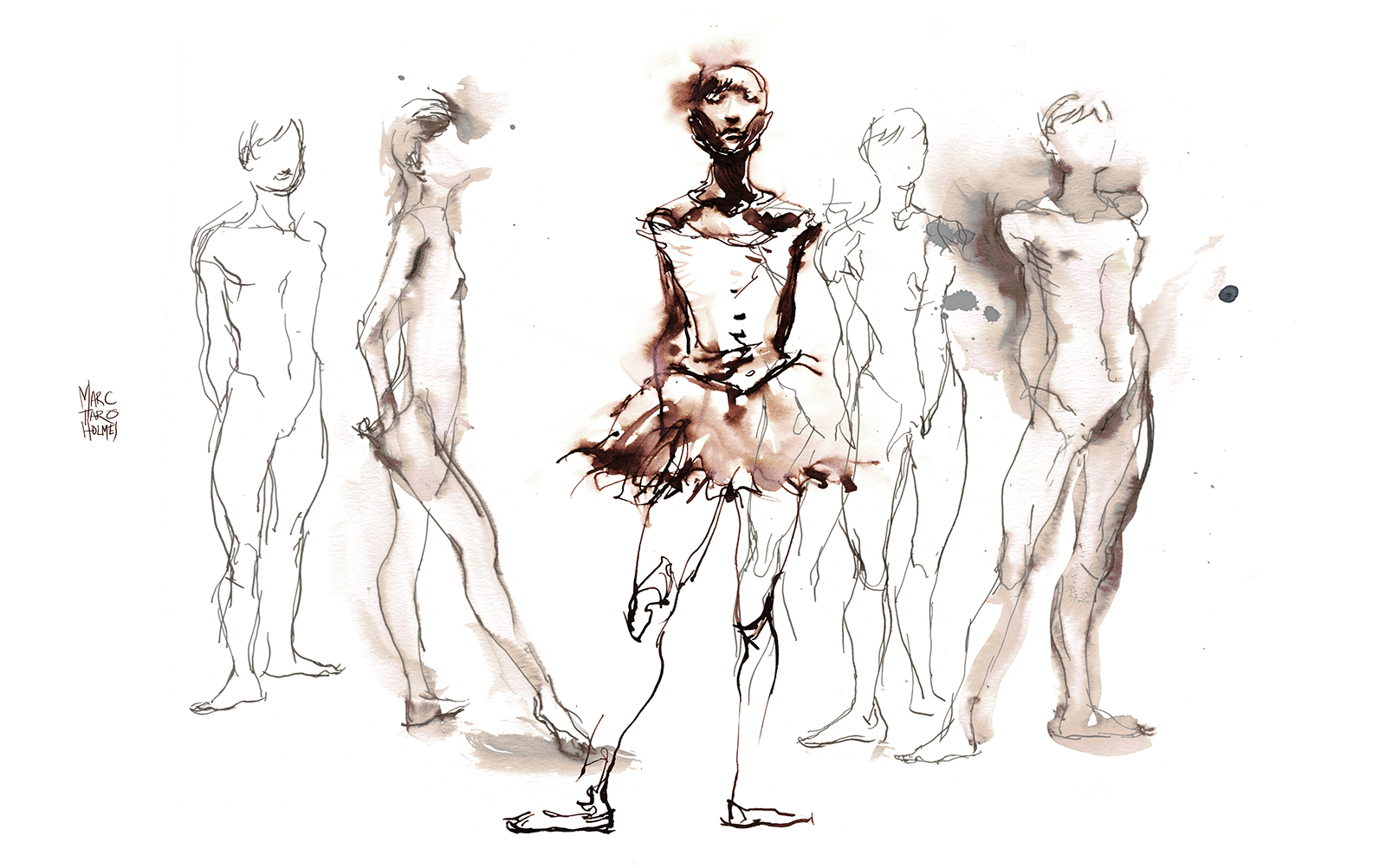 Ms. Buchanan brings us one of the fascinating stories in 19th century art. The real life story of the models behind the paintings.
 In some ways the turning point of the story is Degas’ wax model La Petite Danseuse de Quatorze Ans. (The Little Dancer).
This wax model over an armature of wire, leather and old paint brushes, dressed in actual clothing and with a wig of real hair, becomes the ultimate expression of Degas’ obsession with drawing Marie.
However, public reception to the sculpture was mixed.
The 3/4 life size figure is lauded as the first truly modern sculpture. A triumph of realism in art. Degas turning his back on the pearly-white floating nymphs found cluttering every over-stuffed parlor and gilded brothel in Paris.
Yet, The Little Dancer was simultaneously rejected as simply too ugly. A female ape, a barbarian Aztec, a sinewy-muscled circus acrobat.
Given the frank realism of the work, reaction to the sculpture is also the honest truth that Paris’ elite would never truly accept an underfed guttersnipe like Marie as a prima ballerina. ( Monsieur Degas )
Of course, I’ve neglected to mention a whole other story in the book – that of the older sister Antoinette. Her tale is torn from the headlines of the time.
We see her diamond-hard stubbornness, pressed into her by the crushing poverty inherited from a dead father and neglectful mother, inevitably turn into an ill-fated love affair and an inexorable slide into the underbelly of Parisian society.
Hers is the life of a failed dancer, an actress of little note, and a girl looking for more options than her social class allows.
The intersection of these two girls’ lives is where the real plot develops – and I’ll leave that bittersweet story to your own reading of The Painted Girls.
You may order the novel from my Amazon affiliate links below – and if you do, you’ll be giving me a small tip, which goes towards maintaining this blog and my drawing practice.
Thanks in advance
~m
The Painted Girls on Amazon.com | Amazon.ca
Drawing vs. Painting: FIGHT!

Ed Note: I’m just back from the UQAM life drawing intensive. And I promised to show you the results – but! I’m quite busy getting ready for painting in Ireland and the UK. (Leaving in a few days!). So I’m going to leave that hanging, and start you off on some automated posts that will go up over the weeks we’re away.
Let’s launch with a post I wrote a while back, and never knew quite when to release on the world. This seems like a good time – as I head off to the USK symposium. I’ll be talking to a lot of people about the different value of drawing vs. painting in the coming days!
Hey there dear reader :)
I’ve been trying to articulate an idea for a while now.
It goes something like this:
Drawings should be drawings, paintings should be paintings.
By that I mean: pen & ink line work, if you’re going to bother to do it, should stand on its own strengths, rather than being seen as a preparation for color.
Don’t get me wrong – I do a lot of tinted sketches (the ‘perfect marriage’ of ink and watercolor). So who am I to talk?
But here’s the train of thought:
When you do a line drawing with the plan of tinting it later, it’s always tempting to make it the most efficient, the most economical drawing you can possibly make.
But if you take that as true, then it leads you to not even drawing in ink at all.
Why not just draw in pencil? It’s faster, and the lighter lines are even less intrusive to the painting.
Any contrast you might sacrifice by skipping the ink – you can get back by including deep pigments like Bloodstone, Perlyne Green or Indigo. Any of the various alternatives to black I have on my watercolor palette. I’m recently trying Neutral Tint for yet another black alternative.
And if you take that even further, you realize you can just paint without any under drawing at all.
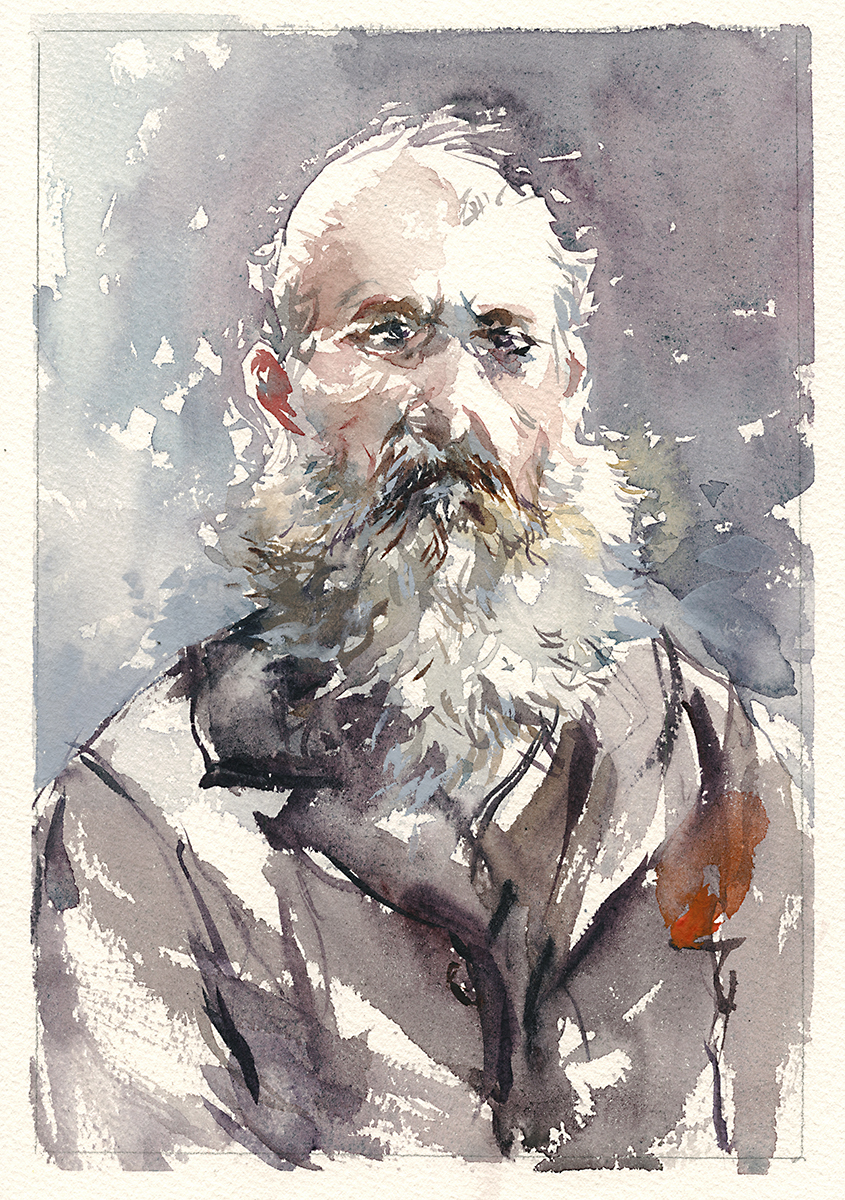
After all – the edges of every shape are lines in their own right. There’s no need to outline every form – just use the reserved white, or the light-against-dark contrasting edge, and follow up with some calligraphic work with a rigger.
It starts to sound like, if you’re good enough with the brush, you’ve surpassed the usefulness of drawing.
But hang on now! 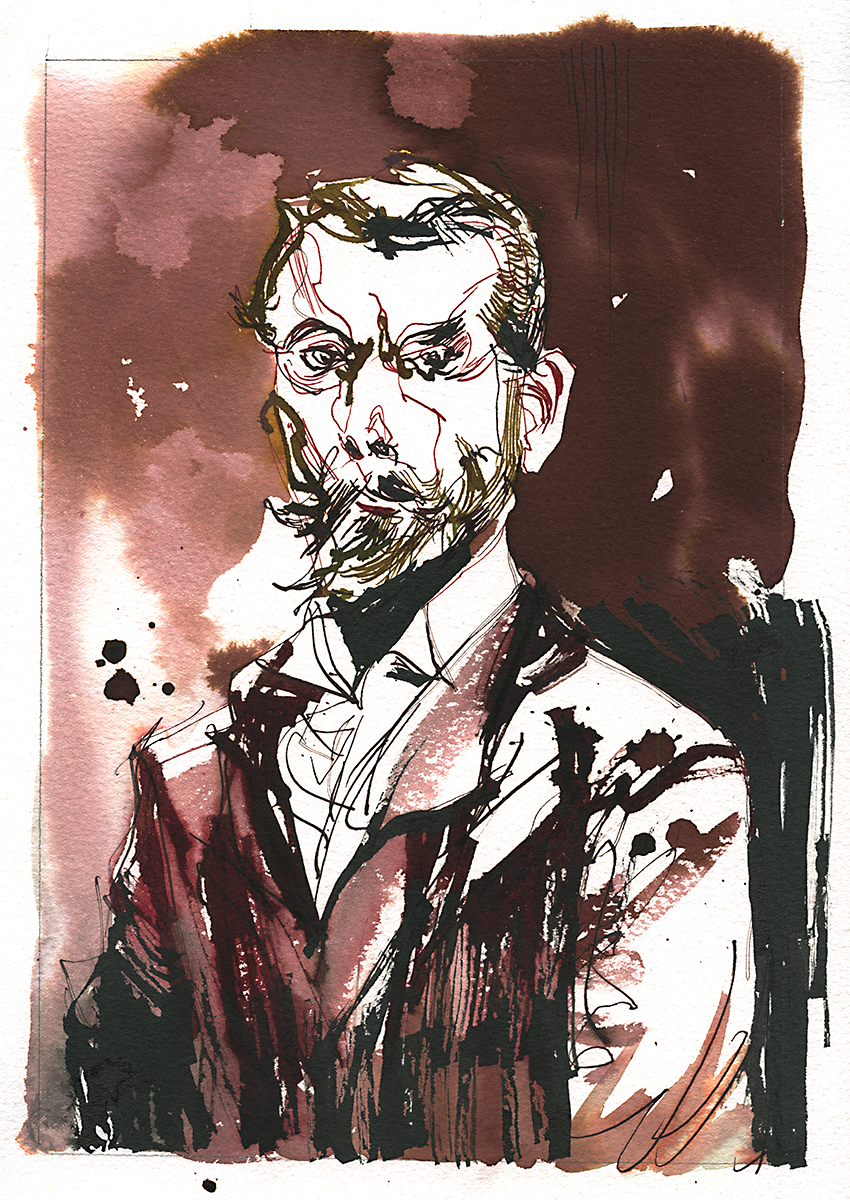 That’s where the chain of logic breaks down for me.
Because, at the end of the day – I just LIKE drawing!
I love the instantaneous stylization of reality. I love the aggressive mark-making. Every fidget and twitch of the hand is boldly visible in a drawing. And I love the way a drawing has to be read. Has to be interpreted by the reader.
I’ve said before, a drawing is poetry, where painting is prose.
 So – any conclusions?
Not really.
I’m not going to make any rash decisions – like swearing off tinting drawings.
Well maybe I will for a while.
Everything goes in phases. But I still need to keep it in reserve for challenging situations.
Draw now / paint later is still the best way to get results when you’re pressed for time and the final presentation matters.
I suppose my main take away is that there’s still a long ways to go towards the mastery of ink – towards even greater range of expression – more interesting marks.
Even as my painting evolves in parallel.
Right now we are packing our bags for a month long painting trip. I hope to have more definitive things to say on this topic when I get back. So stay tuned, and I’ll be haunting your comments from our hotel wifi.
~m
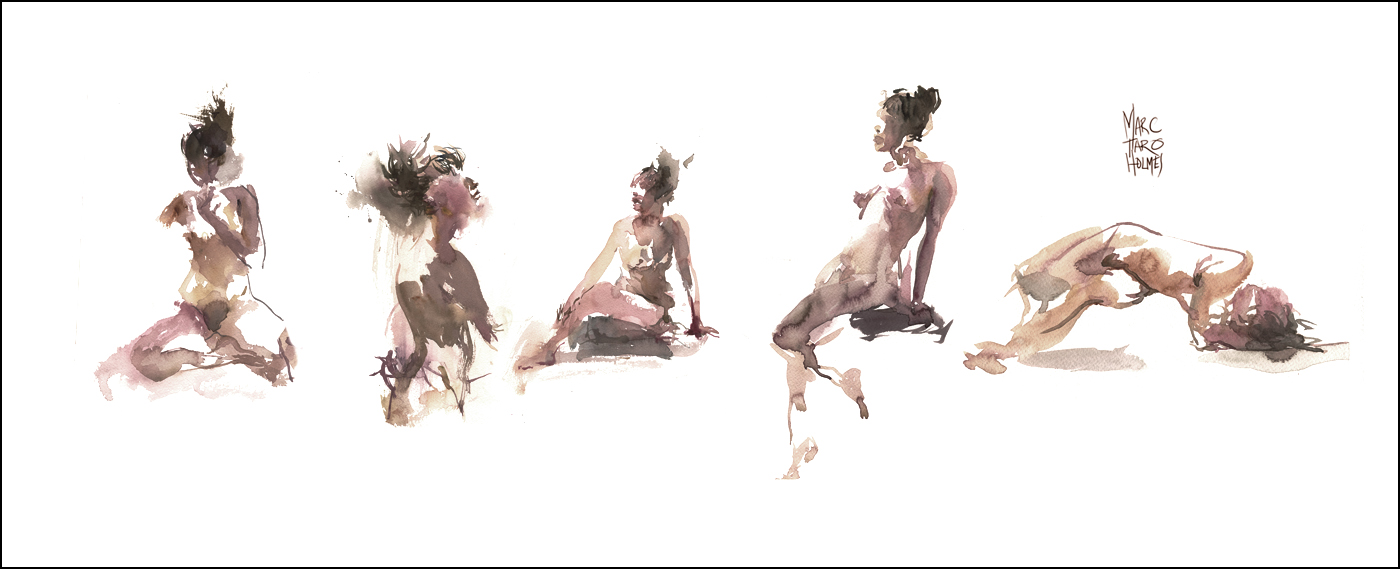
This week I’m taking a class! The twice annual figure drawing intensive course at UQAM. We’ll be doing five full days of figure painting, with a wide variety of models and poses. I expect it to be an excellent bit of training, right before we jump off for our workshop in Ireland, and the USK symposium in Manchester the week after.
In any case – right as I was thinking of heading back into figure painting – I happened to get a question about drawing shadow shapes from a student in my Craftsy.com class.
I collected this set of older images to help answer her question, and I thought I’d repost these examples here.
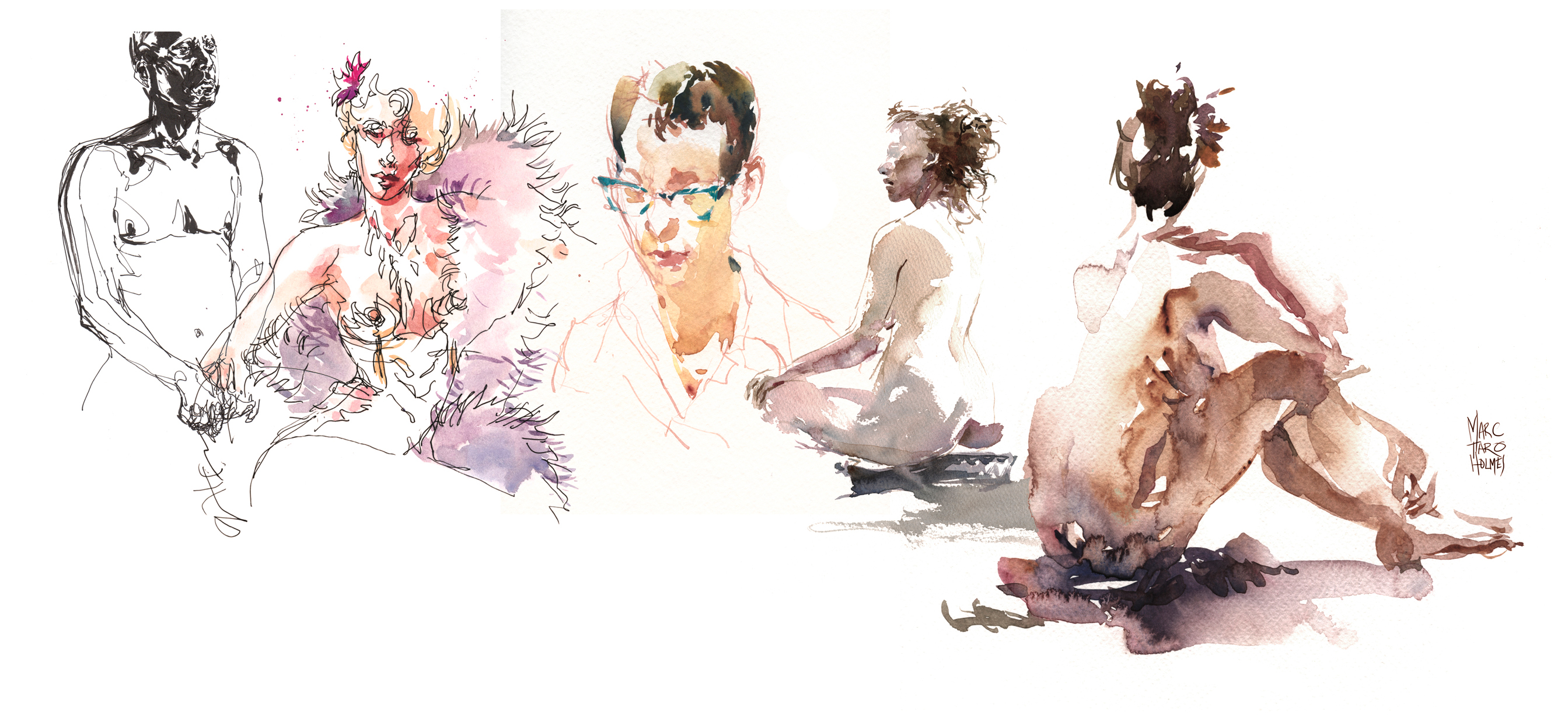 In this collection of images, you can see I’ve been drawing shadow shapes the whole time I’ve been learning to paint. Back in 2010 I might have sketched in black brush pen, or tinted with color over-top of ballpoint pen drawings and later fountain pens. In more recent years I’m starting to draw with calligraphy nibs, and more seamlessly combine washes – or – just sketch the whole thing with a long hair quill brush. Eventually, my goal is ‘real painting’. Just seeing the shapes of shadows as a single unit of color, and not needing a drawing underneath.
No matter how you go about it, this kind of modeling of the form, by drawing the high-contrast edge of the light – it seems to be fundamental to the way I (we?) see.

These are my annual Edgar Allen Poe-traits from 2013 and 2014 (ok, that’s not very annual – I seem to have missed a year!) But you can see two different (equally useful) ways to draw shadow shapes.
First with a pencil – outlining all the edges between values. And in the second version – simply massing in the big shapes, directly with the brush. Using the edge of the wet/dry wash on paper to simultaneously draw the shadow and the light.
 In this direct-to-ink drawing from 2015, you can see a more playful sketch of shadow shapes. Once again, I’m basically drawing the terminator edges of light. I don’t really draw eyes or nose or lips, I just draw light patterns.
This sketch was part of an ink solubility test. I ended up using this Noodler’s Red/Black as my favorite ink for about a year. Only quitting when I found its ultra-slow drying time too great a liability in humid climates. I think the philosophy of outlining shadow edges is also visible in these sketches from the 2015 Rodin exhibition at the Beaux Arts. I always feel like a good drawing contains a map for the color. These kind of ‘note taking sketches’ are drawn on the spot, and often painted after the rush is over. I need to be fairly clear to myself where the volumes of shadow are, if I plan to pick it up the next day.
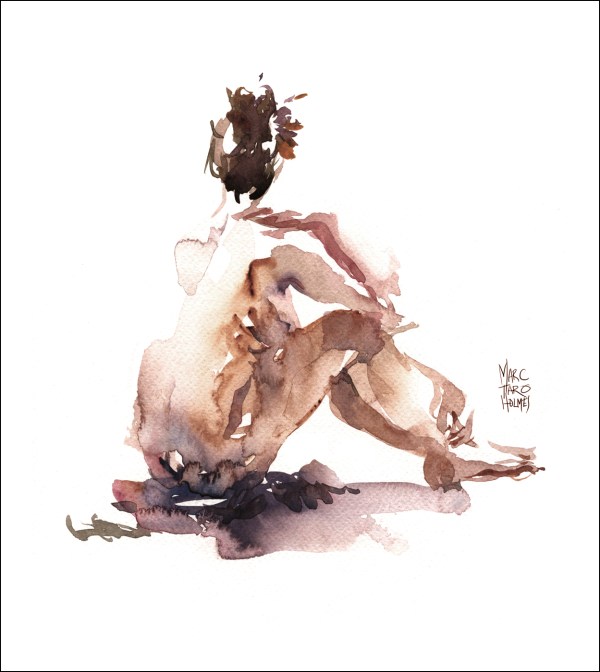
As I dive into this week long figure drawing event – let’s see if I can get back to that feeling of direct painting! I’ll report back in with the results next week :)
~m
L’Occitane en Provence wants you to have a painting!

L’Occitane en Provence wants you to have a painting!
I’ll be in Quebec City this Sat June 25, from 1-4pm at the brand new L’Occitane shop, opening up at 85 Rue du Petit Champlain.
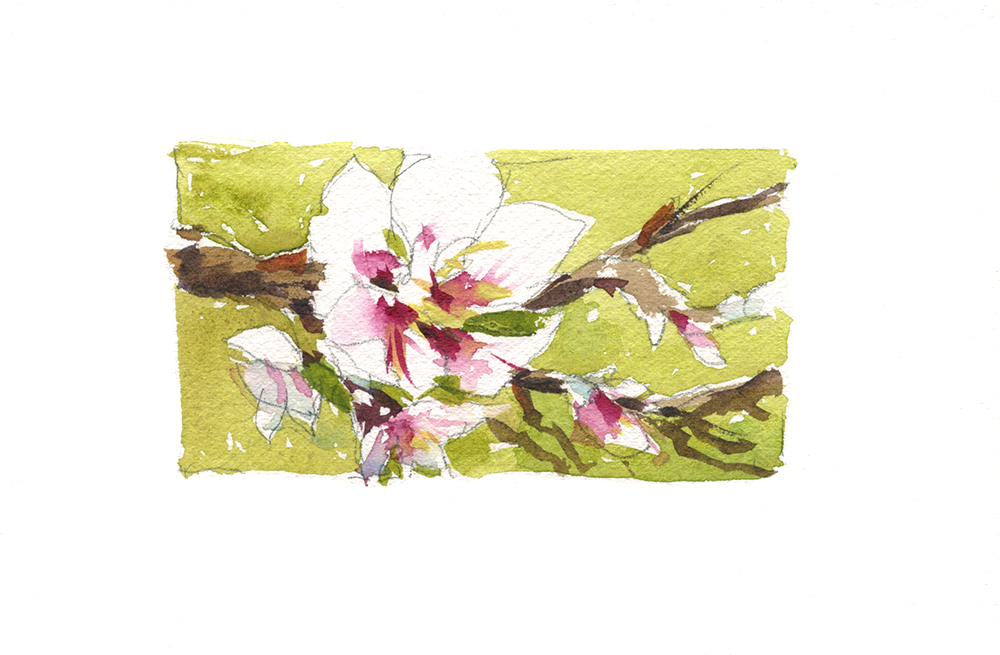
I’ve been commissioned to be on hand, painting live. We are offering my miniature watercolors as a gift to customers. Not sure about specifics of the offer, I know there are $30, $50 and $75 thresholds that give at least 15% off your purchases. At this very moment I am making a large collection of tiny paintings to complement those made on site. All are images of the south of France and the botanical ingredients in their products.

If you’re in town, I hope you’ll stop by! It would be good to meet any readers in Quebec City!

~m
Painting en Plein Air at the Publisher’s Invitational
A few days back a friend called to suggest we stop by the 2016 Publisher’s Invitational paint out. This is an annual event put on by the people behind Plein Air Magazine. This year it took place June 12 – 19th. It’s a full week of painting – but we were only down for the day.

And a beautiful day it was! That’s us painting out in the middle of that field.
What makes this gathering of just shy of 100 painters different from a plein air competition or painting workshop is the absence of either of those two kinds of pressure.
There’s no competing, and there’s no teaching.
Rather, people of all skill levels come together, simply for the love of painting all day, sun up to sun down.
Everyone works at their own pace, and self-organizes into car-painters vs. trail hikers, pastoral subjects vs. rugged terrain. All depending on your limits of age, temperament and frankly, amount of gear you bring. I did have a few jocular pokes at the oil painters with their wet panel carriers, wooden easels, umbrellas, deck chairs, palanquins and horse drawn carriages. ;)
At the end of the day everyone gathers at the college to see what they’ve all made that day. Not too different from the sketchcrawls I’m used to.

Our first outing was a quaint little cottage called Heaven Hill Farm. The group had the run of the place, parking up and down the lane and spreading out over the wide lawns.
The tremendous thing about a group like this – you might find yourself next to an atelier trained oil painter carefully glazing a glass-smooth panel, or wading a stream with a modern impressionist carrying a 30×40″ canvas on her head. A beginner can be quite comfortable chatting with a professional painter and you’ll find people with very different backgrounds painting together. Again, not too different from a USK symposium.

There were beautiful mountains all around, but I took the first one easy and quickly sketched the farm house. Nothing too unusual for me here – this is a ‘Three Big Shapes’ sketch- with the negative space between shapes forming the farmhouse.
Mostly I was talking the whole time I should have been painting, chatting about the interesting philosophical differences (and similarities) between Plein Air Painting and Urban Sketching.
Personally, I think it boils down to we’re more likely to use pens and watercolor and they’re often using oils. We tend to draw in spare moments, they tend to set aside entire weekends. Ours is ‘every day carry’, theirs is ‘pack for a military campaign’. We might be bloggers or authors, where they’re more likely to sell in galleries.
But of course, for every typical one of us or them, there’s someone blurring the lines. So really, these two camps are right next door.
At the end of the day – we’re both getting out into the world to see it first hand, and recording an artistic impression of where we’ve traveled.
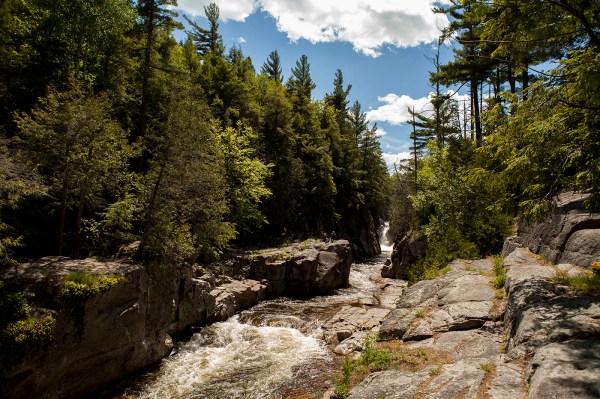
In the afternoon, they took me a bit further afield. We visited the Flume on the Ausable river, hiking down a rushing river cutting a deep gorge into the landscape. From down below a stack of falls we could look back up at the bridge. Kind of a nice ‘interior’ spot. Like a natural courtyard in the woods.

It was a great deal of fun painting this tumble of rocks and logs. I’ll tell you one thing. When I’m painting an opera house or some such historic building – one tends to feel like things have to basically go where they go.
Out there in the wild, I find it easier to play. You can move any combination of rocks and trees, and nobody is going to be much the wiser.
I’ve done a lot of mental landscaping in this one. Making a design that reads well to me. Bringing the foam of the falls closer to the viewer, and clarifying the steps in the river’s downhill progress. I wanted a feeling of a natural staircase leading to the pool – and a lot of diagonal lines leading the eye inward.
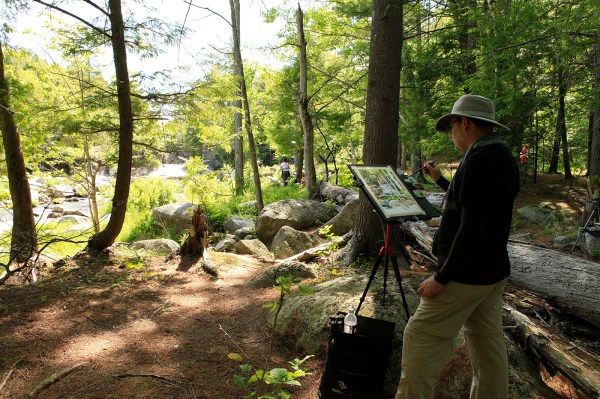
In fact, I couldn’t actually see the upper falls from where I was standing – (we’d come later and there was a row of painters in front of me when I set to). I had to jog a few paces to the right to see the falls, then jump back to my painting and work it from memory.
But anyway! There’s my day with the oil painters out in the woods.
I wish I had spent the entire week. I can imagine by the end of that time they’re feeling tired, but totally tuned up. Your instincts sharpen a bit for every day you can keep a painting streak going.

If you’re interested in next year’s Publisher’s Invitational, or any of Plein Air Magazine’s events, (such as their Fall Color Week – October 7-14) follow those links for more info.
~m
Crafty Question: On Sketching Flowers
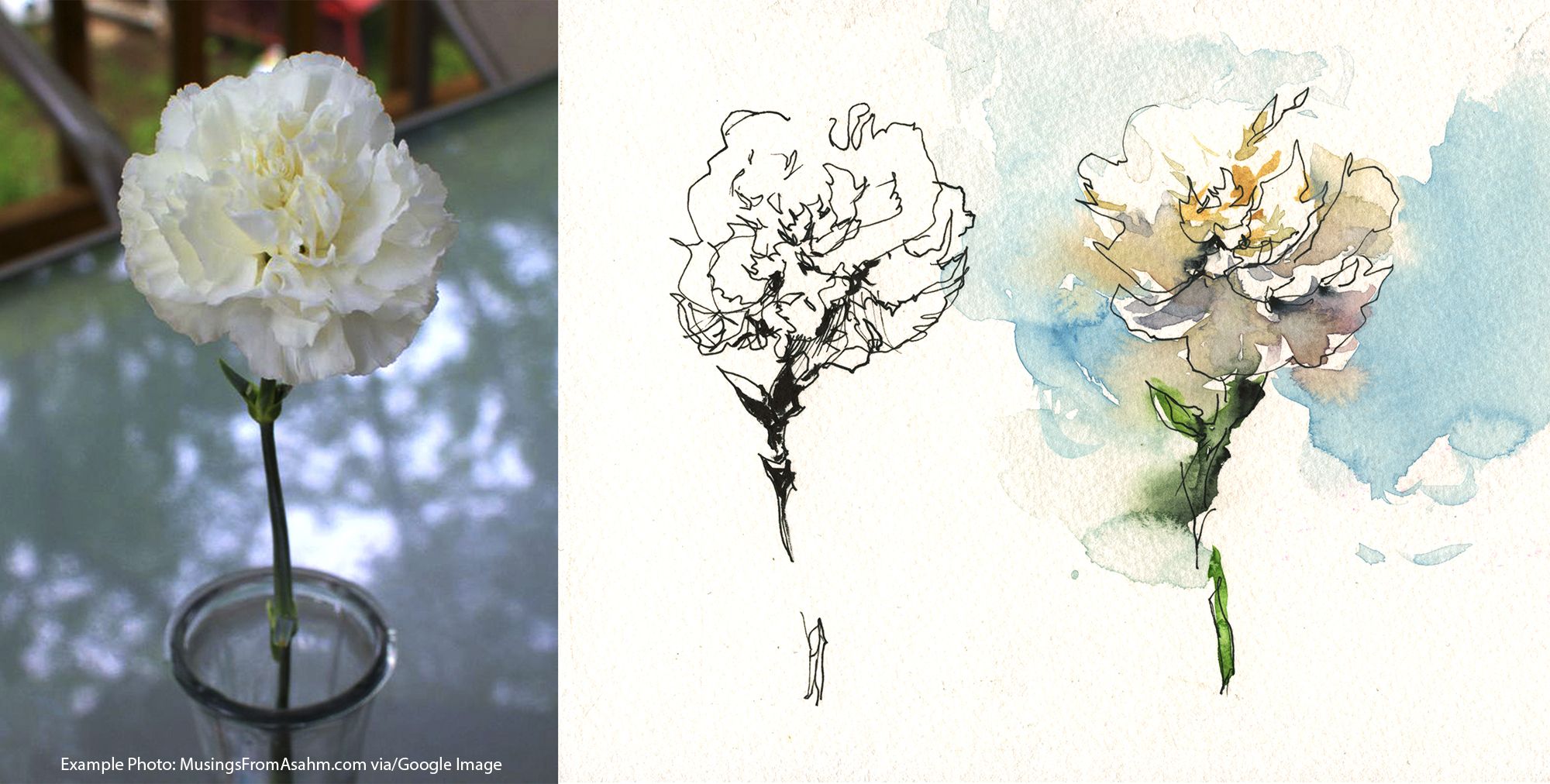
I have a follow up question this morning in my Craftsy.com travel sketching class, on the topic of sketching flowers.
Now, I am not by any means a botanical artist. I’m not even a painter of flowers in watercolor (not yet!). I know the botanical people are committed to accuracy, and the flower painters are all about lush color and beautiful compositions. But this particular class is more about being able to sketch anything, anywhere, anytime!
I guess flowers are going to come up as often any anything else:)
I think this question has been tricky to answer in the class, because I’ve been going on and on about drawing shadow shapes – and often students think I mean *darks* when I say shadow shapes. But of course, some shapes are quite pale. They’re still shadows on a form though! And naturally – a high key, delicate thing like a flower – that is something ill suited to pen and ink in the first place. So it’s going to take a light touch!
BUT – we can’t shy away from that. Just go for it, and think – less is more when it comes to this sort of thing.
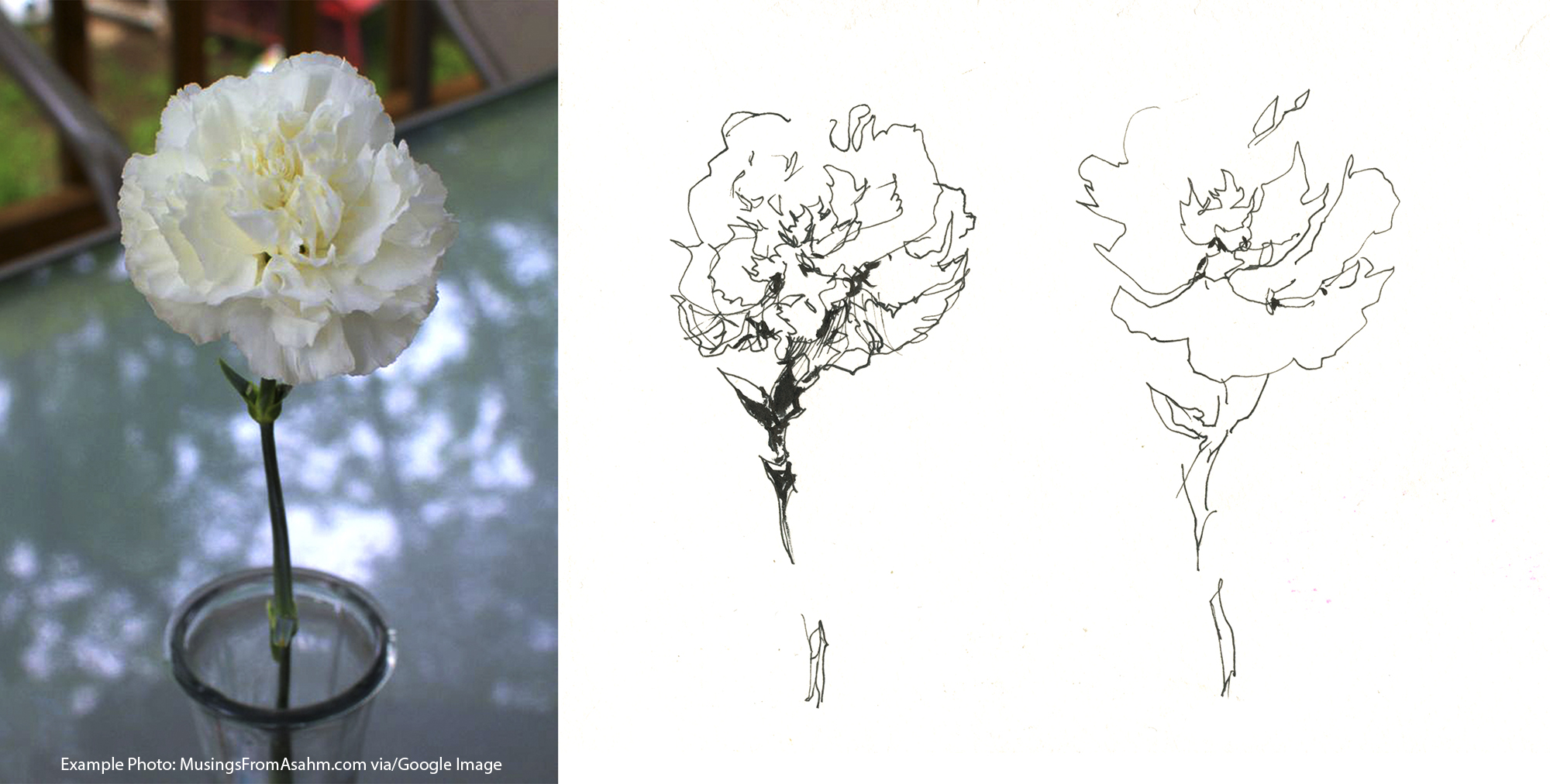
Here’s two little sketches – first – if I was going to just draw this flower in pen-and-ink, and second, if I intended to paint it.
In point of fact, if I was going to paint it, I might draw that in pencil, so the line was even less dominant. But – for the purposes of this demo, this is a Platinum Carbon EF nib fountain pen, and a few touches of the Kuretake Sumi Brush pen.
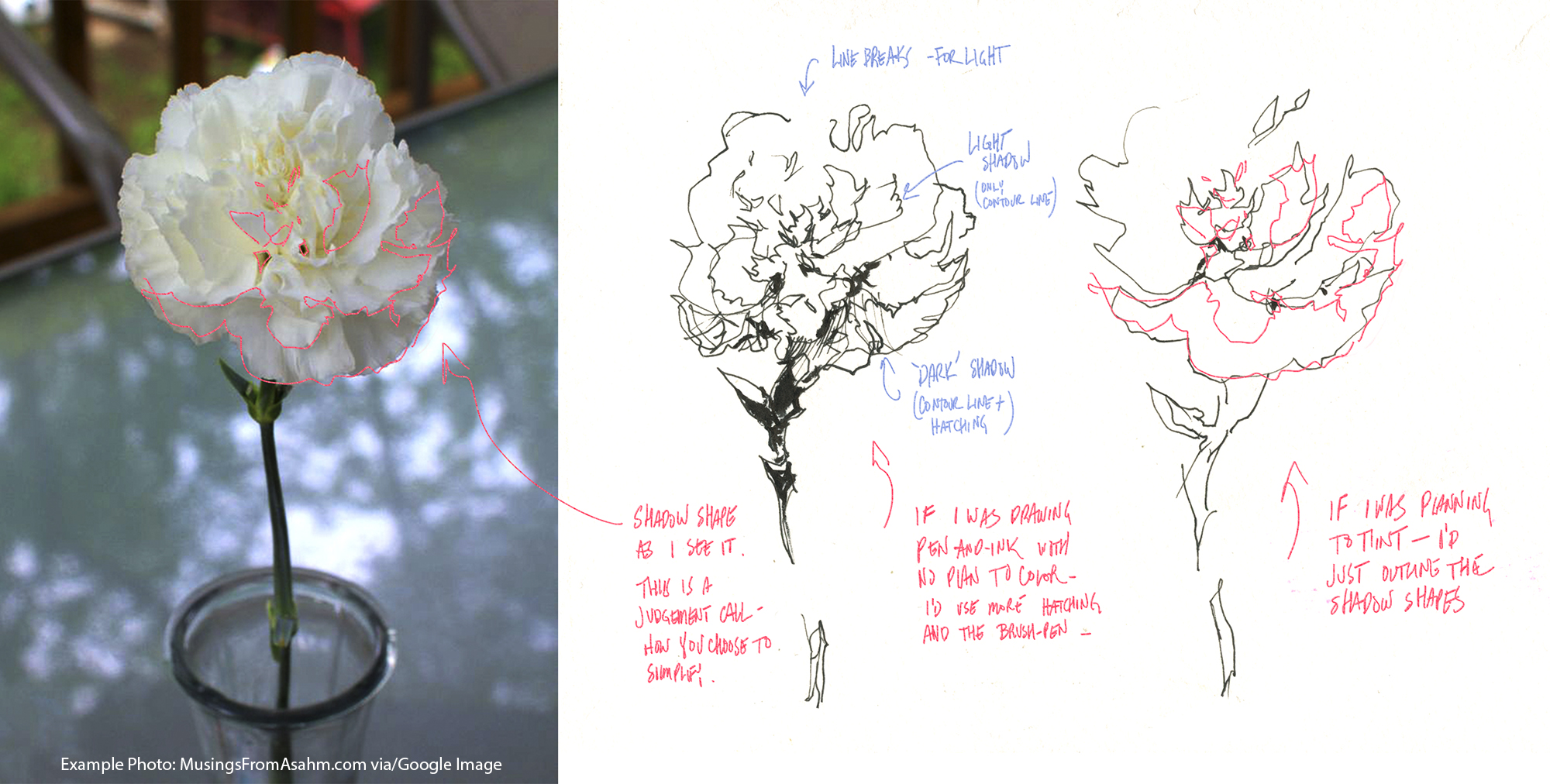
Some notes – see the pink line drawn over the photo (click to enlarge) – that is what my eye is ‘tracing’ when I’m drawing the shadow shape of this flower.
Here’s some light washes. See how I’m using that shadow shape like a map for placing the color?
This is how sketching helps us learn to paint. Over time you’ll train yourself to see these shapes without a guideline. But when you’re sketching fast – that pen or pencil line is invaluable to help you paint it later. (Just like the other day, when I was sketching from life, and painting after).
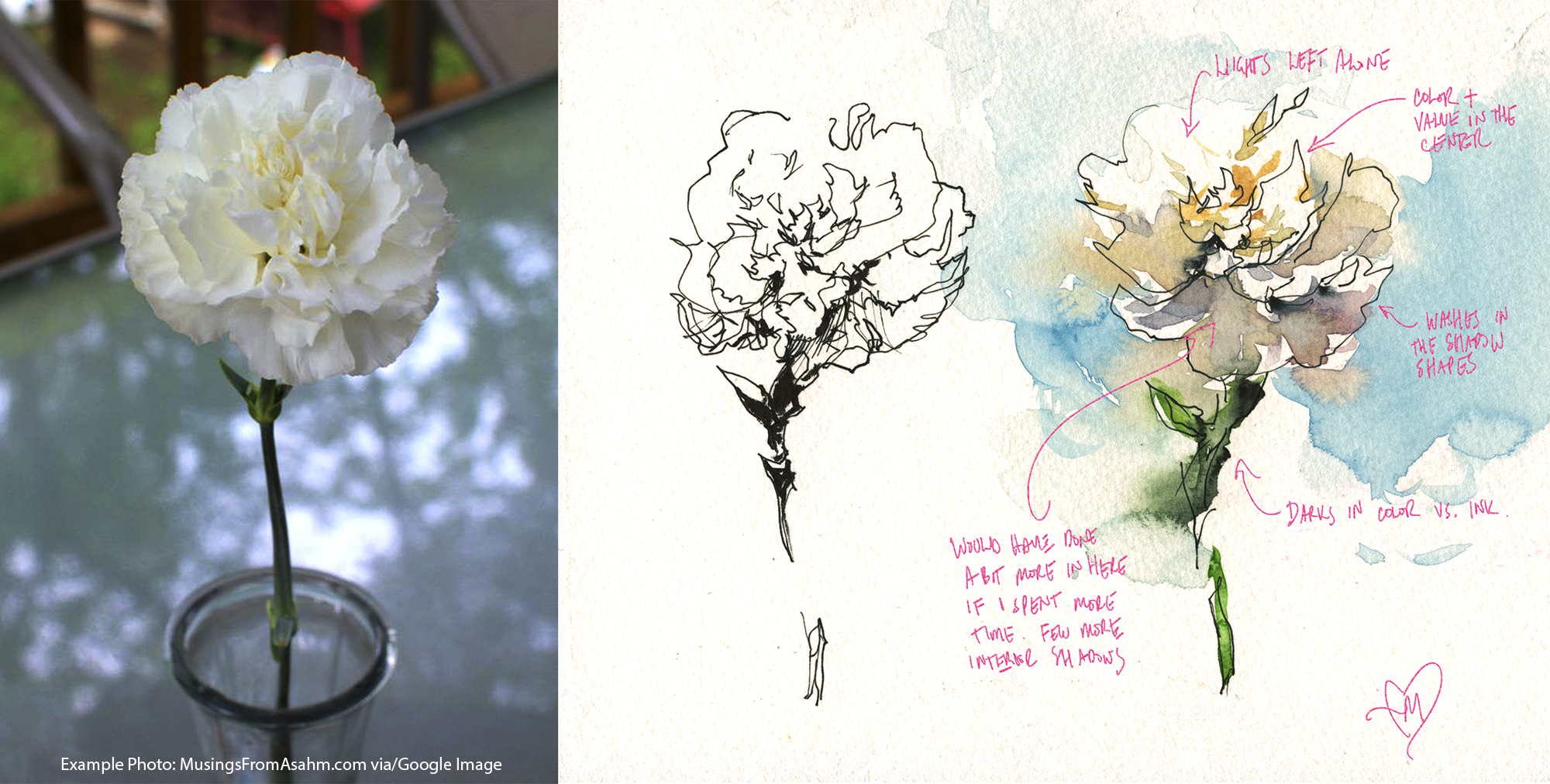
So that’s going out for Louise B :) Hope that helps clarify my earlier explanation!
~m
Sketching at Chapeau Mont Royal
 The other day Les Amis de la Montagne invited a few sketchers from our drawing group USK:MTL up to the mountain – to attend their annual benefit luncheon Chapeau Mont Royal.
 It’s a fundraiser in support of the famous mountain park that gives our city its name. But also, an opportunity (or maybe a challenge?) for the glitterati of Montreal to come out on a beautiful sunny day and show off their most extravagant party hats!
 Why not combine civic duty with a chance to show off your unique fashion sense? That seems like a perfectly Montreal solution to keeping our park a vital center in city life.

 These were sketched as the reception line flew by (we knew each guest would have to briefly stop to shake hands with the greeters – a perfect drawing spot for the sketcher-paparazzi). I’m using only a 0.3mm pencil on the moving subjects, jotting written notes as to colors, then painting with watercolor that afternoon.

We did our best to play along with the theme. I even replaced my ubiquitous baseball cap. I mean – the most important thing for me is shading my eyes when drawing. Men’s hats right now are experiencing a shrinking brim situation!
So, thanks to Les Amis – and now that we know the score, maybe we’ll be back next year with some fancy millinery arts of our own :)
DVD Review: James Gurney’s Portraits in the Wild
 Plein-air artist, educator, and illustrator James Gurney has recently announced the latest in his series of instructional DVDs.
Portraits in the Wild takes on a new subject in the field-sketching series, bringing his ultra-portable mixed media sketching kit to the subject of portrait sketching on location.
By way of disclosure, James sent me a free preview of this latest video, which will be released to the public on June 13th.
I know Mr. Gurney from a few painting outings, and in fact, I’m visible sketching in the background of one of the video clips. As well, my own portrait, sketched at a post paint-out dinner the day before, ends up getting some screen time, as it happens to be on the page next to the demonstration.
Here’s my own doodle from the other side of the dinner table: Greg Shea, James Gurney and Gavin Baker.
This collection of four demos is a natural follow-up to his earlier release Gouache in the Wild, carrying on with a mixed media approach using watercolor, water soluble pencils, gouache and casein all in combination. (Though one of the portraits is a side jaunt into alla prima oil painting).
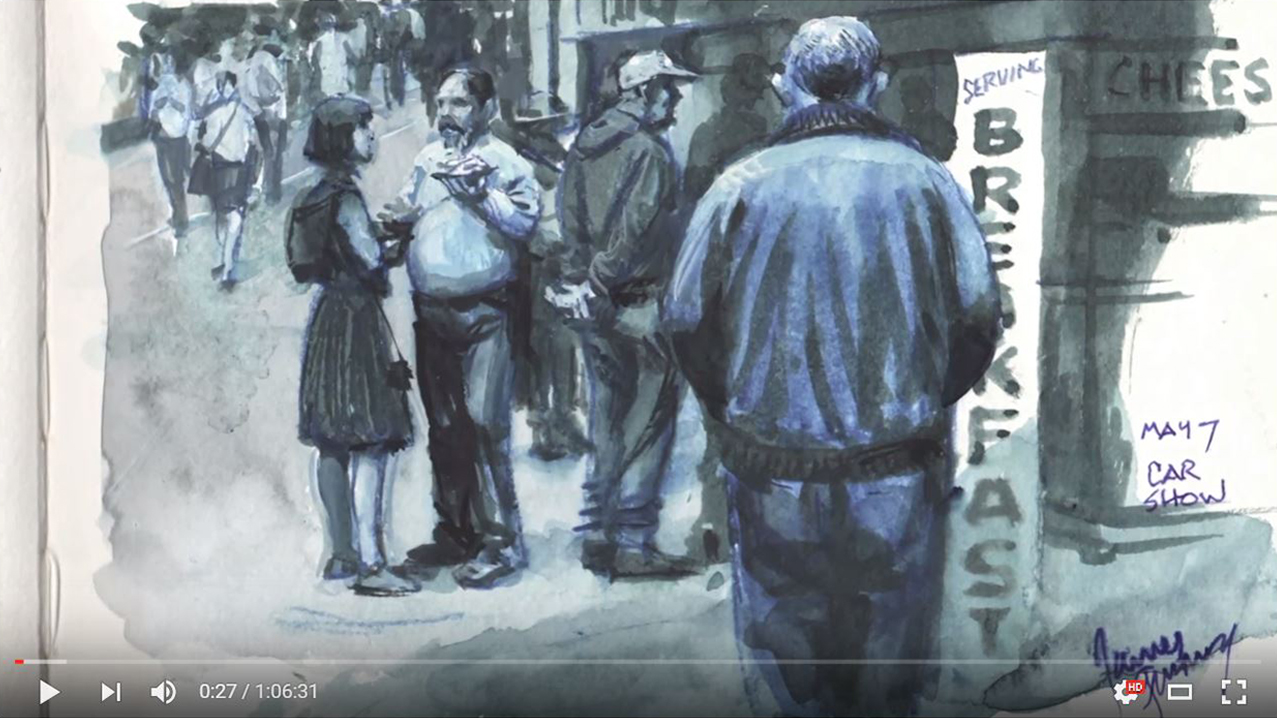
The first sequence is a genuine Urban Sketching affair – sketching the crowd at a regional car show.
It’s always a challenge selecting what you want out of a moving mass of people. James illustrates the trick of combining the multiple people coming and going, drawing onto gestures of his favorite poses and finding faces that complete the story. Something that will be familiar to readers of my own blog.


Next up is a sketch with a narration by the subject himself. James cleverly gets Scott Corey, a docent at Sturbridge Village, to give a spontaneous monologue while he is being painted.
I wish all models were such great storytellers!
This sequence features a bravura bit of painting where James, with no great fuss, goes into what might have been an 80% finished portrait, and obliterates it with gouache, so that he can repaint for better results.


Next up, we get treated to an alla prima oil painting from first brush drawing to final touches. While not exactly in keeping with his field sketching theme, it’s instructive to see how much his approach remains consistent across different media.
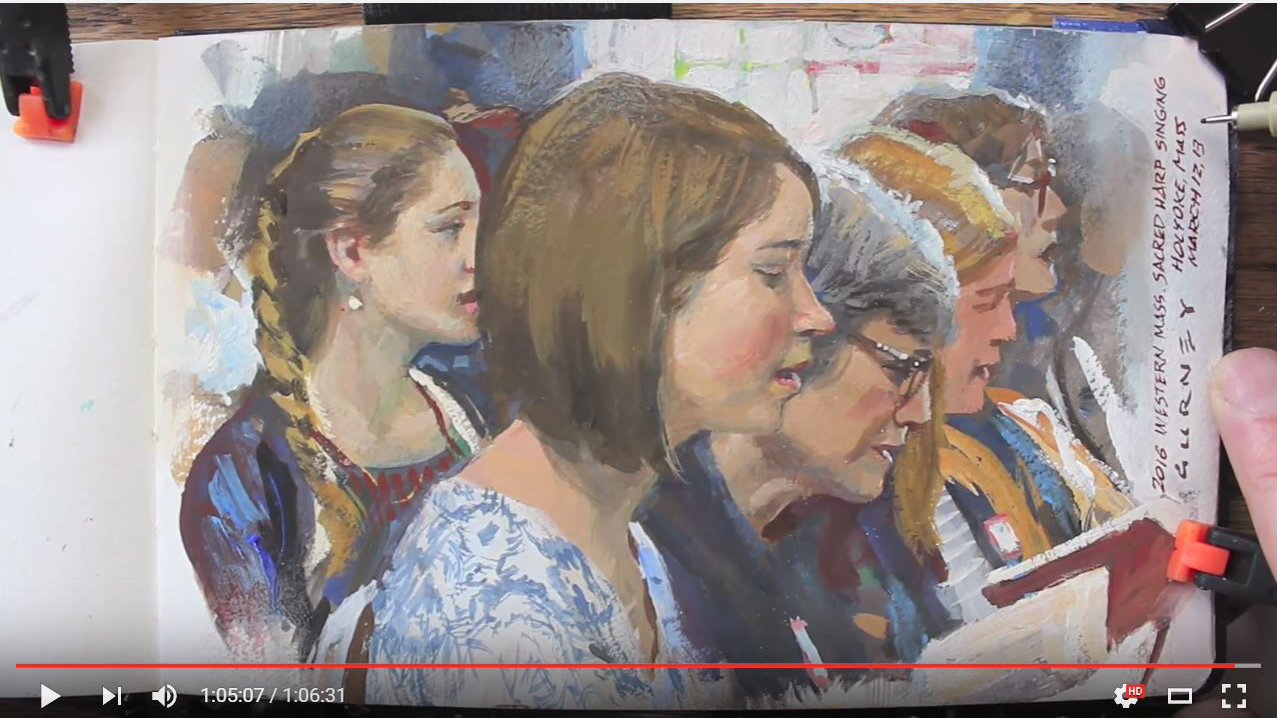
And finally the big finish, a sketchbook painting of a group of singers in a choir – a tricky situation with multiple portraits in constant motion. This one is made even more remarkable considering it’s in a little 5×7″ish sketchbook.
As soon as I saw this painting in the introduction, I knew I was looking forward to the bit where he paints the pattern onto the dress. A sequence he makes look as easy as painting any other bit. Which I suppose is part of the lesson. Painting a girl’s face, or braid of hair, or a patterned dress – the same principles of color, pigment, and brushwork apply.


As with the rest of this video series, Portraits in the Wild is independently produced by James and his wife Jeanette. Purchases go directly to supporting his art practice, his informative and entertaining art-blog, and future releases of more videos.
~m
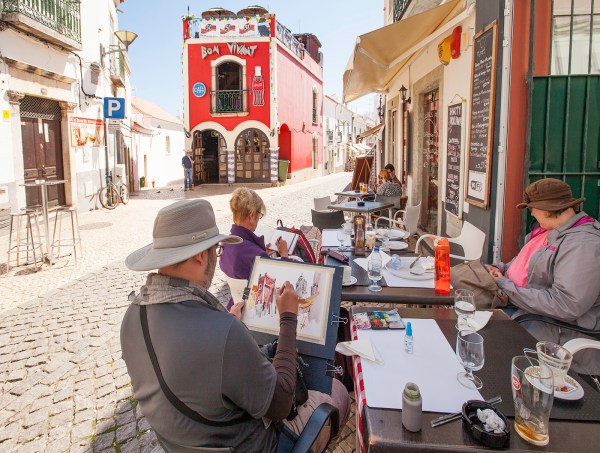
The Bon Vivant : Café Sketching in Lagos Portugal
 I saved this last one from our recent trip to Portugal. It’s one of my favorites, even if it’s not technically the best piece. Just some playing around while waiting for lunch.
That bright red building (The Bon Vivant) was quite eye catching. How could I resist?
I love how, if you just relax and have fun with a sketch – it always shows through in the final result.
Yes, proper perspective goes out the window, but the enjoyment of the gestural brushwork can make up for any flaws in realism.
The internet gives me a quote from Georges Braque which says:
“The hard-and-fast rules perspective imposes on art were a ghastly mistake it has taken four centuries to redress…Scientific perspective forces the objects in a picture to disappear away from the beholder instead of bringing them within his reach as painting should”.
In this case, I really could see that bell tower down the street – if I leaned way out to the left it was just in view. So, perhaps I had to lean the block over to get it in? Not to mention the other choices. Dimming the Bon Vivant’s paint job to a more mellow perylene maroon, slimming down the boxy old building, and giving it some Ottoman empire arches, similar to what we saw on another building that day.
After all – there has to be a reason we’re doing the drawing in the first place – when otherwise a photograph would serve perfectly well.
~m


 Citizen Sketcher