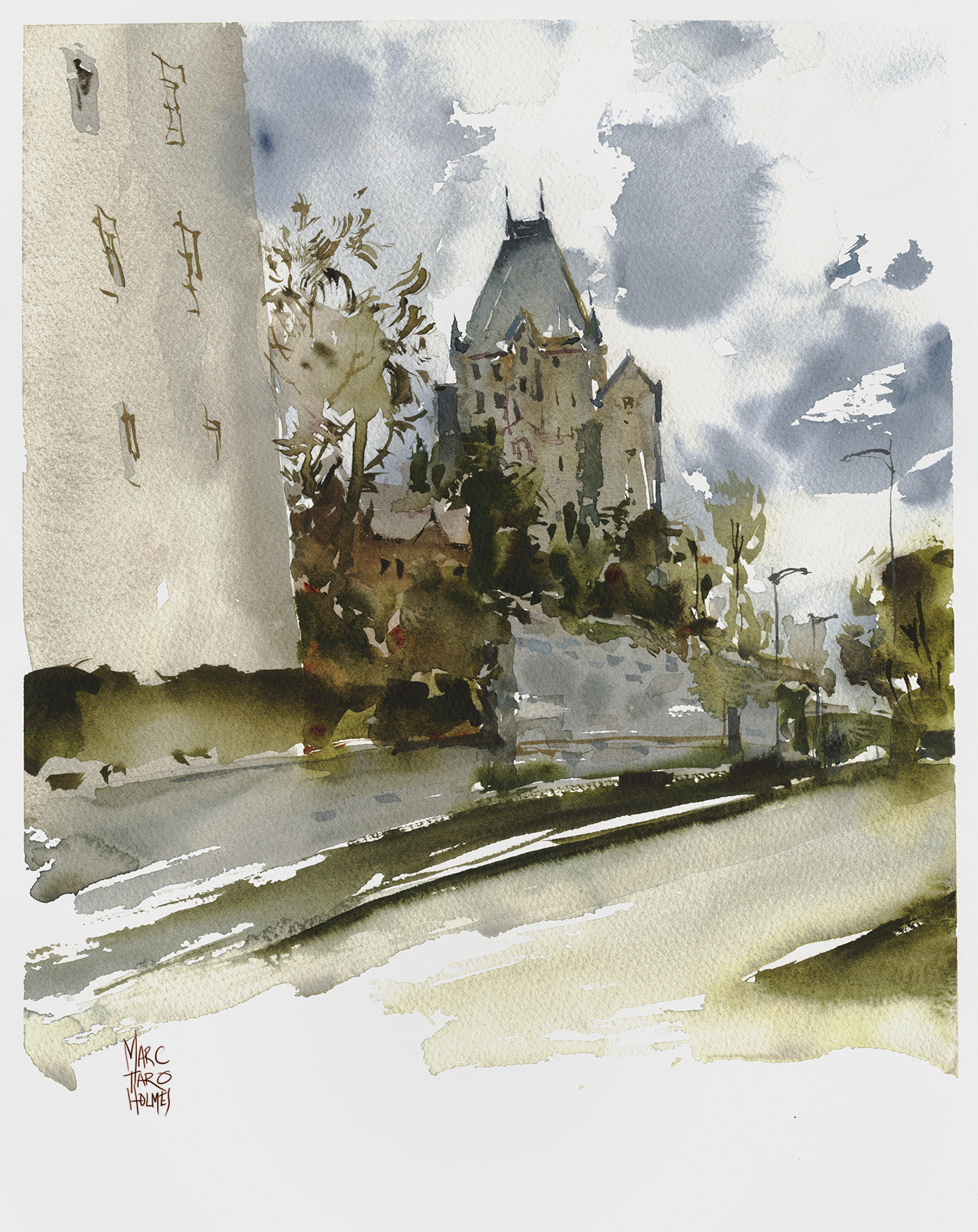

What went wrong?
Rushed out in the morning for a sketch – choose another view (not this one) based on shelter from the rain. I thought I had something workable, but two terrible attempts on location and I was out of time.

So – took a snapshot from the car, and used that for a sketch in the studio.
I’m developing a theory of painting from reference which is: Bad Photos make Good Paintings.
This is obviously me being Mary-Mary-Quite-Contrary. But my point is, a great photo has too much information. You end up being dominated by the image, slavishly painting what the photographer gave you.
A terrible photo doesn’t own you like that.

Incidentally, even back home in the studio, it’s not always easier. Here are two examples of a false start.
If I don’t come out of the blocks right, I might as well give up. I feel like the sooner you can sense the need to bail-out, the better. Save your energy for the re-do! If there’s a fundamental flaw – like too much chroma in the base color – the painting is doomed. (At least in watercolor). As well, there’s no saving bad proportions or improper placement on the page.
This is something I see far too often with students or beginners. Trying to beat a dead horse, instead of giving up and just starting again.
If the placement on the page is poor – spending time finishing that is not going to help! You’re just going to feel worse having used your whole time on that painting! Once you produce that dud, it’s as if we don’t have the energy to do it again. Or – more likely – we’re feeling a (false) sense of failure.
Think of every re-do as a victory over a bad painting! Not a failure – a necessary sacrifice.
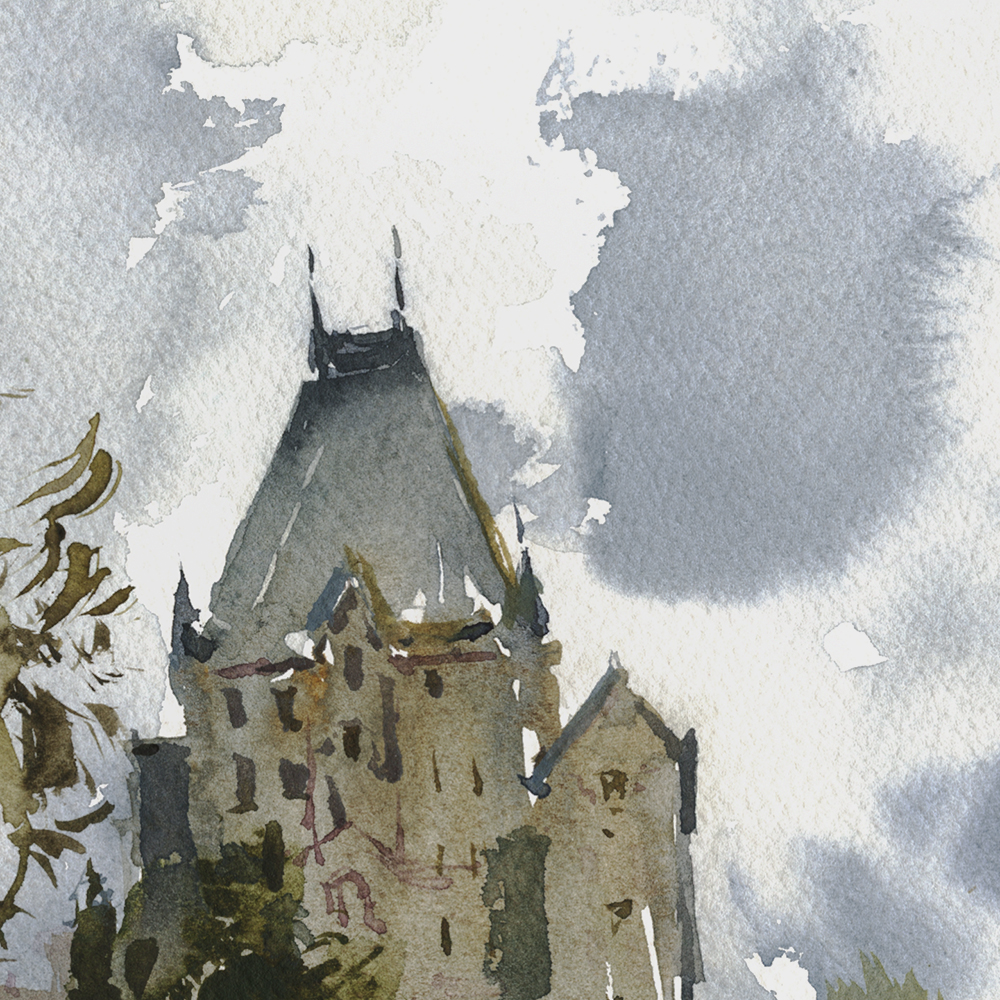
So – what went right?
I’m remembering how to draw with the brush. What precision feels like. And remembering to pre-visualize the shape I want to draw – then draw it completely. All in one go. One shape at a time, not jumping around.
Keep edges sharp, and avoid holes in the silhouette, or any false hard-edges inside what should be a clean, simplified shape.
Also, I’m getting a good base value finally.
When a value is perfect the moment you place it – it will dry TOO LIGHT.
It has to look too dark initially so it will dry upwards to a proper value.
Watercolor generally shifts up in value – the wetter the wash, the more the shift as it dries.
Also, I feel like on day three, I’m judging paint consistency more accurately. It’s Tea in the stone walls, but Milk in the clouds, and juicy Honey in the dark trees.
Ok, that’s day three! See you tomorrow!
~m
Day Two : #30x30DirectWatercolor2018

One thing for sure about Saint Joseph’s Oratory – you can see the thing from almost everywhere on the island of Montreal.
I was told when I moved here it’s the third largest domed church in the world. Though – I can’t find any proof of that one way or the other.
Across the street from the oratory grounds is the College Notre-dame. If you walk up to Jean-Brillant, just north from the main street, Queen Mary, you’ll find yourself looking at the dome from across the school’s soccer field.
On a rainy day like today, you can ignore all the details in-between and imagine the dome as some hill top church in Tuscany.
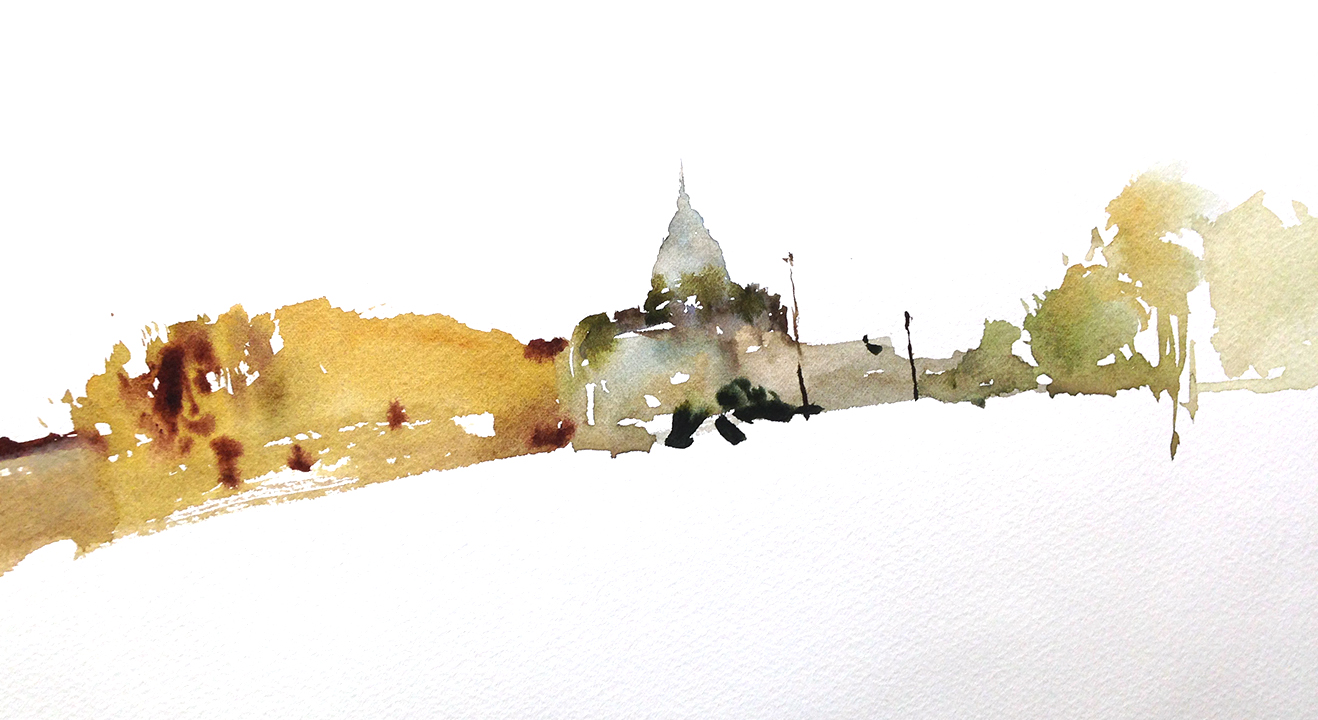
What went wrong?
Today’s painting of the oratory is actually my fourth attempt. Here’s one of my false starts.
Sometimes you know the thing is beyond redemption and it’s best to just stop now, save your energy – and the piece of paper! If you don’t flog it to death you can still use the back of the page for another try.
This one’s a flop for A: poor placement on the page, the horizon is too low, the oratory too centered. B: Too much chroma. The colors in the foliage are much too bright, the darks too contrasty. It looks like a glorious fall day, not a rainy Montreal spring.
I’m sure the problem is, I’m rushing myself.
My whole plan for this 30×30 thing was to pop out first thing each morning, fresh as a daisy at sunrise, dash off a wonderful little sketch, and be home before breakfast. (Seriously! I imagined myself having breakfast out as a reward). Hah! In fact, I’ve been wasting time and paper all day!
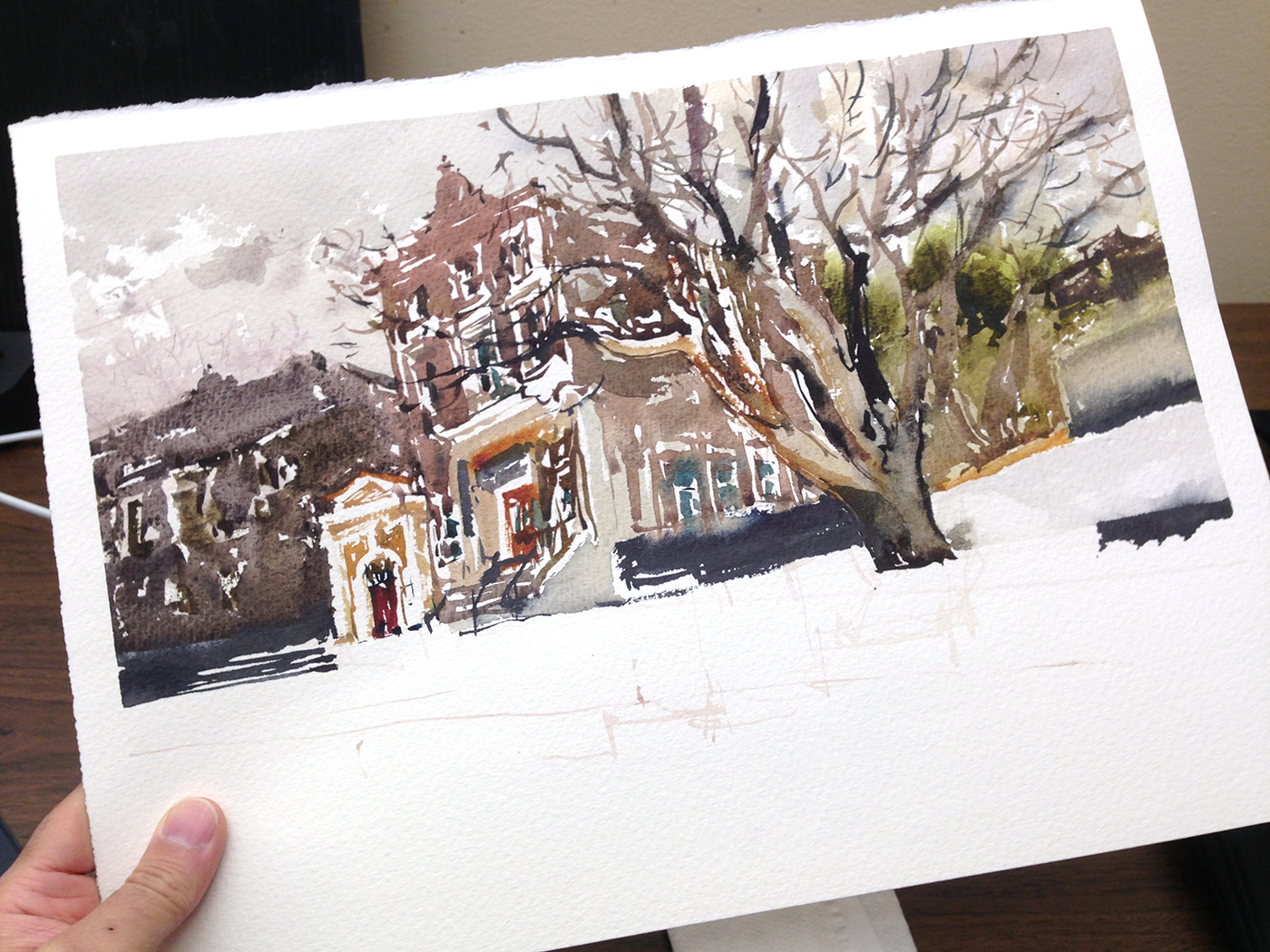
Here’s another reject. This one is just out of control. The brushwork is sloppy, the reserved whites too coarse, and the building looks like it’s been through an earthquake.
This is probably normal for day two. It’s going to take a while to knock-off the rust from our long winter. I envy southerners who can paint outside all year round.
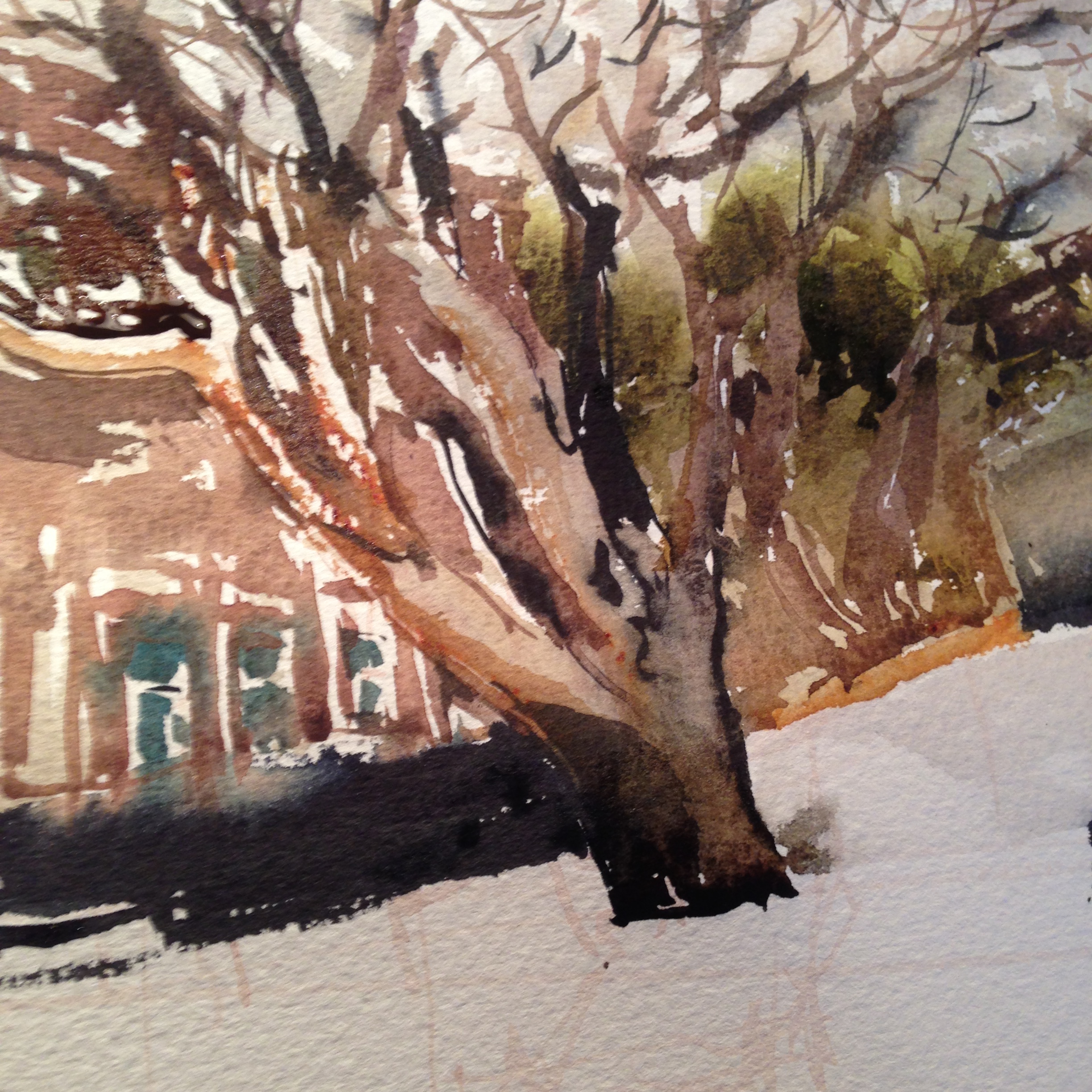
I don’t mind this tree. Maybe I should have just cropped it and called it my Day Two.

What went right?
This is something that happens to me fairly often. Getting frustrated, and having to mentally re-set. I try to recognize the feeling when it happens and just shut down the frustration.
Sometimes I rip up the bad sketches right on the spot, to get a little revenge. Then I end up deciding, I’m clearly a fraud, and I’m going to give up painting forever, so – I’m just going to have fun with one last sketch.
That’s when they turn out!

Any pressure on myself to succeed, (like, I’m going to launch an international painting event and show everyone how great I am! <hah!) and you’ll stiffen up, become afraid to take risks, and otherwise interfere in your own success.

It might not look like it in the snapshot – but this view is a better choice of subject than the Snowdon Theater. Certainly better than the failed attempt this morning. I tried to pick views based on cover from the rain, instead of holding out for a subject that grabbed my imagination. That never works. This is one case where drawing from a photo was useful. (I did the painting from this cell-shot). Bad weather makes for atmospheric views! But it’s no fun painting in the rain. (I mean, I’ve done it – but I need some external motivation – like being at a workshop, or on a once-of-a-lifetime trip.)
Also – I’m remembering my own advice from Muckross House: Get further away from the subject! If you can’t see the details, you’re not tricked into over-drawing.
~m
Day One : #30x30DirectWatercolor2018 : Street Scene

So! My day one begins on an overpass above a busy freeway, in high winds and direct sun – my first plein air painting day of the year.
Ed Note: I’m actually in Chicago right now at their 2018 USK Sketching Seminar. But! Luckily I planned ahead. I’ve started my #30×30 early. Don’t worry – I will absolutely do it in 30 consecutive days! I’m doing the same challenge as everyone, I’ve just shifted the time-window.
This is a sketch of the Snowdon Theatre. Or, at least the block it’s in. It’s the tall streamline era sign in the middle there.
This abandoned neighborhood landmark has been disused for as long as I’ve been in Montreal. There was a sports camp for kids in there for a while, until the place fell so fully into neglect it wasn’t safe for habitation. I suspect the roof fell in or the pipes burst at some point, and that was the last straw.

OK so, what went right?
I picked a cluttered view, with no clear center of interest. I knew I wanted to draw the old theater sign – but otherwise, it’s just a jumble of boxy functional buildings and freeway-junk. Considering that – I’m quite happy with my version of this un-romantic reality. I think it’s succeeded despite itself. This is a slice of my everyday life, seen as a work of art.
What went wrong?
What didn’t! I’m so out of practice with street sketching it’s not even funny! Things were so awkward. Constantly searching around for where I put my binder clips, or digging for a brush in the very bottom of my bag, or what pocket has my spray bottle. I’m using too much mental energy on the basic functions of getting paint and paper together, and I think it shows in the painting.
There are no clear silhouettes. It’s broken up with patchy white spaces, making the forms dissolve. The flattened lack of perspective, and the strange tilt – while it’s an artistic solution – is also kind of a reflex. A self-defense technique of style over substance.
The first solution to complicated perspective is – ignore it! If that was good enough for Cezanne, it should be good enough for me. But still – I feel the stylization is kind of a crutch. You can only get away with playing the artistic license card so many times in a row.
Anyway – that’s my day one! It can only get better from here :)
~m

CSPWC Exhibition May 27 to June 22, Etobicoke ON.

The Canadian Society of Painters in Water Color, (of which I’m a member) is holding their members’ exhibition, Water Reflections from May 27 to June 22 at the Etobicoke Civic Center Art Gallery, Etobicoke, ON.

They’ve chosen one of my two paintings here for the exhibition. It’s either the Top Of the World, Laguna Beach (above) or this one, Joshua Tree, CA.
Which one would you choose? :)
~marc

Here are two ways a painter can see an object: A: as a positive shape, or B: a negative shape.
On the left, the silhouette of the horse. Simple eh? Easy :)
On the right, the silhouette reserved out of the background and then filled in with the ‘shadow mass’ of the horse.
I think you can see how the negative shape is more complex. You have a figure-ground relationship. The horse (the figure) interacts with the values in the background, and, there is the implication of falling light, created by the white left over in-between.
Why do we care?

When painting directly in watercolor, sometimes leaving white negative spaces, is a very effective way to build up a scene. Water shapes have to stop somewhere! You can’t have wet edges touching willy nilly – or the drawing will lose clarity. You can use a negative silhouette to draw a shape, leaving dry paper for later – or – to put other shapes on top.


Here’s how I drew the Positive Horse.
I start with a Dot Plot. <read more about that]. This is a way I can do some measuring, but avoid making a committted underdrawing. What I’m sighting in on here is the base of the horse’s neck (the shoulders) , the point of the jaw, and the tip of the rump. (Now that I say this, it’s pretty similar to the way I suggest drawing people in this free download. <pdf).
After the dots, I might draw some lines – which I convert into shapes as I go. <Remember the previous demo]
Most people (me included) find this positive method fairly straightforward. It’s easy to undersand, and then you just have to master the mechanics. Brush dexterity, and mixing viscosity.


Here’s how I drew the negative horse.
Start with a dot plot. And then just put a value into everything that *ISN’T* the horse.
I don’t know why this is harder to execute on – but it often is for me. It should be just like drawing a white horse. But somehow, it is harder to visualize.
Also – you have to work faster. (You can tell I’m rushing by the out of focus photos). Anway – if you want the background to completely knit around the figure – with no unwanted hard edges in the fused wash – you have to use a larger brush (for more water) and keep the tone shapes moving, wet edge to edge – so they melt into each other.

There ought to be a third example, which I neglected to make – which is, of course, combining the two approaches.
You could paint part of the subject in positive and the rest is negative. Say, you start the horse head in positive mode, then cut out the rest of the figure. In a way, I’ve done this here. The legs are little positive shapes (on top of that pale gold) holding up the body.
I will try to make an example of combined pos/neg approach (I would call counterchange). and stick it in here later.
Using this technique, you can build up a scene like a puzzle. Fitting silhouetted shapes together, positive next to negative until you have the composition.
Here’s a few older examples.

Can you see the Shape Puzzle underneath this sketch? How the houses are simple negatives cut out by the trees? (and then later filled in with some shadow – like the horse!).

I exaggerated the size of the trees, and simplified them into masses, so I could make a nice clear silhouette of this general store. Then I went back and put in the shadow shapes that make balconies and windows. But if you ignore that, it’s just a white horse cut out by background :)
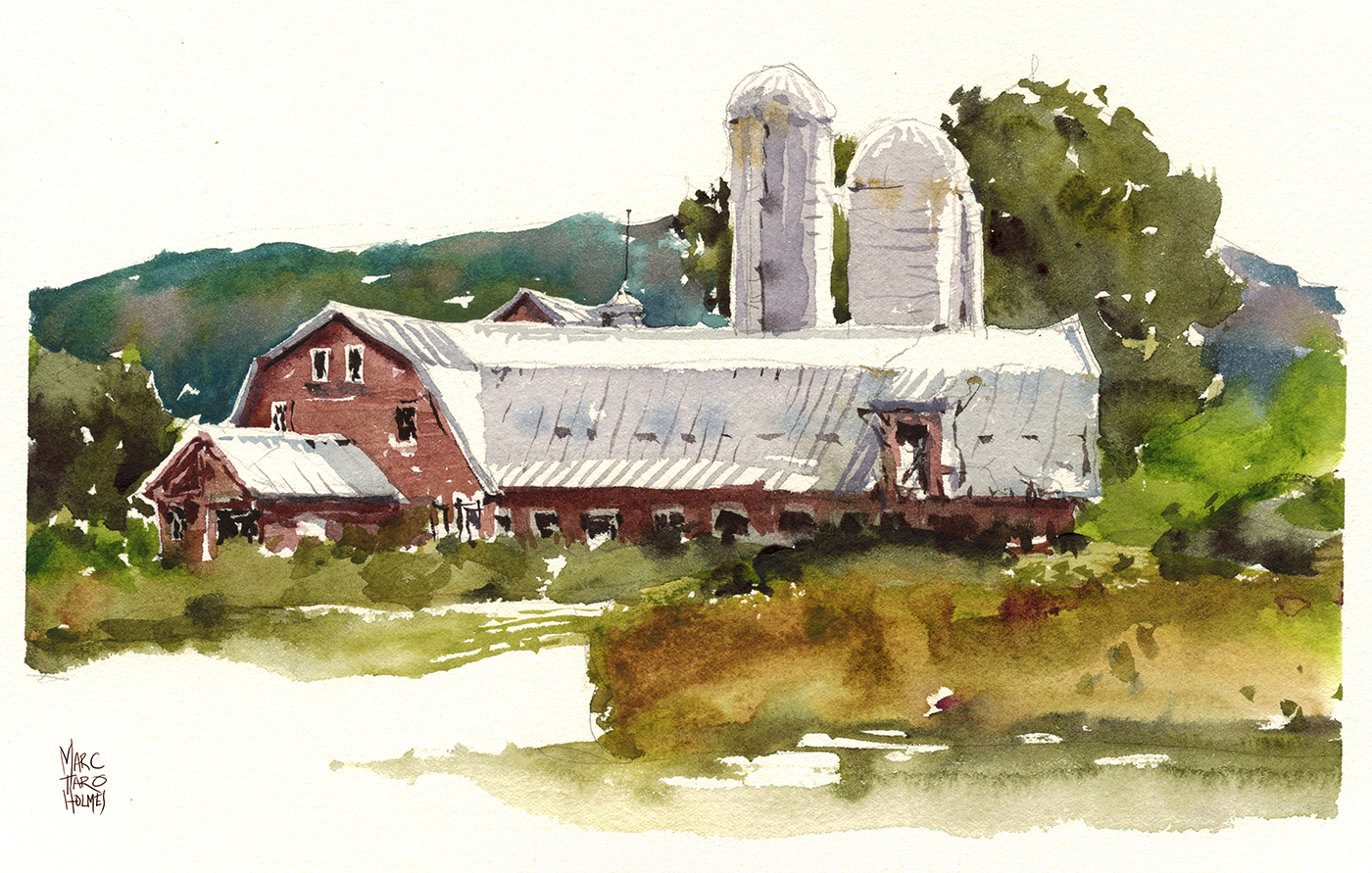
Now you can really see the trick underneath rgiht? :) The metal roof of the barn is a huge negative shape, cut between the trees and the red wooden siding. Then we just add some shadows to the negative shape, and voila. You’re in Vermont.
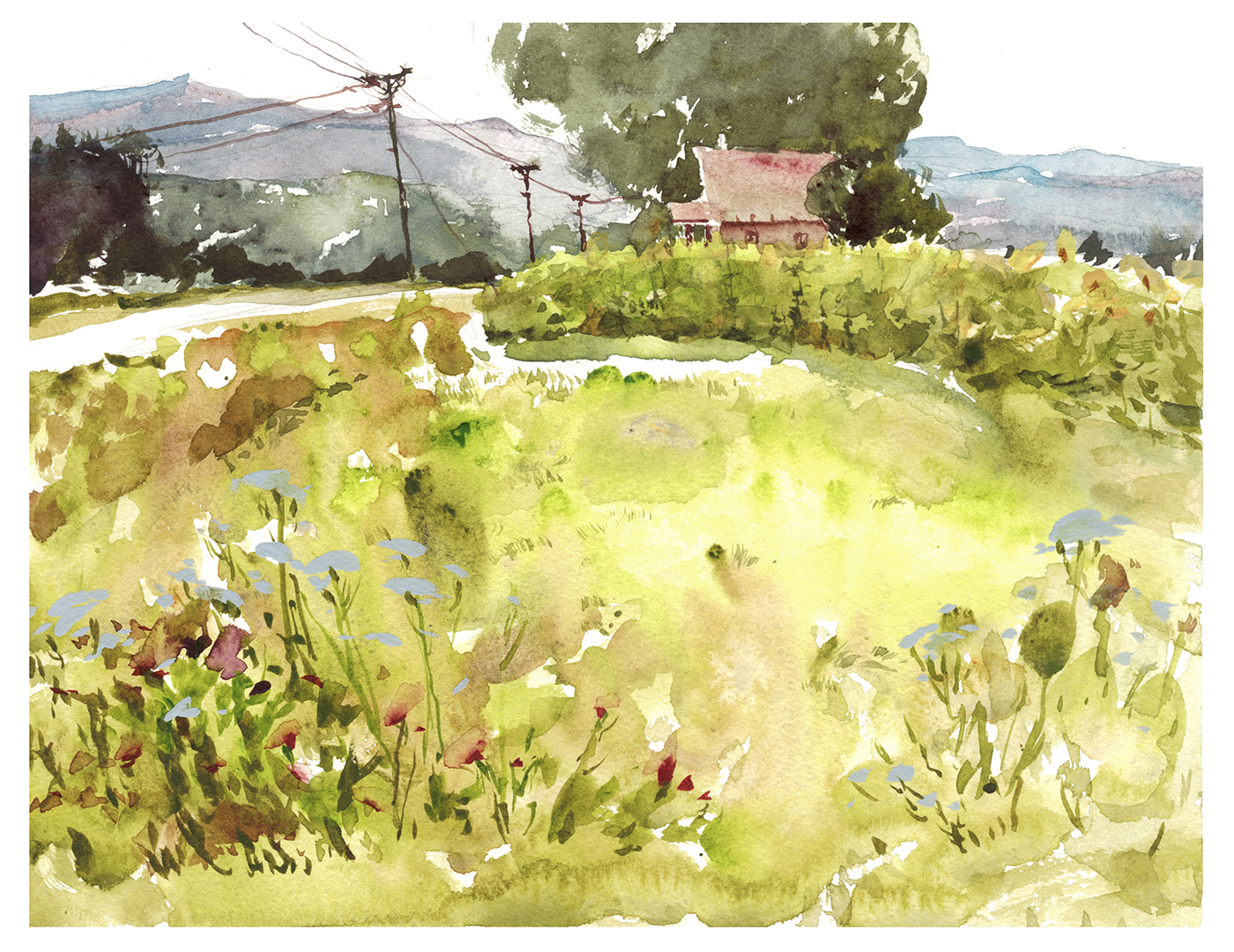
Sometimes the trick is subtle. See the negative cutout of the farmhouse? (Which I filled in later with faded red). Now it’s obvious how I used the trees (re-composing, simplifying, silhouetting) in order to make the little house into a nice clean shape, which is the focus of all the compositional lines created by the other color blocks.
I kind of regret the smaller tree on the right. It looks like a bite taken out of the house. But oh well, we can’t fuss over plein air paintings.
Ok- that’s some food for thought for your #30x30DirectWatercolor2018!
We’re starting soon, a little over a week to go!
~m
Converting Line to Shape in Direct Watercolor
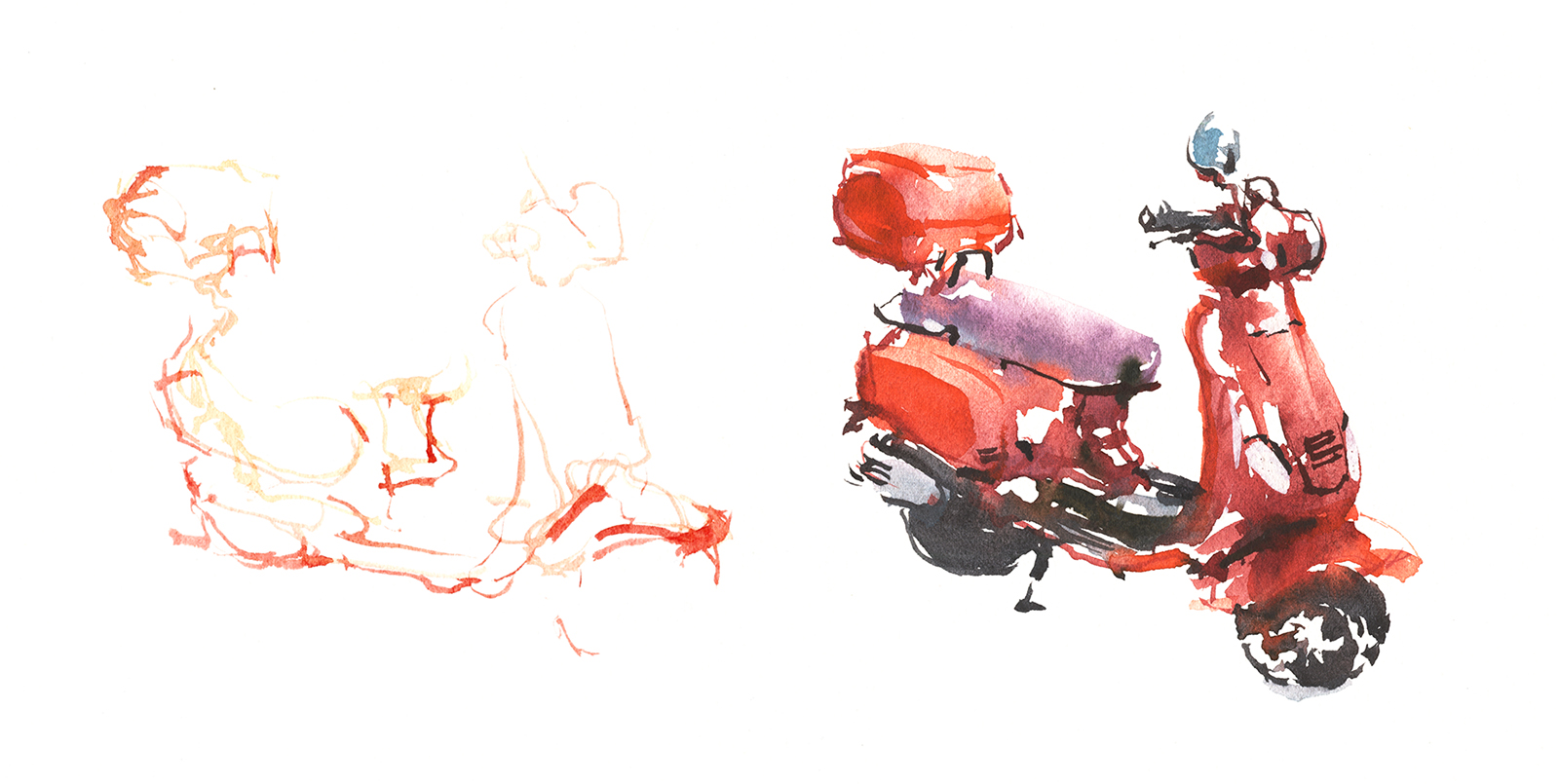
What if I want to paint Direct Watercolor, but I still think in line?
That’s certainly my situation. I want to paint, but I think in line :) It’s such a habit from years of drawing.
So!
I’m thinking about my upcoming demos in Chicago and Porto, and how we might break down Direct Watercolor into achievable exercises for people.
The first thing should probably be – how a beginner might approach brush drawing.
I’m thinking of calling this Converted Line. But it might also be called Absorbing your Lines.

If we begin by drawing with the brush – well, it’s harder than drawing with a pencil.
There’s no erasing, and, of course, the brush tip is harder to draw with.
BUT – the advantage is – we get a WET line, which we can simply ABSORB into shapes made with the side of the brush.

In this way, the drawing progresses from LINE to SHAPE >>>> at the same time <<<<.
(Don’t wait so long that your line is bone-dry, or it won’t melt into the shapes as nicely).
I think this is more organic than a drawing in pencil and filling with color later.
But also, this helps us see how little drawing we actually need to see a shape. (With practice).

Sometimes it’s too organic! You *will* sacrifice accuracy. That is absolutely true.
But what you get in return is a kind of internal blending of color, that you cannot achieve any other way.

l still try to proceed [Larger > to > Smaller] and [Lighter > to > Darker]. Just as if I was tinting in the Tea, Milk and Honey method.

And I still have to wait for the shapes to dry before I put in some small touches with more brush-line.
It might seem a fruitless exercise when seen in isolation like this.
Why do I want to make this clumsy drawing? When I can make a better (more accurate) drawing with a pencil?

Because the goal – eventually – is to use less and less and less guiding line, and be able to think in wet shapes.
Shapes fuse together in more solid, structural ways. And – eventually – can give you a feeling of minimalism, in which less is more.

And of course, shapes can be knit into the background, to make a fully integrated water painting, which begins to consider the figure-ground relationship – and later on, the use of depth in the background, as well as any number of things that can be your next level of practice, after you are comfortable with brush drawing, and painting directly!
The Direct Watercolor Palette : From Art-Toolkit.com
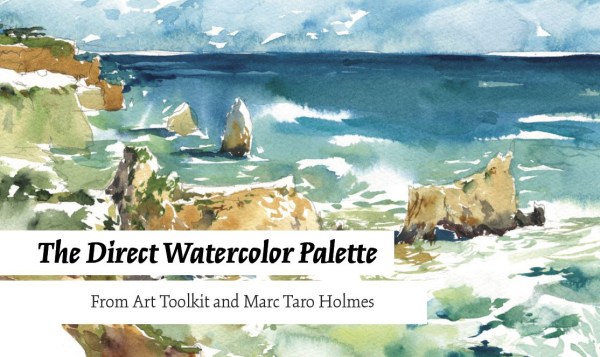
I’m pleased to show you a little side project that’s evolved out of #30x30DirectWatercolor2018!

One of our 30×030 guest-artists, Maria Coryell-Martin is the designer behind Art-Toolkit.com, a project where she’s creating the ultimate compact watercolor palette. Her system is a unique product based on her experience as a travel sketcher in the most extreme locations around the globe.
At the same time, it’s super-cute and fun for people who are just scooting around town making sketches in their daily lives.
I’ve talked before about the kits Maria has sent me to play with. This year, in preparation for the 30×30 event we decided to go one further!
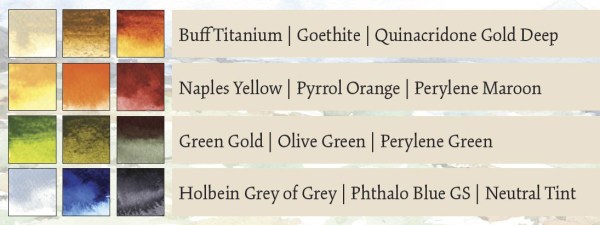
The Direct Watercolor Palette is a 12 color selection, chosen by me to be my absolute minimum landscape and urban sketching palette. These colors are based on the larger 21 color palette I’ve fine-tuned while working on my book Direct Watercolor.
These are my desert island choices. When I want the smallest possible portable kit, this is what I’d bring.
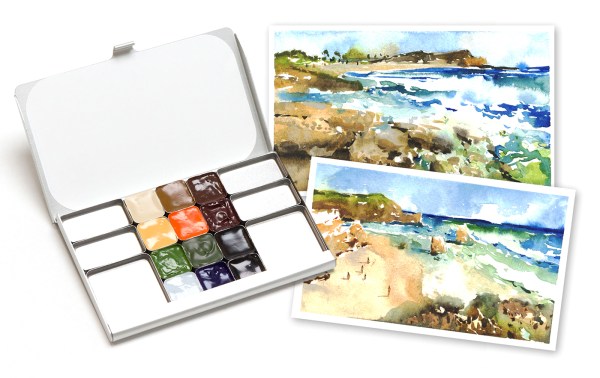
Maria has created a special limited edition of her Art-Toolkit, set up in my ideal layout, with two big mixing areas, and 12 mini-pans pre-filled with Daniel Smith watercolors in my color choices.
Supplies of this kit are limited! If you’re in the market for a compact kit – maybe to help you with your daily paintings in #30x30DirectWatercolor2018 – order your limited edition Direct Watercolor Palette today!
>
BONUS TIP! Maria is also running a giveaway for the Direct Watercolor Palette on Instagram. Visit @ArtToolkit [www.instagram.com/arttoolkit/] to enter!
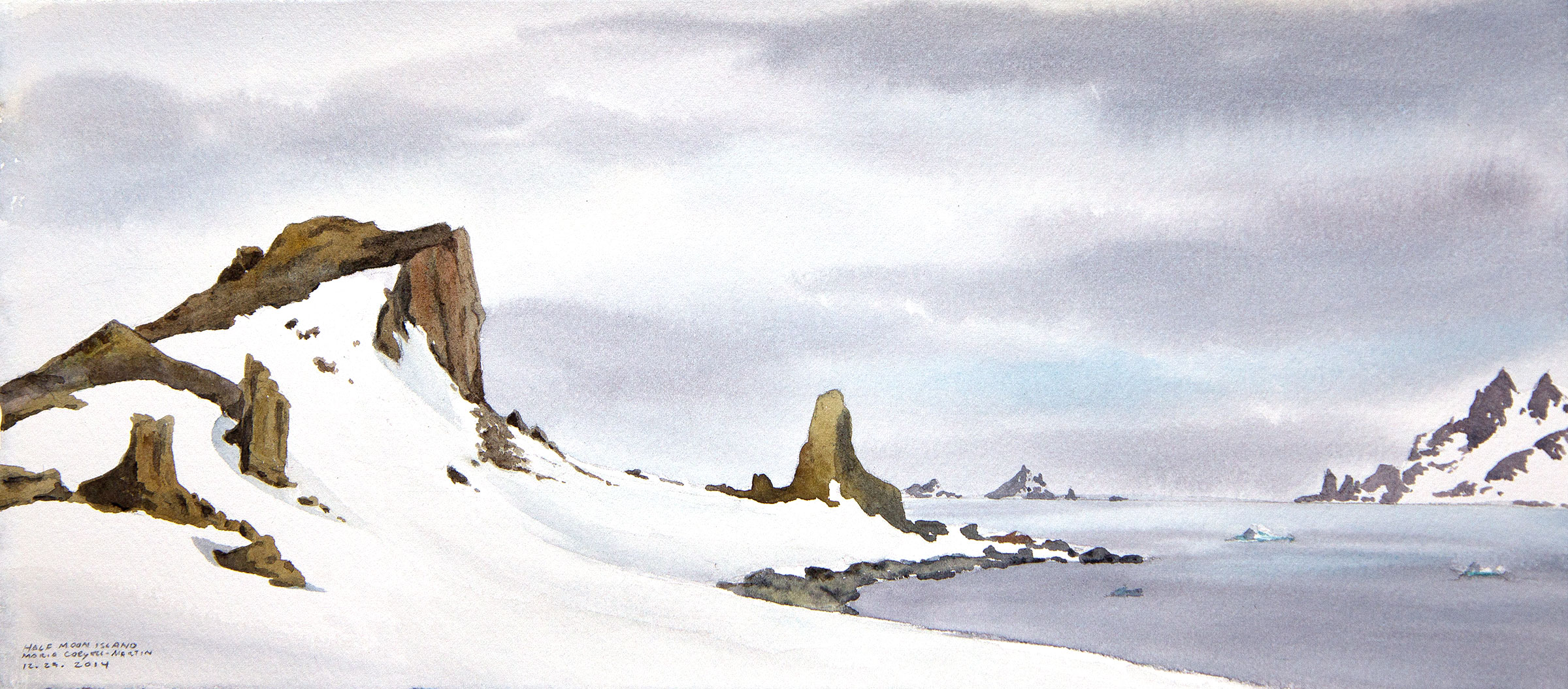
30×30 Guest Artist : Maria Coryell-Martin

30×30 with Maria Coryell-Martin
Now, I don’t precisely *know* Maria. We haven’t met in person, only online.
These days, don’t we all have people we’ve found on the internet? People who we don’t really know, but we love what they’re doing, and we’d kind of like to have their lives, if only for a few days.
Maria is a traveling artist on an entirely different level from my own experience. She’s on a kind of artistic adventure that brings to mind scientific illustrators from the turn of the century. She’s traveled with research expeditions to the Arctic, and, as the winner of the Thomas J. Watson Fellowship, circumnavigated the globe making art in remote regions.
Find out more about Maria’s and her work at ExpeditionaryArt.com, or follow her on instagram @ExpeditionaryArt. She’s also on the Facebook <here).
It’s a great honor to have her joining us for 30×30. She’ll bring a unique viewpoint to the group. I’m very excited to see what she comes up with over a month of new work.
Five Questions for Maria about #30x30DirectWatercolor2018:
When you think about 30 days of daily practice – do you have a theme or a goal that might guide your work the month?
Maria : I moved to my home in Port Townsend, a small seaport town in western Washington, just two years ago. I plan to use the 30×30 project as an opportunity to sketch and learn about the town’s cultural heritage, maritime industries, and connection to the water.

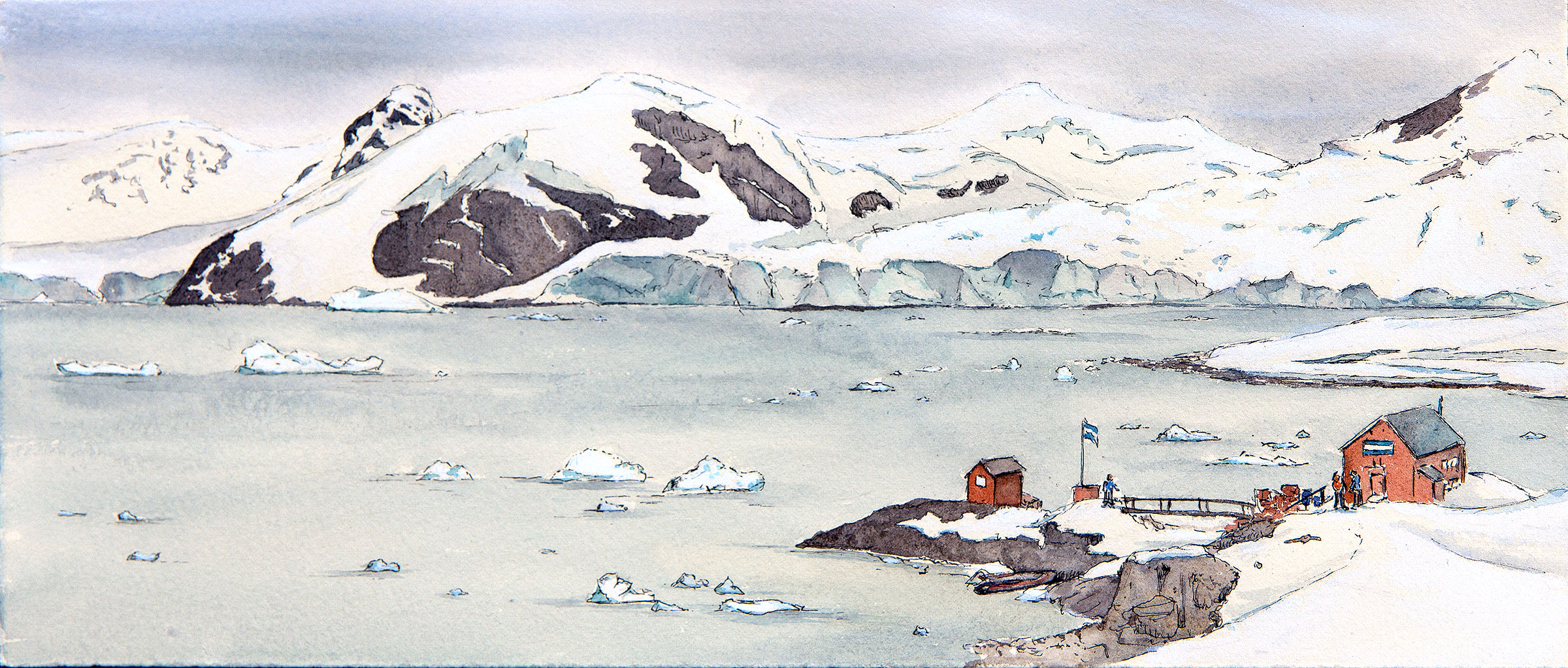
[Ushuaia, on the southern tip of Argentina]
Are there any specific materials or techniques you plan to investigate? Will you use your reliable tools, or use this time to experiment with a new thing?
Maria : Ink and watercolor is my sketching comfort zone. For this project, I’m excited to leave behind my pens, using watercolor only (with some pencil sketches), with the Direct Watercolor Palette. <read more about this here).
I plan on using my favorite toned paper, with some additional white gouache for brights. The mood and techniques reference the natural history tradition which is an inspiration for my expeditionary art. I’ll be using primarily Arches Cover tan paper which has a beautiful soft feel, and perhaps some Canson Mi-Tientes (sand color) which is heavy enough for light watercolor wash, but dries very quickly. I buy both in large sheets that I cut down to size. I have prepared sheets in a couple of formats (5″ x 7″ and 6.5″ x 15″ panorama), so I have some choice for composition. I reserve the right to experiment with other colors or formats, no rules are written in stone.

[Here’s Maria writing about making this View of Niaqornat]
Do you think 30×30 will be a challenge? Or is one painting a day easy for you?
Maria : Painting daily (or doing anything daily for that matter!) is a challenge for me right now as I balance my life with a toddler and working at home. For the 30×30, I give myself permission to play, experiment, and embrace, “practice not perfection!”
Let’s have a small tip! Give us a strategy people might use to reach the goal of 30×30?
Maria : I recommend preparing your materials for the month all in advance, so they are ready to go. Choose your sketchbook or paper, prep your watercolor palette, and keep a small bag packed up so when you want to paint, you are prepared.
What do you hope have gained at the end of the 30-day marathon?
Maria : I hope this marathon pushes my understanding of my tools and techniques, and builds a daily sketching habit that I can sustain beyond the month. I’m also sure I’ll encounter some surprises along the way.
There’s a quote I love by David Boyle from his book, Art and Fear:
Vision is always ahead of execution, knowledge of materials is our contact with reality, and uncertainty is a virtue.
Thank you, Marc, for organizing this wonderful project!
Looking for the FAQ/Announcement < click here!


30×30 Guest Artist : Liz Steel

30×30 with Liz Steel
Liz Steel needs no introduction to readers of this blog!
Liz is the co-creator of #OneWeek100People2018, our week-long drawing-sprint that was the model for this bigger and better 30×30 marathon.
She’s the force of nature behind the worldwide artists’ community SketchingNow, and of course her immensely popular blog LizSteel.com. Both of which are packed with practical advice on location drawing, sketchbook journaling, and – increasingly – painting in watercolor. She can also be found on Instagram at @lizsteelart.
Liz is the sketcher who showed me the value of speed. (So important to a reportage artist!). When we first met, I thought I was pretty fast. Yet – she was doing three for every one of my pages, showing me what a real travel-journal could be like.
In a way, it was her, and other journal-keepers like her in the online community, that put me on my 10-year path towards Direct Watercolor.

Five Questions for Liz about #30x30DirectWatercolor2018:
When you think about 30 days of daily practice – do you have a theme or a goal that might guide your work the month?
Liz : As I’ll be traveling for the entire month of June, I won’t have any themes – except that I’ll be sketching different subject matter every day. I’ll be in Italy, Scotland, and Poland during June. < Ha! What an incredible way to do a 30×30! ~m)

Are there any specific materials or techniques you plan to investigate? Will you use your reliable tools, or use this time to experiment with a new thing?
Liz : I’ll use my normal materials – my standard watercolor palette and my 1/2 inch dagger brush (by Rosemary & Co) and I don’t expect to do any experimentation in regard to different materials/tools. This is because I’m traveling and limited to my most essential stuff.
Do you think 30×30 will be a challenge? Or is one painting a day easy for you?
Liz : Once again, because I’m traveling (and not teaching this trip!) this should be very doable. I normally sketch six days a week, doing a number of drawings a day. (Sunday is my rest day). What’s fun about this challenge is, it’ll force me to do at least one paint-only sketch per day. I normally start with ‘direct watercolor’ but add lines halfway through the sketch – so it’s only occasionally that I create paint-only sketches. I’ll have to be intentional to meet this challenge!
Let’s have a small tip! Give us a strategy people might use to reach the goal of 30×30?
Liz : Keep it simple! A 30 day challenge is a big commitment, so try to stick to simple subjects to paint – even if you want to sketch out on location for most of the month, make sure you have some ideas for everyday still life composition at home.
What do you hope have gained at the end of the 30-day marathon?
Liz : I want to develop some clear strategies for working with paint only. At the moment it’s a little random. I don’t know when starting my sketch whether I’ll just use paint, or add some ink lines at some point. Without any ink I’ll have to be more intentional with my washes – especially as my practice is to sketch very quickly.
Looking for the FAQ/Announcement < click here!

30×30 Guest Artist : Uma Kelkar
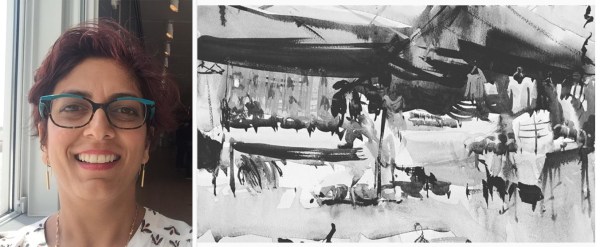
30×30 with Uma Kelkar
I first met Uma at the USK symposium in Chicago last year. We’re both about to return (in just a couple weeks!) to teach at the 2018 USK Chicago Sketch Seminar. We’re actually going to be there for the first few days of #30×30, making things extra complicated. (Or, even more fun – we’ll see).
You can find out more about Uma at her website: umakelkar.com, or follow her on instagram @umapaints. She also has an artist’s page on facebook.
I’m going to admit – It’s a little intimidating to be teaching next to her.
I’ve been following her work closely, and she’s tapped into a kind of wild spontaneity, that I’m only getting close to touching. I talk all the time about the fundamental need to work without fear of failure. A direct watercolorist has to be completely free to make marks by instinct. Uma has this mind-set on speed dial.

Five Questions for Uma about #30x30DirectWatercolor2018:
When you think about 30 days of daily practice – do you have a theme or a goal that might guide your work the month?
Uma: Yes, of course, I have a goal for the 30-day marathon. And that is to have a sustained habit not just for myself but also for the family around me so that they too help to make time for my painting. The goal, in addition, is to get looser but also to develop the thinking that goes on before the brush hits the paper.

Are there any specific materials or techniques you plan to investigate? Will you use your reliable tools, or use this time to experiment with a new thing?
Uma: I will use the 30 days to hone my skills, so it will be attempting to reach another painting level in the 30 days with tools I am used to.
Do you think 30×30 will be a challenge? Or is one painting a day easy for you?
Uma: Painting once a day, if I had the time, is not a problem at all – it is the making of time for painting that is the issue and which I need to solve quite urgently for my own sanity. I am hoping this 30×30 marathon more than nudges me into fixing my desire to paint every day into an unshakeable habit.

Let’s have a small tip! Give us a strategy people might use to reach the goal of 30×30?
Uma: I think since I want to improve my painting skills, I am going to come up with 4 topics – one for each week and repeatedly paint the same subject one week at a stretch until some of the decisions in painting that topic becomes muscle memory. This I think will free me to think more deeply on brush strokes and value composition.
What do you hope have gained at the end of the 30-day marathon?
Uma: Eyesight! I expect to have gotten a new eyesight, to pick out the important things in a particular genre of paintings, after 30 days of study with mini emphasis on a weekly topic.
Looking for the FAQ/Announcement < click here!
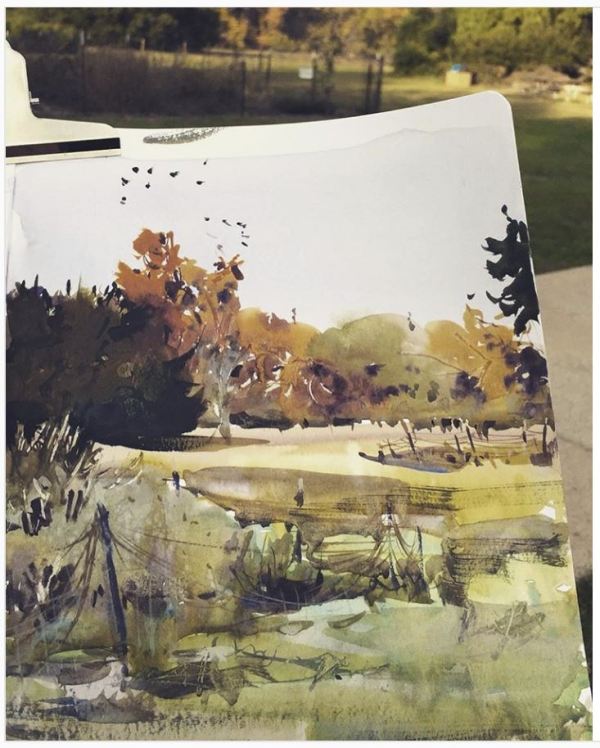


 Citizen Sketcher