Announcing a new video lesson: Travel Sketching in Mixed Media!

Hey everyone! I’m excited to announce my second video series with Craftys.com!
Travel Sketching in Mixed Media is a followup to my 5 start reviewed course Sketching People in Motion.
This time, the focus is on making sketchbook drawings and rapid watercolor sketches as you travel the world. My number one goal with the course, is to help you come come with sketchbook full of memories from your trip. Be it a family vacation, a day trip, or just taking a long lunch hour every Friday – my greatest reward is seeing people’s sketchbooks fill up with images.
Or, click on over to the Instructional Videos page of the blog to find out more about Travel Sketching in MIxed Medial! You will find a special registration discount offered to anyone who joins via my blog.
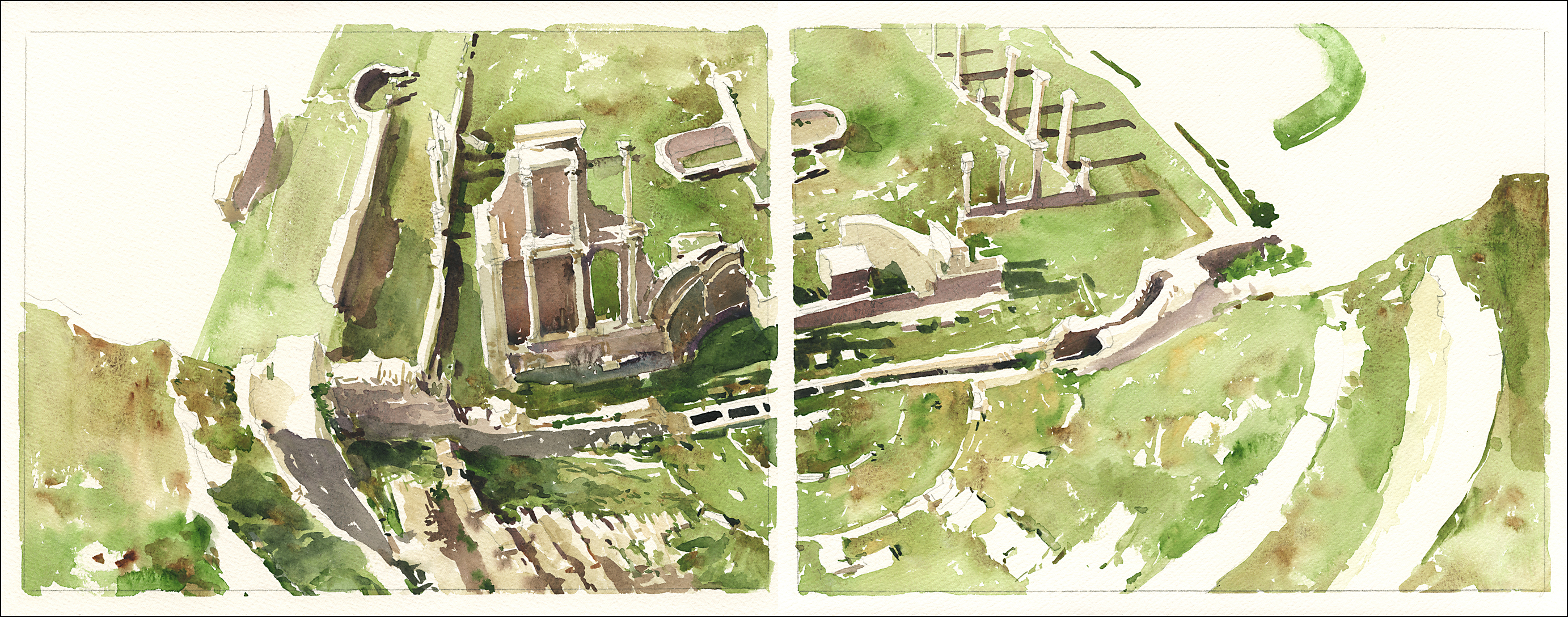
This is my personal favorite sketch from our time in Volterra. It is perhaps not the most pictorially beautiful painting. It could even be called confusing.
You are looking down at the partially reconstructed ruins of a Roman theater, with scabby grass growing between the rocks. It was hot and dry, baking the moisture out of the painting almost immediately. This was actually helpful getting this completed in the short time I had these interesting shadows.
This might not be the sketch you would choose to hang on the wall – but in my mind it holds an interesting story. Which in all honesty, we would never have heard about, if not for our friend Simo showing us around.
These ruins had been lost for many years. But apparently it was obvious to those who understand these things, that there was a Roman theater hidden here. The shape of the terrain is distinctive – and there were probably records – old maps and manuscripts with drawings of the place, or people’s diary writing. So, while most people had forgotten, someone always knew there had been a grand structure here .
In the years between the Romans and the 1970’s this piece of history might have fallen naturally – or been scavenged for stone used to build the town. But there was also a kind of willful ignorance humans will always employ. Because of the high 13th century era wall, and the location at the edge of the city center, it was somehow considered a great spot for tossing garbage. Eventually the ruins were completely buried below the city dump. I guess if you have a surplus of stone ruins in your area, you don’t care about burying a few rocks under your midden heap.
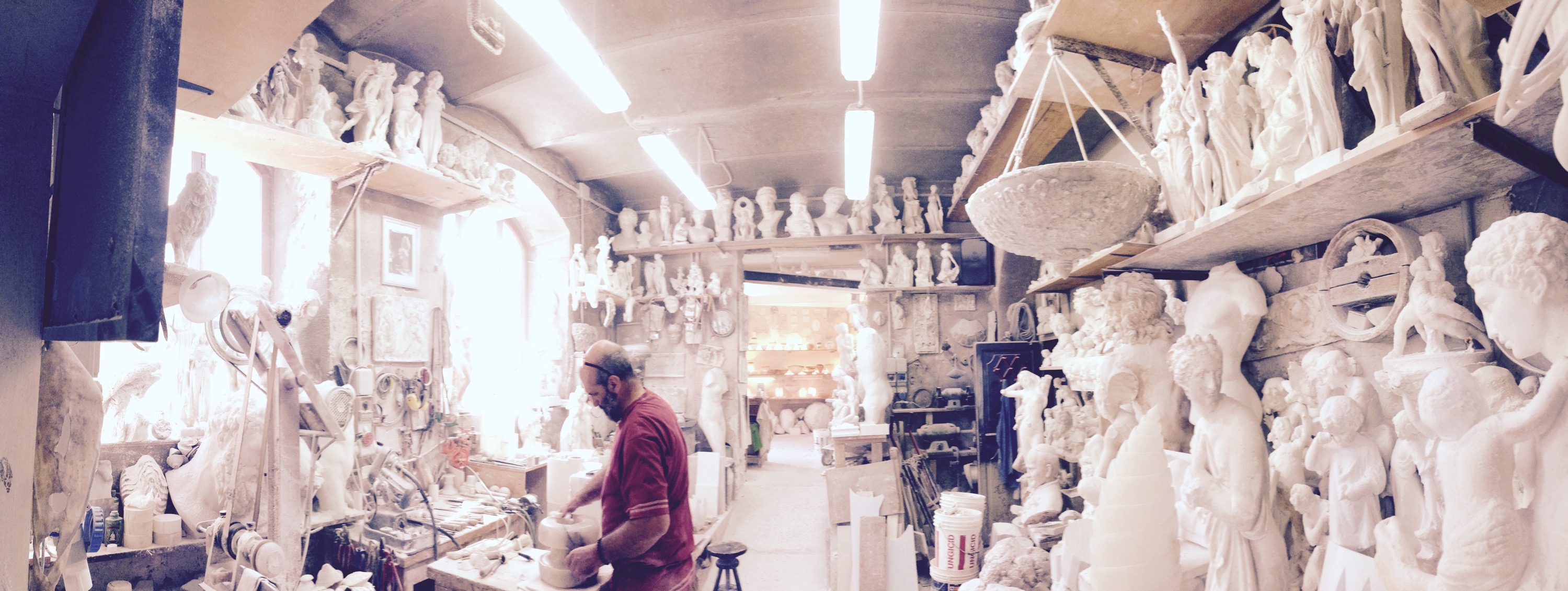
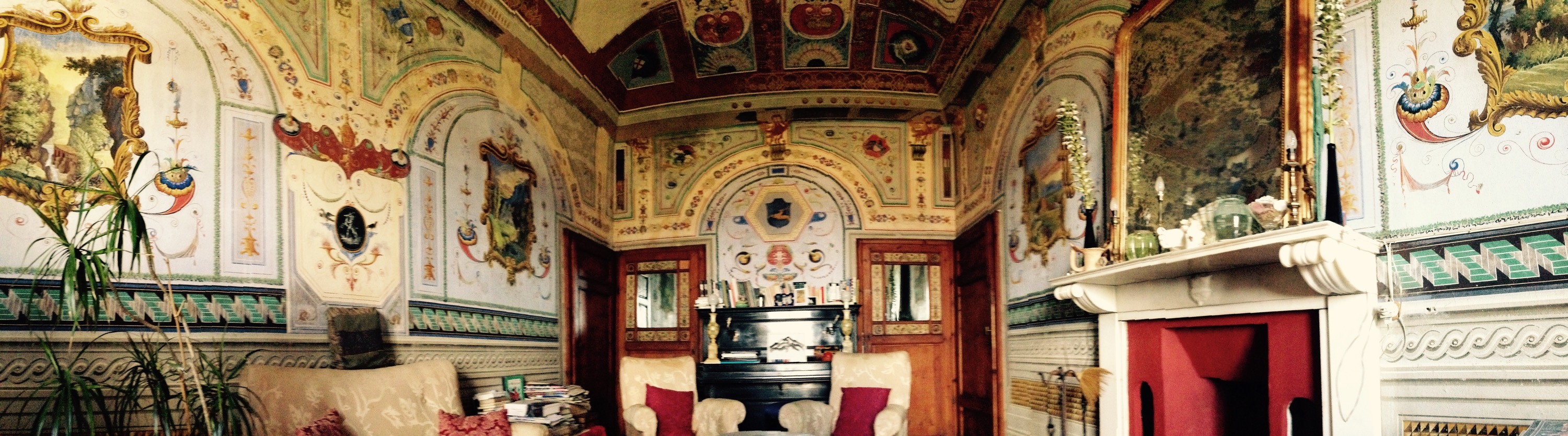
The town of Volterra, which goes back to the Etruscan times, had two modern industries before today’s reliance on tourism. At first it was the heart of an Alabaster carving empire. We heard about at least two great families who made their fortunes exporting treasures in Alabaster. During our week painting, we stayed in a beautiful villa that had been the country home of one of these art-barons. Today it is an artist retreat/bed and breakfast run by artists Klaudia Ruschkowski and Wolfgang Storch.
But the most recent economic engine of the city was an entirely different thing. A huge mental asylum.
Sometime before its decommission in the 1970’s, the ever expanding complex had a population of 6000 patients. I can only imagine it must have been a Dantean warehouse for the mentally ill – along with any number of unfortunates who were simply tossed in there, never to return. A few internet searches about the asylum raise up grim stories such as 200 patients sharing a bathroom. Modern day Urbex photographers have infiltrated and brought back photos like these.
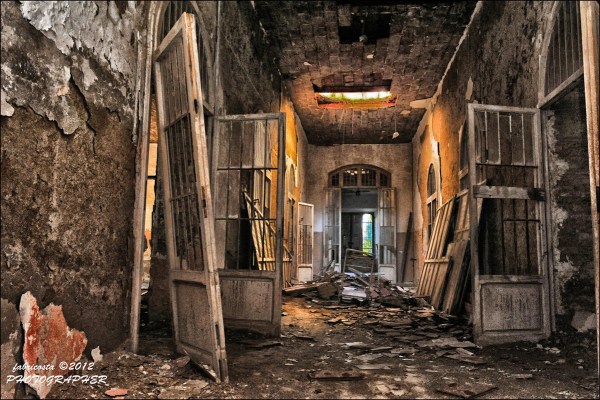
(Photo: Fabrizio Costa)
We are told that at one point everyone in the town worked for this hospital in some capacity. If not actually guarding the inmates, they were probably washing the sheets, cooking the food, or whatever support was necessary. Perhaps this came naturally, as the town has, since the middle ages, also had a stone fortress with a dungeon, which is still used today as a prison. Presumably the medieval cells have been modernized. (I hope). Coming into town by bus from Florence, we met an artist/actress who was on the way to a theater project in which they perform inside the prison. Somehow in collaboration with the prisoners? I didn’t get the details.
In any case – at some point in the 50’s, a local man named Enrico Fiumi who had been educated as an economist was working at the Guarnacci Museum and Library in some capacity. He became an expert in local history and became aware of the buried Roman theater.
In an incredibly Italian story, he achieved two things. He convinced the asylum to *lend him mental patients*, to carry out the excavation. Presumably as volunteers who would do anything to get out of that place for a short time, and presumably working entirely with hand tools, and without any real training or supervision in Archaeology.
As well – as the excavation took shape – he conducted a many year long campaign to relocate a modern day soccer field that had sprung up next to the old dump – finally allowing them to fully uncover the theater. It was probably harder to evict the soccer players that it was to borrow the mental patients.
Today, you can look down while passing from one gelato shop to the next espresso stand, and snap a picture of the ruins without ever becoming aware of this strange history. This is the kind of thing that I find fascinating, and what leads me to spend an hour in the blazing sun, making this painting.
For the artists still reading to the end: the sketch itself was drawn quickly in pencil to capture the complexity of the floor plan. Then, working very quickly, I painted the dry grass with a marbled mix of Sap Green and Goethite, working left to right systematically in little patches of wet on dry. The pigment Goethite (brown ocher) from Daniel Smith is quite similar to the commonplace Yellow Ocher – but I enjoy it for its opacity and extreme granulation. Effects like this patchy grass can be easily implied by the natural sedimentation of the earth tone. The shadows are mostly mixes with DS Moonglow. A cheater’s color for shadow if there ever was one.
Steam and Stone with Simonetta
Our week painting with Simonetta Capecchi in Volterra was a different sort of Tuscan experience. Not the usual tour of Italian food and culture the area is known for. She’d chosen the painting locations based around the theme of states of matter. Steam and stone.
We spent time in the town of course, the various historic squares and churches – but the real focus of Simo’s locations was the earth itself.
We visited many strange landscapes, starting with a drive through an area used for geothermal power generation. The ridge above us featured conical towers with the disturbing look of nuclear power plants. The steep valleys bisected by fat chrome pipelines arching over the road and cutting down hillsides transformed the entire valley into a postmodern sculpture.
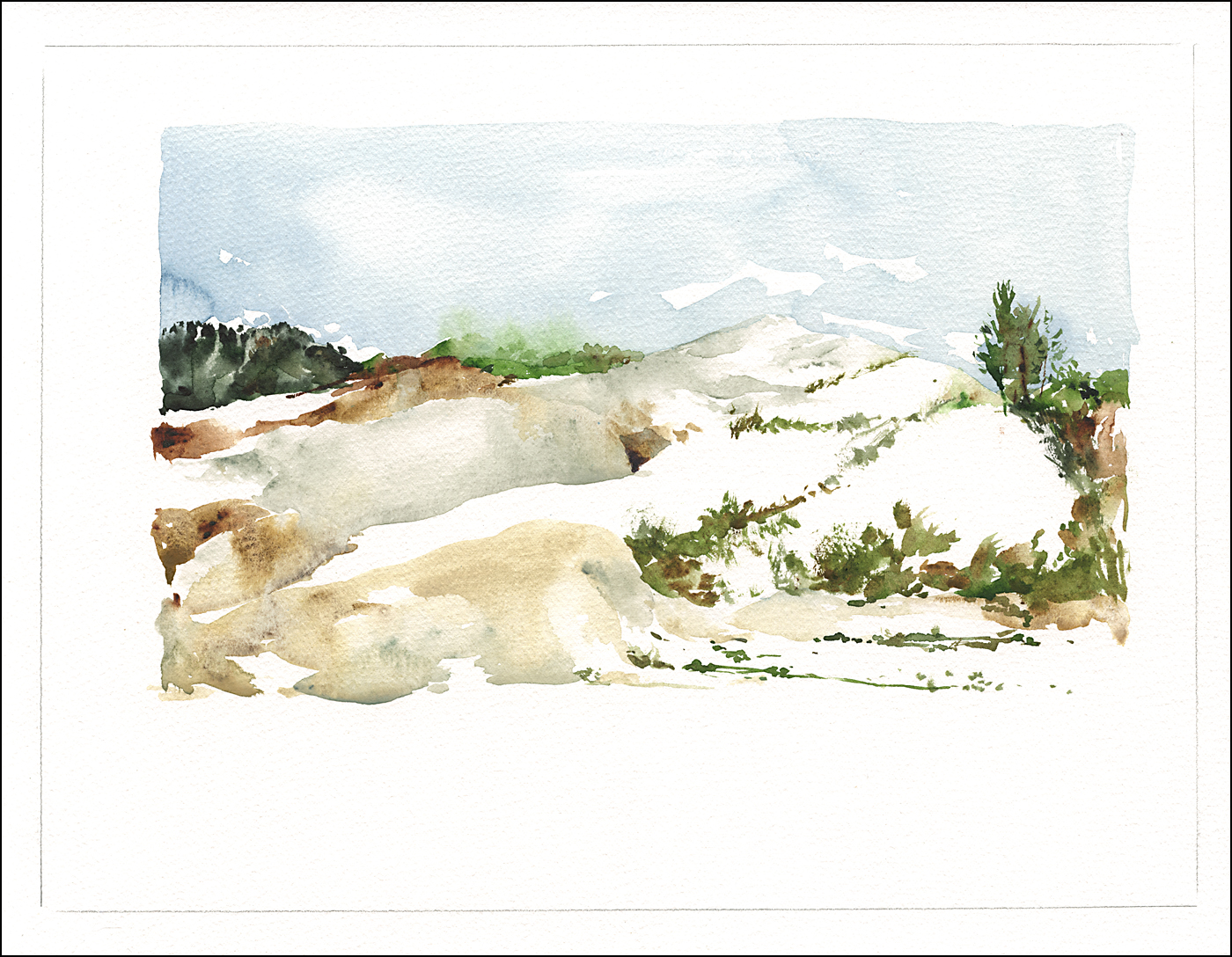
We started the exploration with a short walk through white clay hills that had the feel of a miniature Sahara desert. I did a quick sketch of the pale dunes, then turned around and sketched the reverse view directly behind – a stand of hard-scrabble olive trees and tinder-ready underbrush.
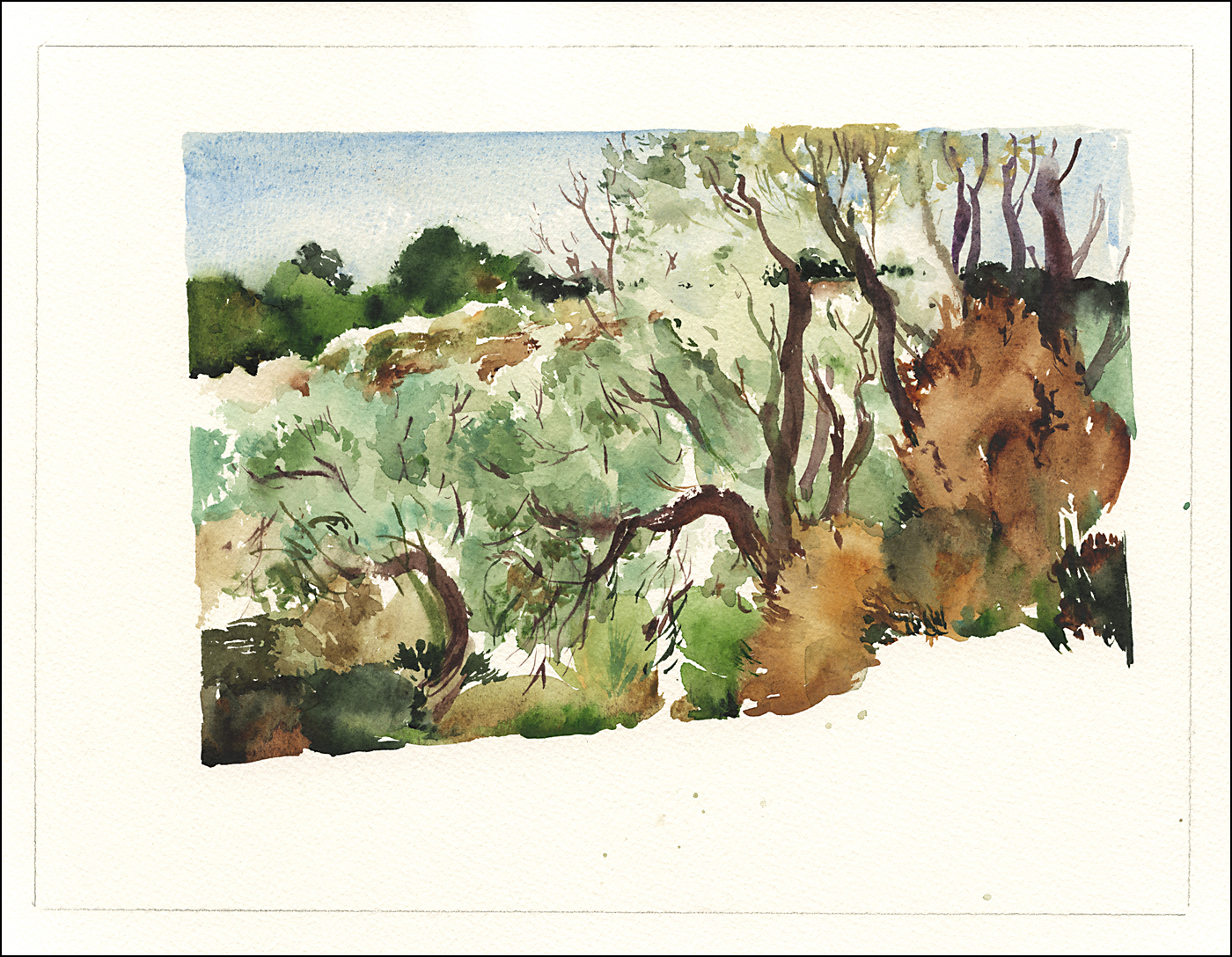
It was odd to see the two different landscapes sit right next to each other. We had a hot and dry lunch of bread and cheese and moved on.
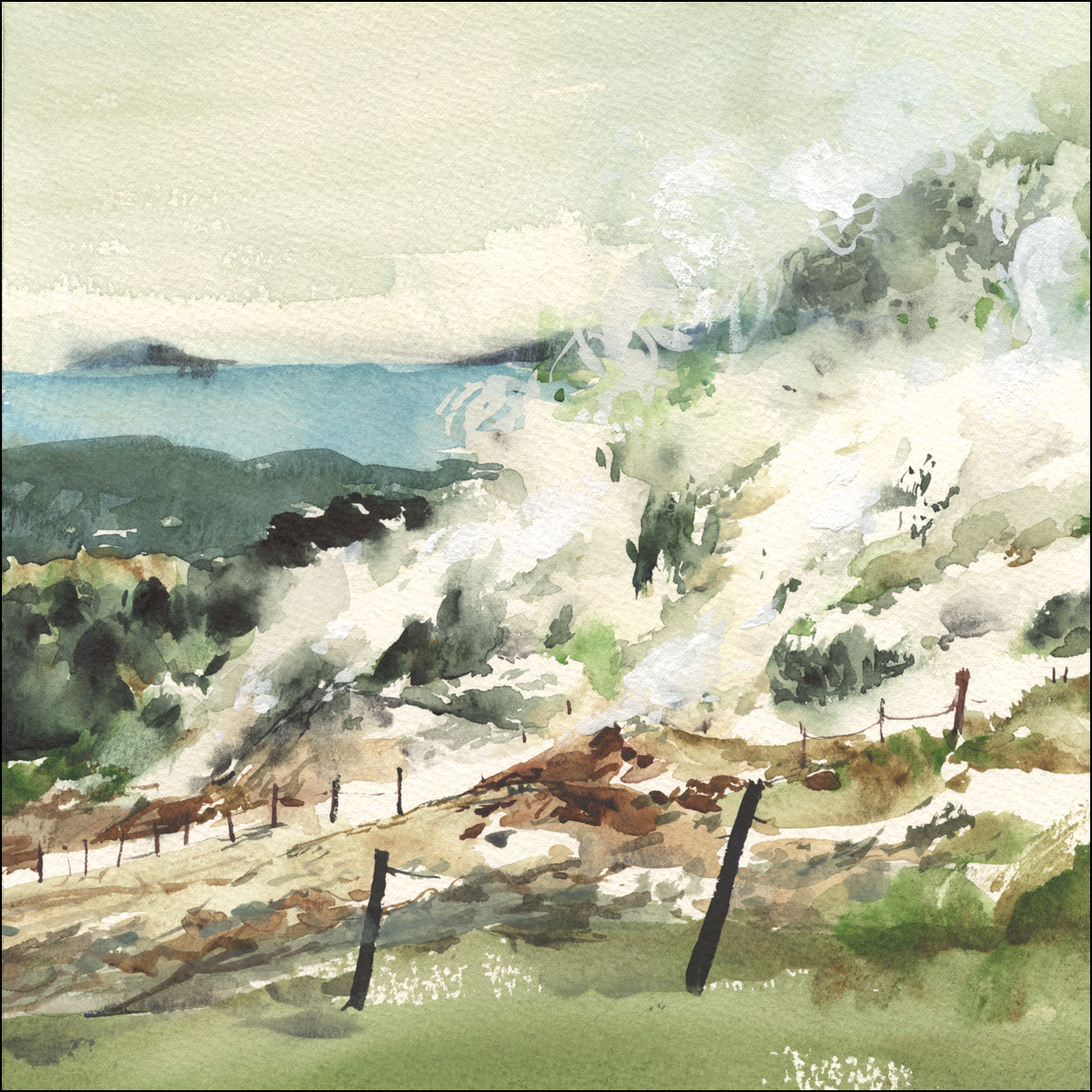
Over a short but steep climb, we started to see the steam vents. Initially just small holes in the earth emitting a puff of smoke that might have been a dust-devil – but soon enough we came to the fumaroles themselves. An area that looked like a land slide or a small open pit mine where there was no top soil – just sand and red rock and big cracks in the earth emitting tendrils of smoke. This is the natural engine beneath the geothermal plants.
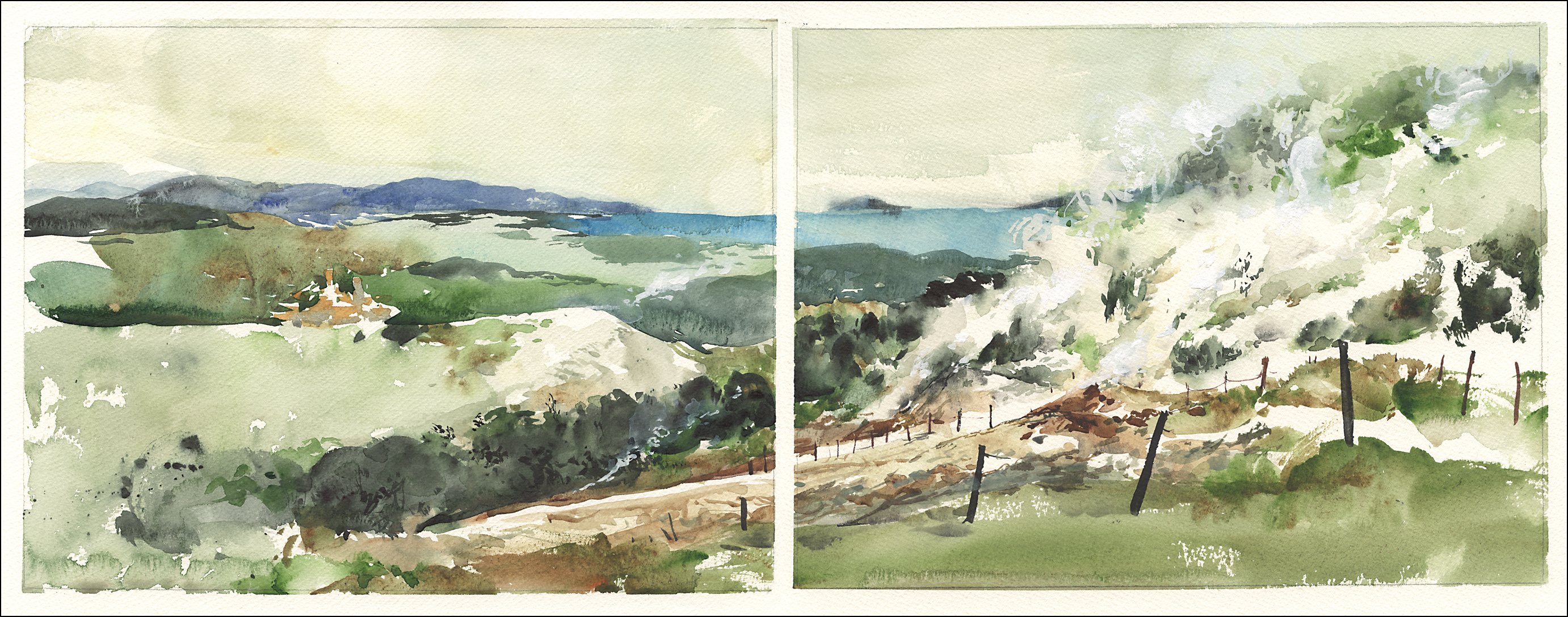
It might have been a moody landscape – there could have been a hellish feeling even – except for the surrounding green hills, and the blue sea in the distance. I was told we could see Corsica on the horizon.
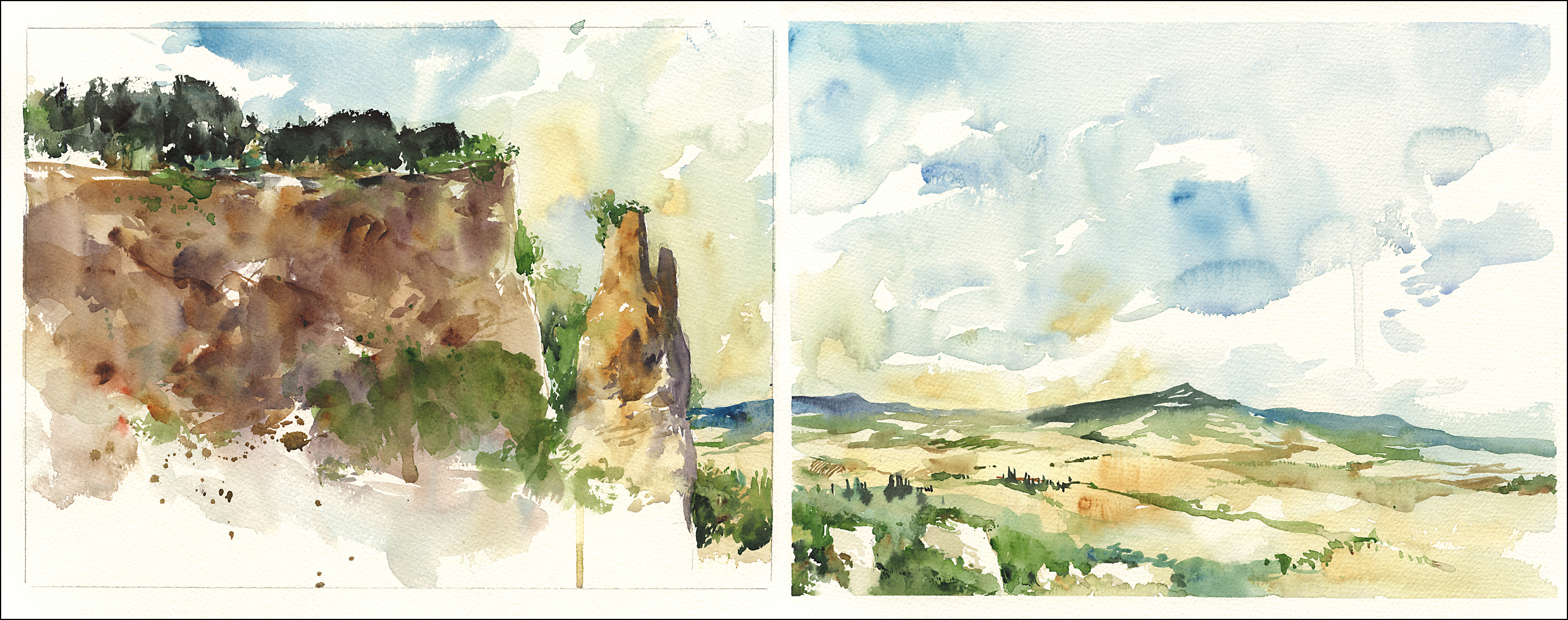
The next day we visited The Balsa – a great wall of red rock that is part of the foundations of the town of Volterra. The flat-sided ridge tapers off to narrow pinnacles, reminding me again of miniature versions of other places. Something like what we saw in Utah. I suppose this is the reason for the phenomena of the Spaghetti Western.
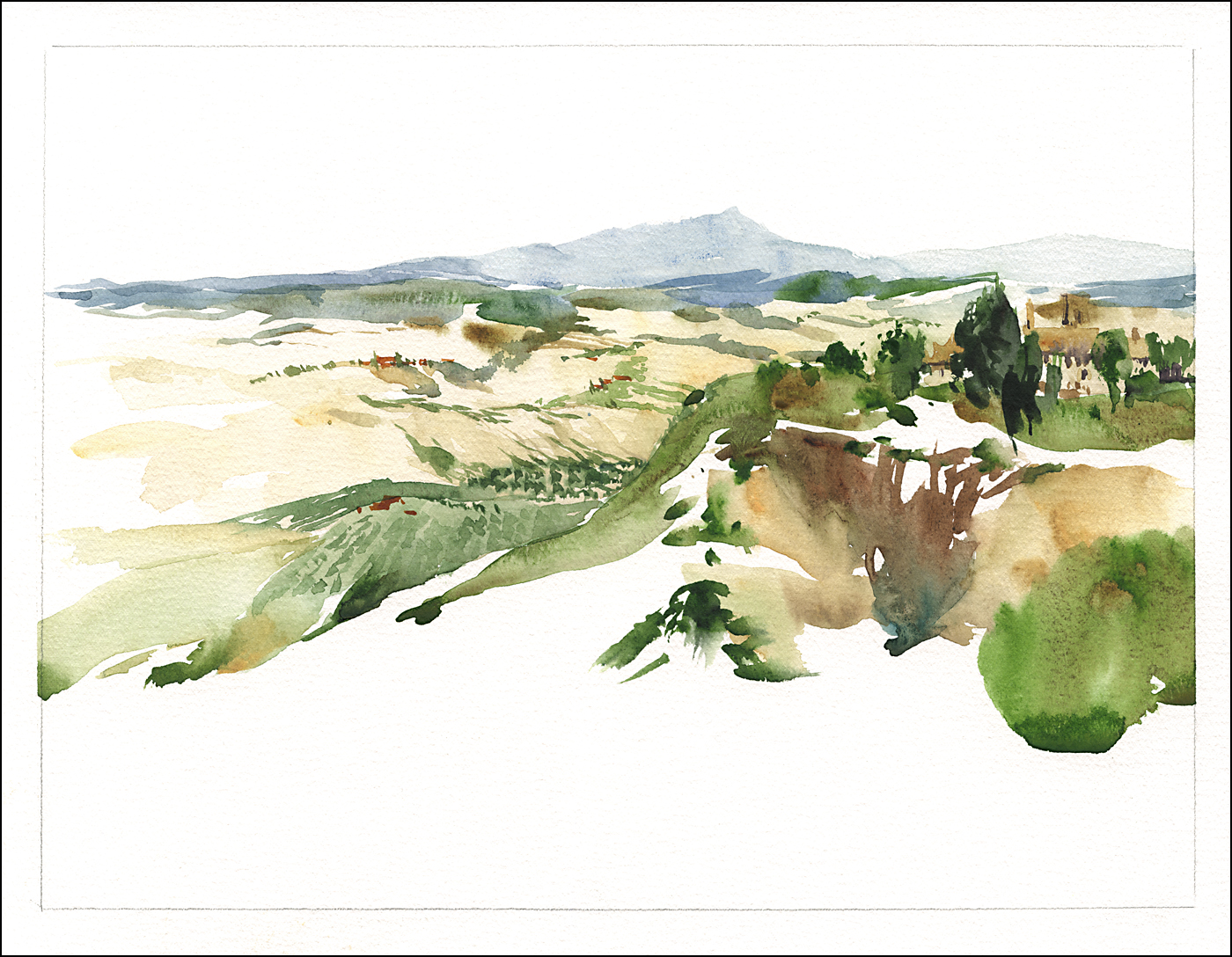
On the way back from this view point, I pulled off a nice 10 minute sketch while standing in the blazing sun. I strapped my umbrella to my body using my shoulder bag, had to hunch a little to stay underneath it. I’m sure this looked ridiculous, but was the only thing that made the direct sun bearable.
I’m continuing to love these direct watercolor sketches. I used to talk endlessly how the drawing was so important, and how everyone should make a careful line drawing before considering color. It seems I’m moving away from that technique – but I suppose I am still making a drawing – it’s just that now I believe you can make that drawing using only the edges of interlocking shapes. The line can happen in the very moment the washes are forming.
In the time since these Italian sketches, we continued onward to Asia for the Urban Sketchers workshop in Singapore, and a followup painting holiday in Cambodia. So I’ll be showing some more of these ‘shape paintings’ in the next few posts. Stay tuned!
~m
The Cortona Panorama
So, of course I’ve already mentioned, we’ve recently been sketching in Cortona Italy. We were there in June teaching a workshop – which I was actually a little nervous about initially.
This was to be my big first sketching event outside the umbrella of UrbanSketchers.org and I was unsure what it would be like. I was working with a company I’d never partnered with before, and we’d chosen a town I’ve never seen. So there were a lot of questions how the event might go. Of course I need not have been concerned.
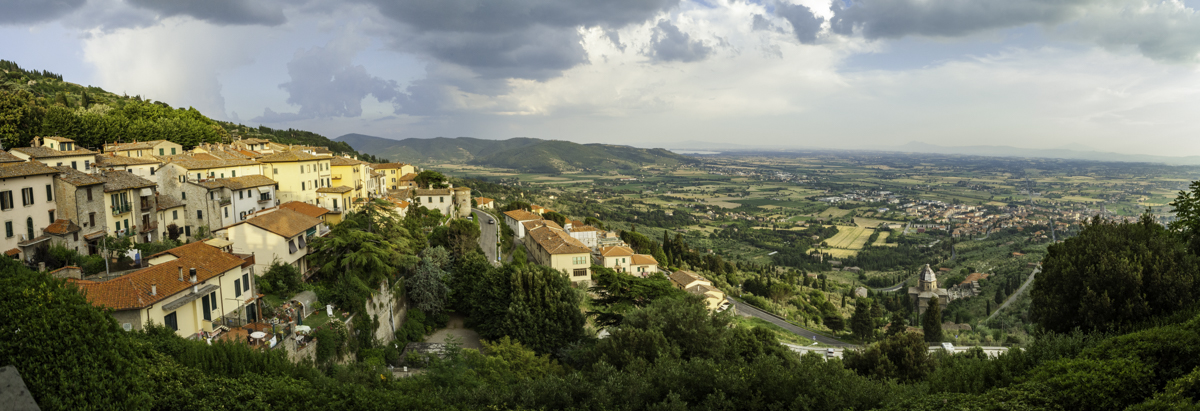
The best thing about these workshops is the people. Anyone willing to drag themselves halfway around the world to go sketching is someone worth knowing! From the first day, our little group was exploring Cortona, drawing together like old friends.
By the end of the week, we’d been doing a lot of pen and ink sketching, and I was raring to get in a for-real painting. People were interested in seeing a big demo, so we set up at the lookout point in Piazza Garibaldi and I did this 9×24″ panorama.
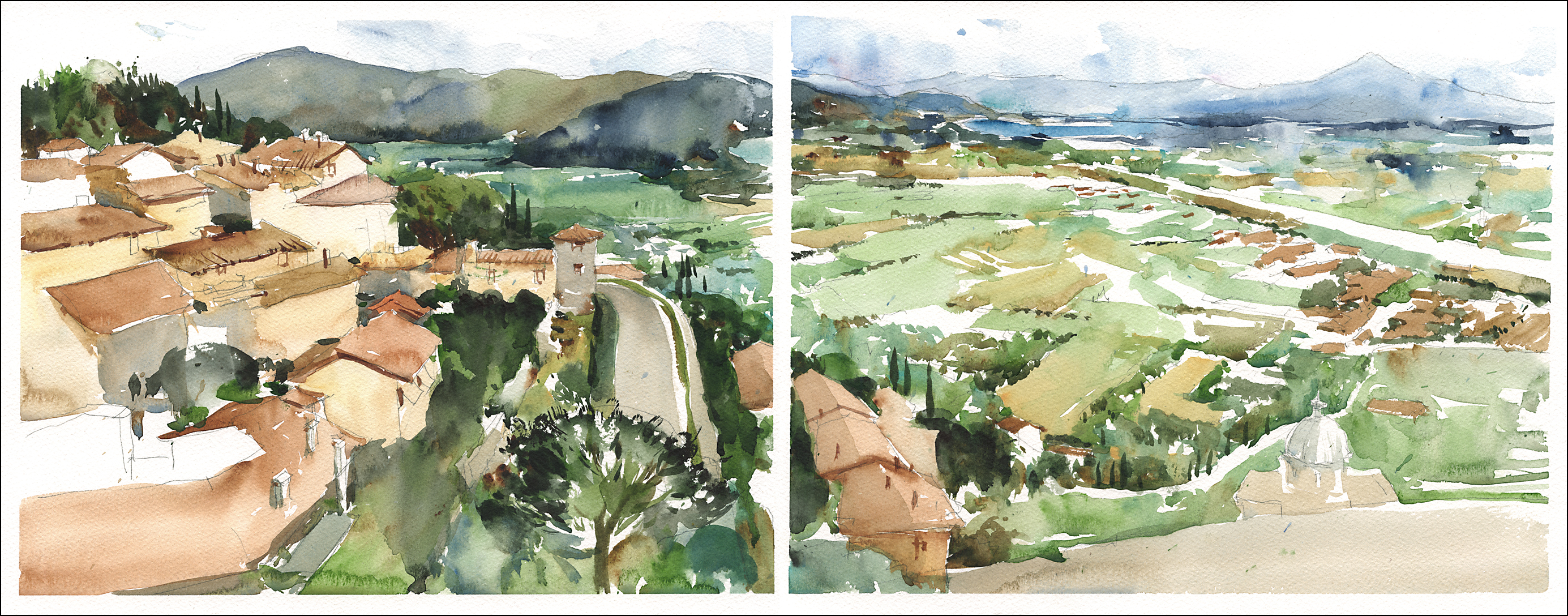
I was – again – a little nervous going in. I’d been drawing all week, and felt a bit rusty with the brushwork. Plus, I was a bit concerned about tackling this incredibly complex view. Not that I was going to back down once I’d set up the easel. You just stick to your game plan – do the things you are always telling people – “simplify, see the big shapes, draw with dry edges, let water play inside, come back when dry to re-enforce darks”. And miraculously – one of my favorite paintings of the trip just appeared before our eyes – like watching someone else paint it.


Flying out to Singapore!

Heading out to Singapore for the big USK symposium first thing tomorrow. In case you can’t make it – here’s the notes for my workshop. Maybe you can try and sketch a few characters back home. More news when we hit the ground sketching! ~m

I made these sketches last winter, while observing the Blais-Létourneau tobacco trials here in Montreal. You may check back here and read about my experience as a first time court room reporter, and my initial impressions on the sides of the argument.
Yesterday afternoon Justice Brian Riordan (sketched above) published his 236 page ruling – coming down clearly against the tobacco companies. He says:
“Knowingly exposing people to the type of dangers that the Companies knew cigarettes represented without any precaution signals being sent is beyond irresponsible at any time of the Class Period. It is also intentionally negligent.”
So there it is. A straightforward conclusion that the tobacco companies knew they were poisoning people, that they intentionally hid the truth, and profited from those lies of omission.
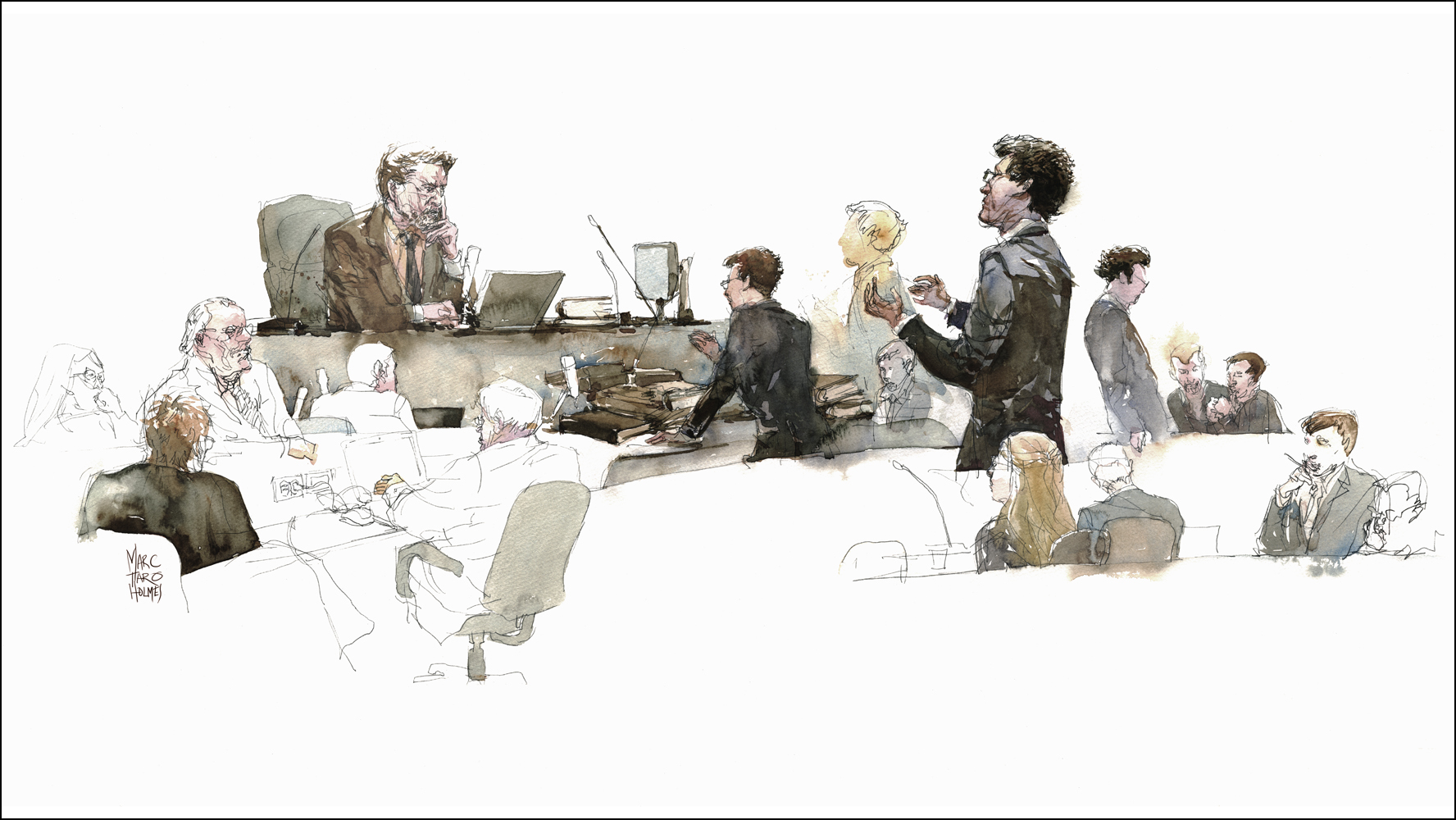
Guy Pratte speaking for Imperial Tobacco Ltd
What this actually means for the industry, and those who are seriously ill remains to be seen – but here’s the meat of the ruling:
Justice Riordan awarded $6.86 billion in moral damages to the almost 100,000 Quebec smokers whose serious illness makes them eligible to be members of this class. Once interest and other charges are added, the total could be $15.5 billion.
Those who have lung or throat cancer will receive $100,000 if they started smoking before 1976 and $80,000 if they started smoking after 1976. Those with emphysema will receive $30,000 if they started smoking before 1976 and $24,000 if after. Once interest is considered, these amounts could be doubled or more.
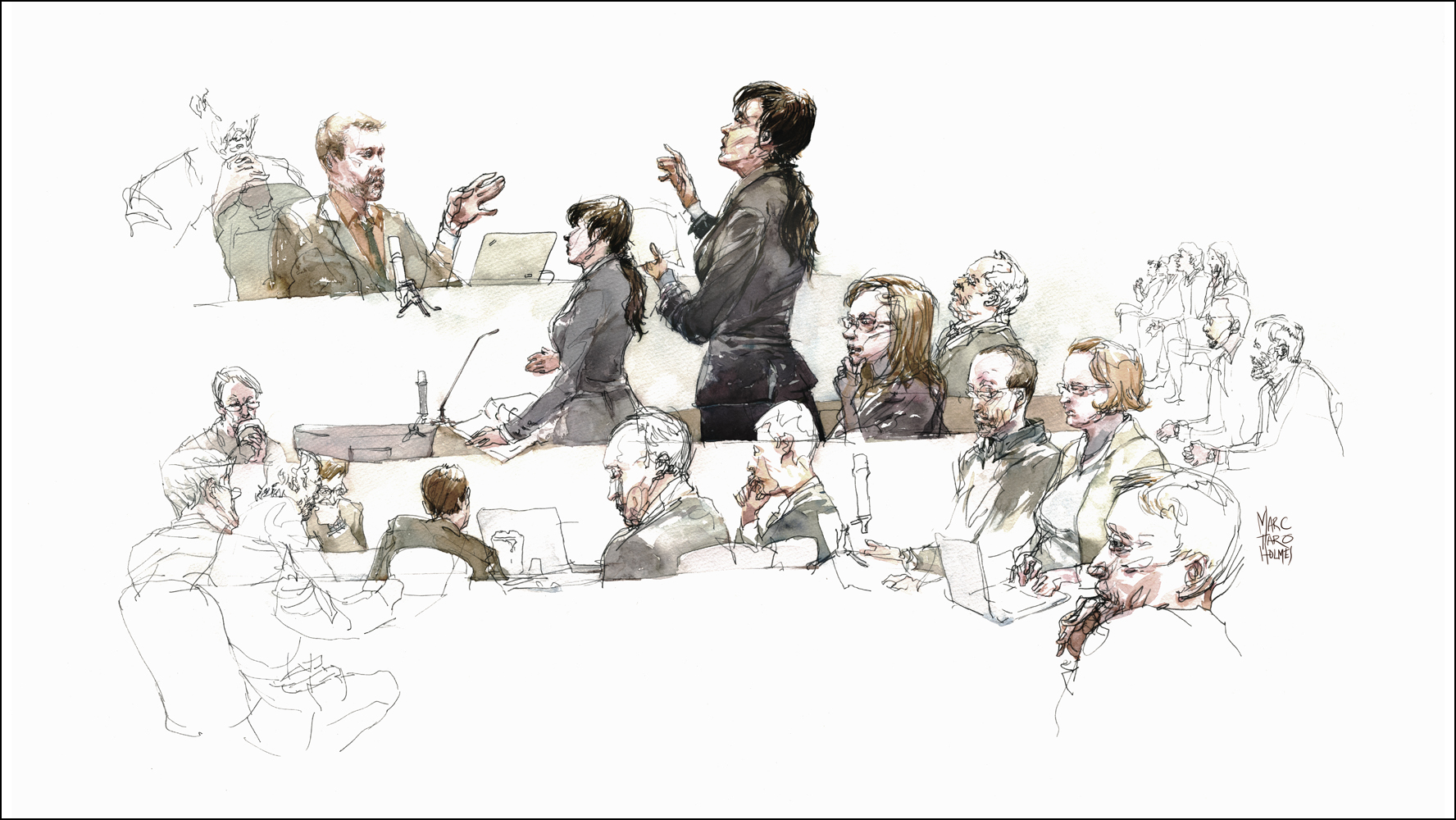
Suzanne Côté, recently appointed to the Supreme Court of Canada, (standing)
I believe this means that it is the justice’s opinion, that the warning labels on the packages are insufficient defense – probably they came too late after knowing about the credible threat. (I have not read the report in detail, but this would be my guess as to why complying with labeling was rejected as a defense).
I must also assume that the ‘everyone knows smoking kills’ argument did not absolve the industry. Considering their knowledge that people could not overcome their addictions, despite the warnings and jokes about ‘cancer sticks’ and ‘coffin nails’, it’s not sufficient to say ‘don’t do this thing that I know you can’t resist doing and that I am so seductively advertising to you’.
And then there is the ‘well, motorcycles kill, and we still sell motorcycles’ defense – which apparently also did not hold water. I would imagine the logic is that motorcycles have the potential to be used safely, given proper precautions – whereas there is no safe use for cigarettes.
So damn! We kind of all knew this, but it’s rather incredible to see it happen in court.
I’m excited to see what comes next. Does this mean then that the sale of cigarettes will be banned in Quebec? What will happen at the appeal? I will be watching with curiosity. I’m not sure I will have the opportunity to make any more drawings on the subject – but it was tremendous to be able to be there sketching on that historic occasion.
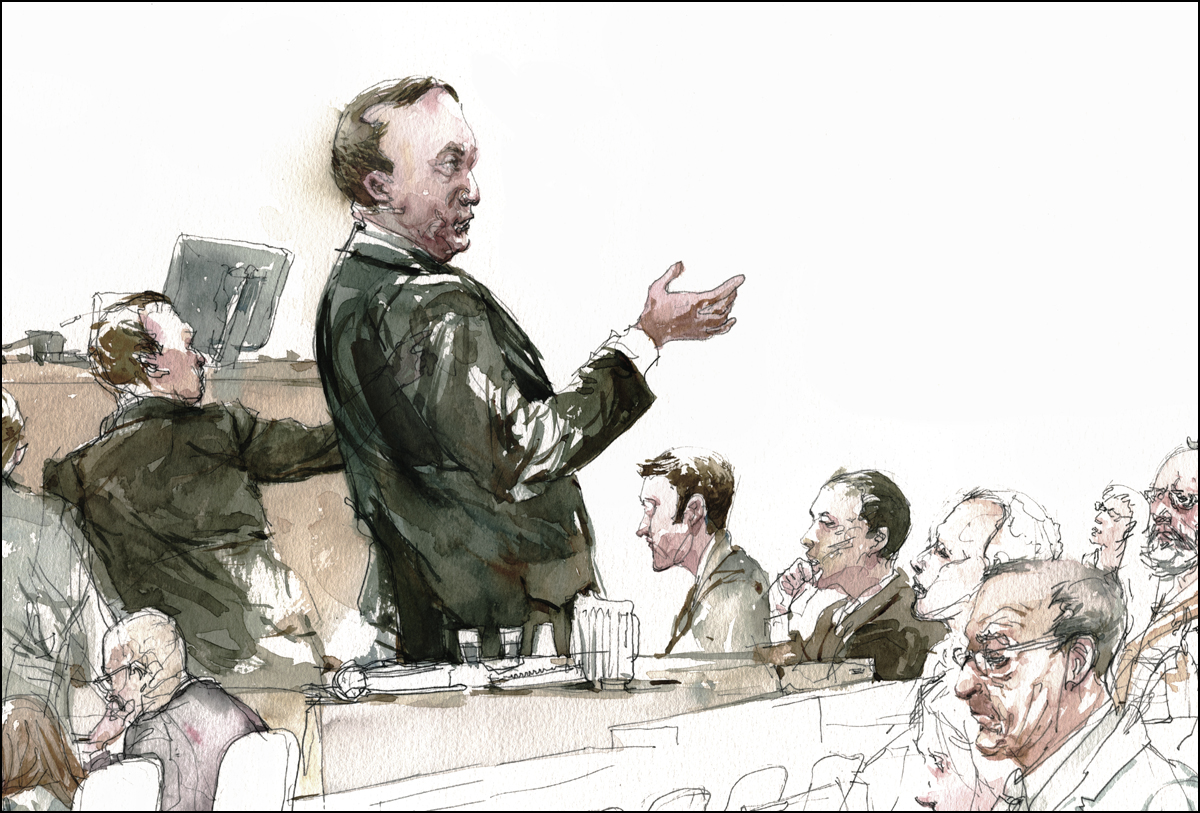
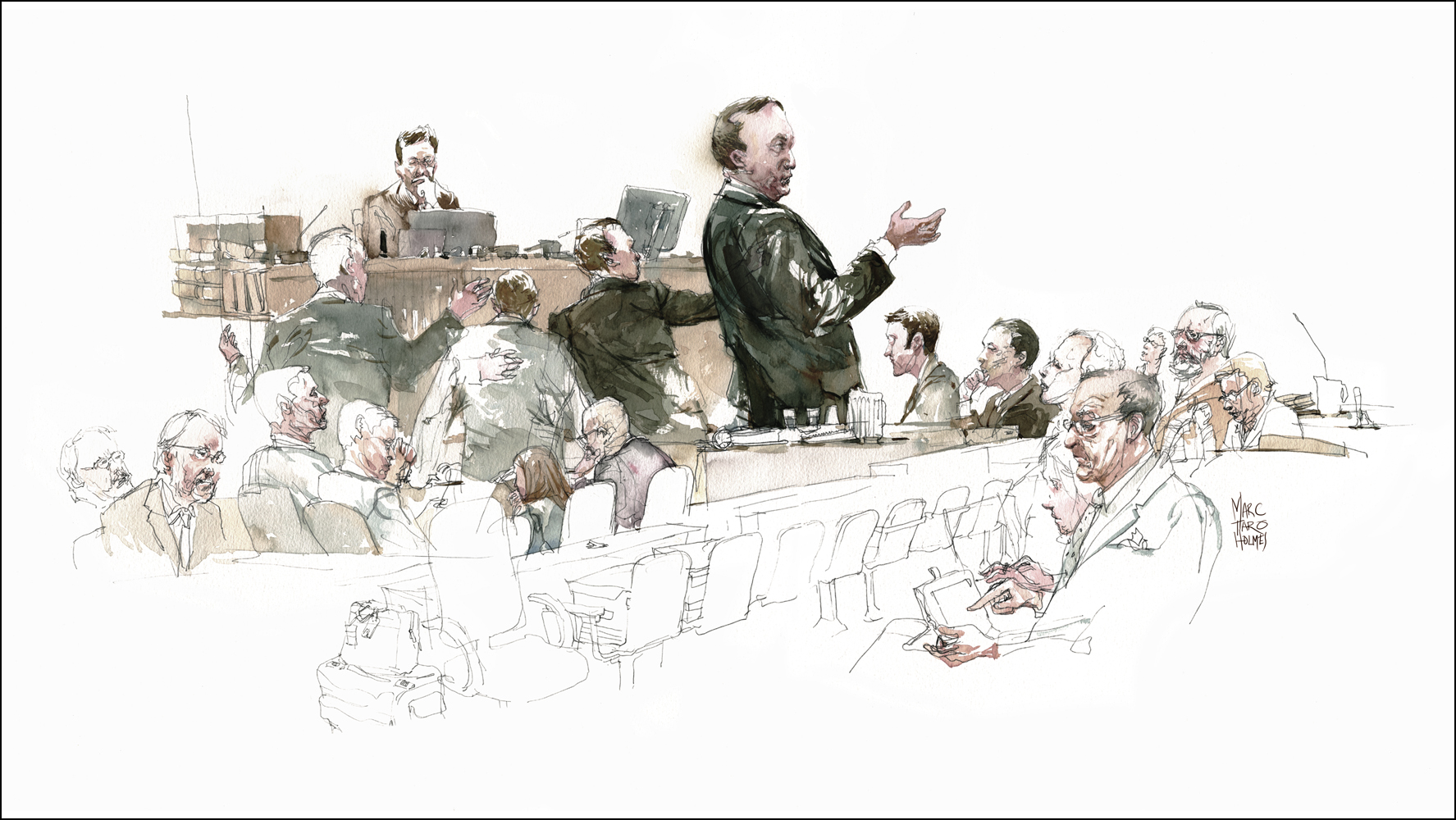
Simon Potter representing Rothmans Benson and Hedges

I have had a generous offer to be a guest artist at Galerie Farfelu in Westmount.
My friends Lydia and Marin are showing their gold and sliver jewellery, and have offered me the wall space in their show. We’ll be there Tuesday June 2 for the opening, or you can see the works in the window anytime between June 1-14.
If you remember these from awhile back – they are quite a departure from my usual watercolors. But in a way – they are an attempt to paint oils like a watercolorist :) In big areas of wet in wet!
If you get a chance to see them in person, you might enjoy the effect.


Spring in the Cemetery

At the time of writing, it’s been a very dry spring. It’s looking more like second fall around here. The Noodler’s Red Black and Rome Burning I’ve been using lately are really helping with that fall color feeling.
Here’s some sketches from the smaller of our neighborhood cemeteries: Notre-Dame-des-Neiges.
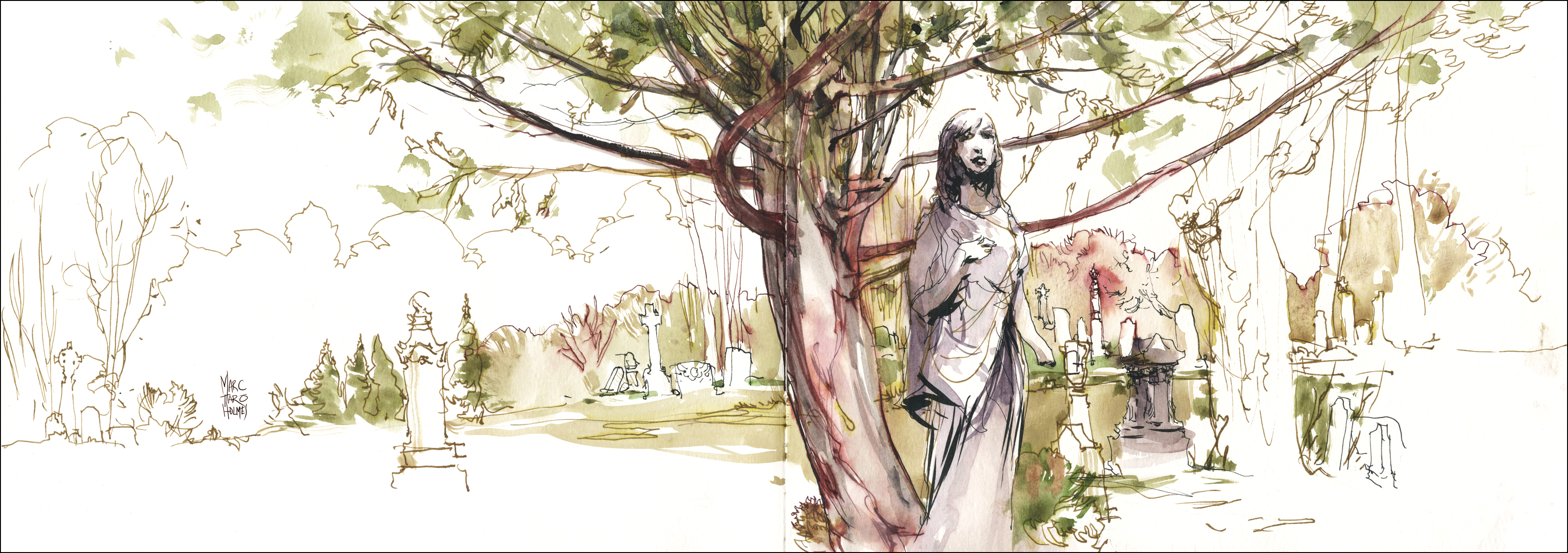
These are sketched in a Moleskine Folio Watercolor Album, (11.75 x 8.25″) – which is a beautiful book, with this very wide format. But it is frankly just a little bit too large for every day use. It takes up a lot of room in a bag, and I’d definitely consider a backing board and bulldog clips to hold it open when drawing. It wants to flop around, fall off my knees, or otherwise behave badly. I’m starting to think that a book bigger than you can easily hold in one hand calls for an easel for sketching. But if I was going to do that I’d just paint rather than sketch.
Still – it is a beautiful book, and will look very nice when filled :)
Philadelphia!
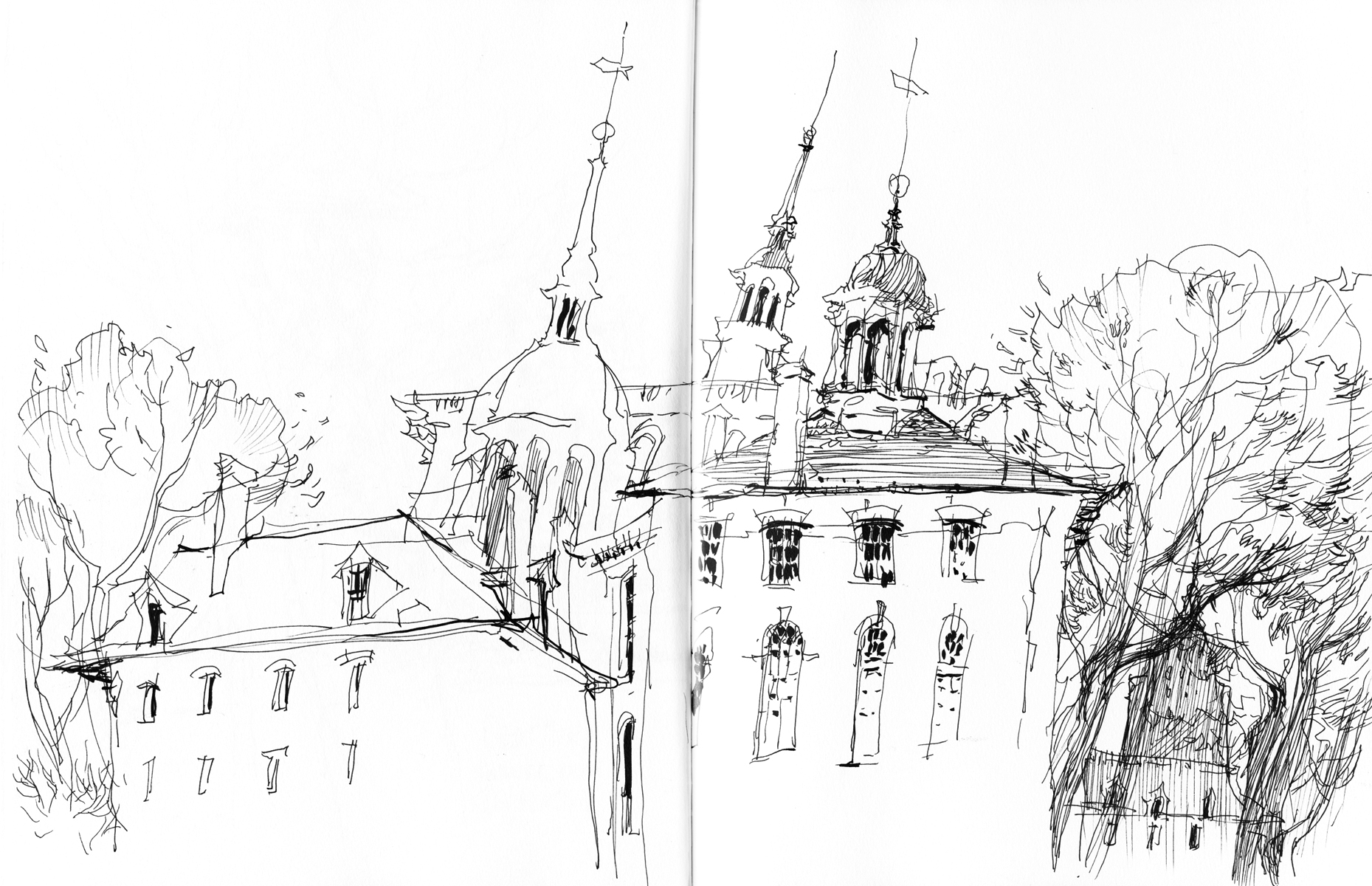
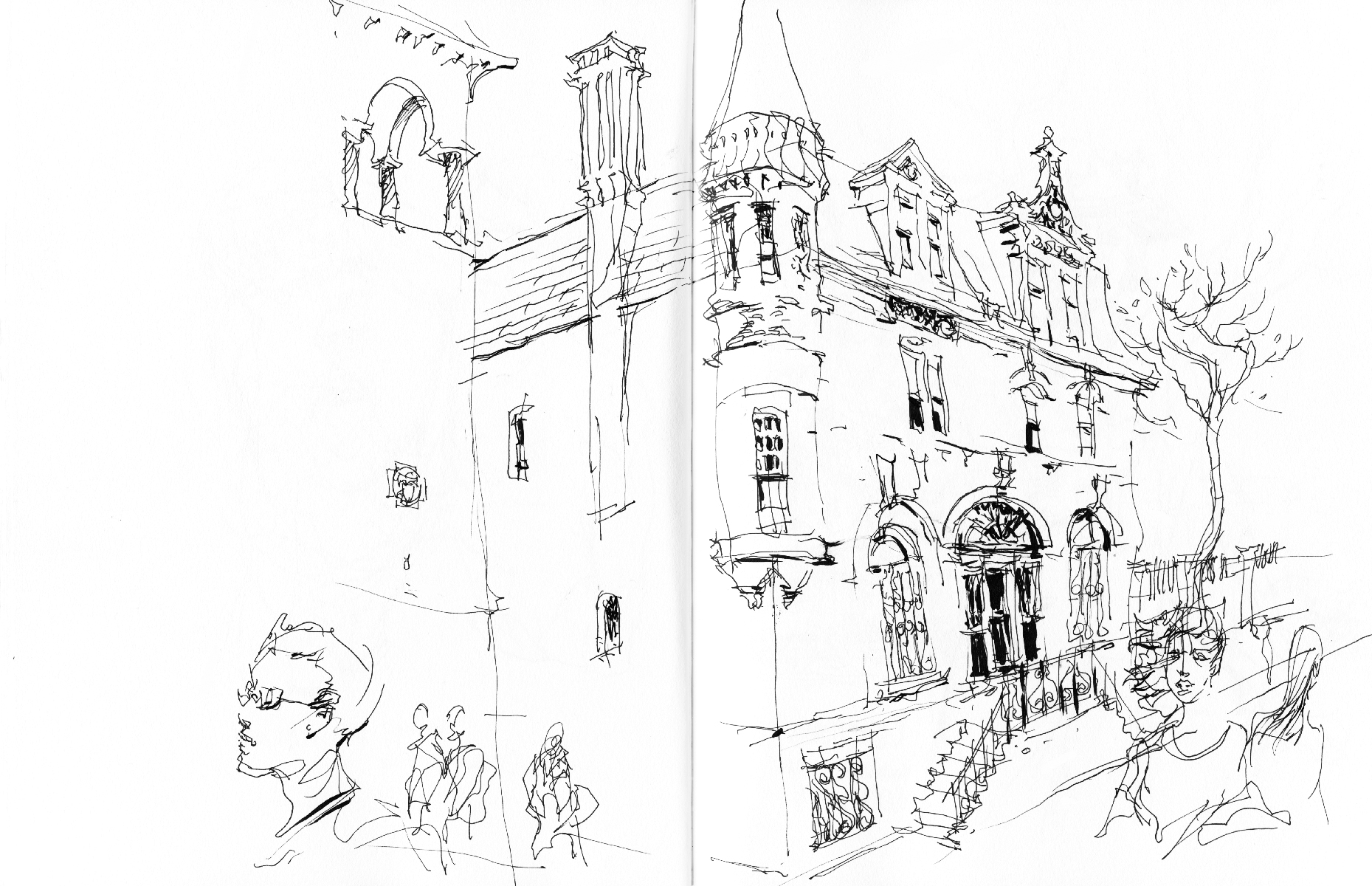
Just some doodles from a drive-through trip to Philly. I’m out of town right now, working on a secret sketching project I hope to be able to announce soon. Back in a couple of days! ~m
One Day : One Sketchbook : The Plateau Panoramas
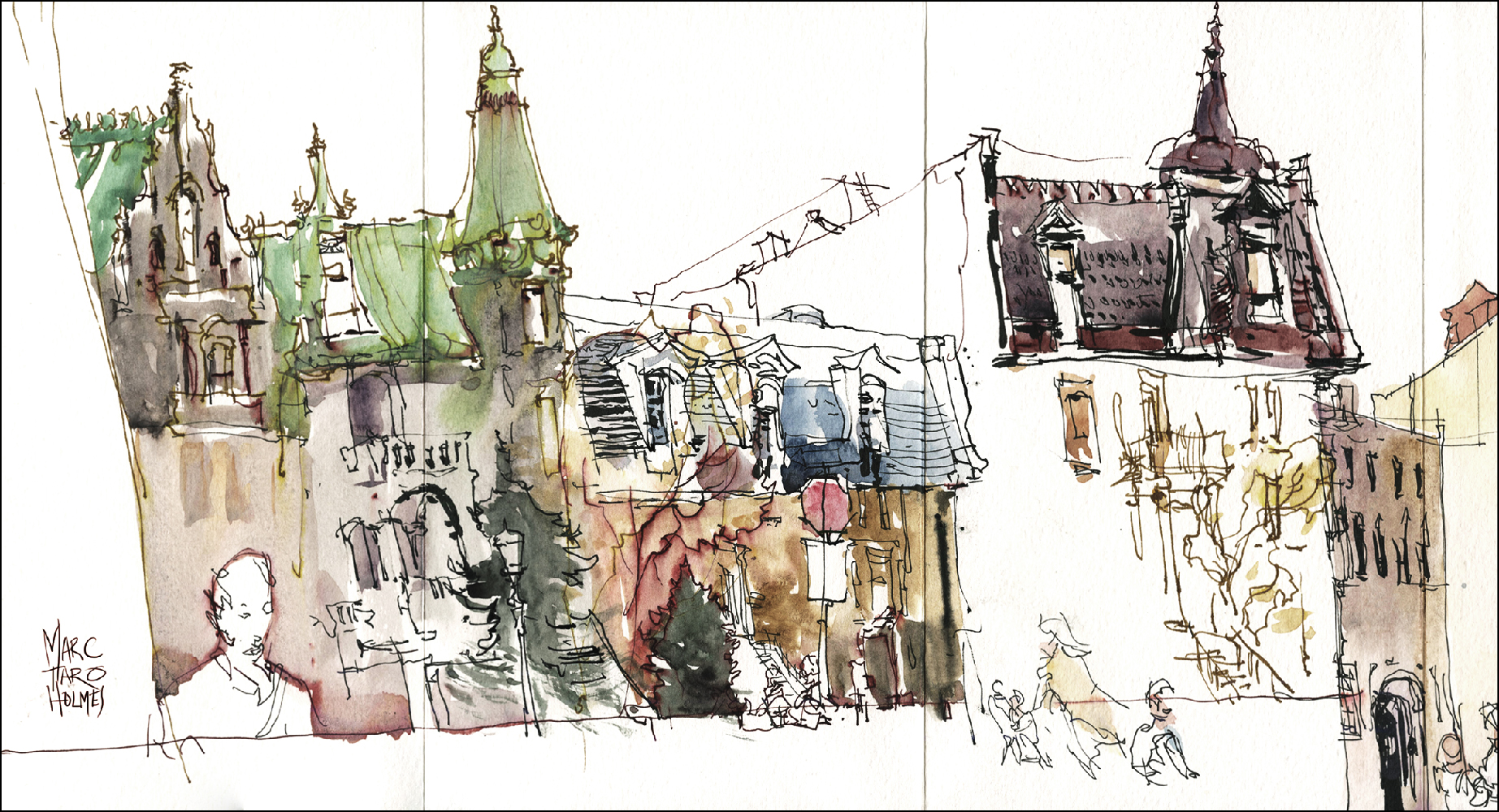
This past May Day was the first alignment of great weather and time off I’ve had in Montreal for 2015. I met up with a couple of friends from USK, and spent the afternoon sketching in the Plateau.
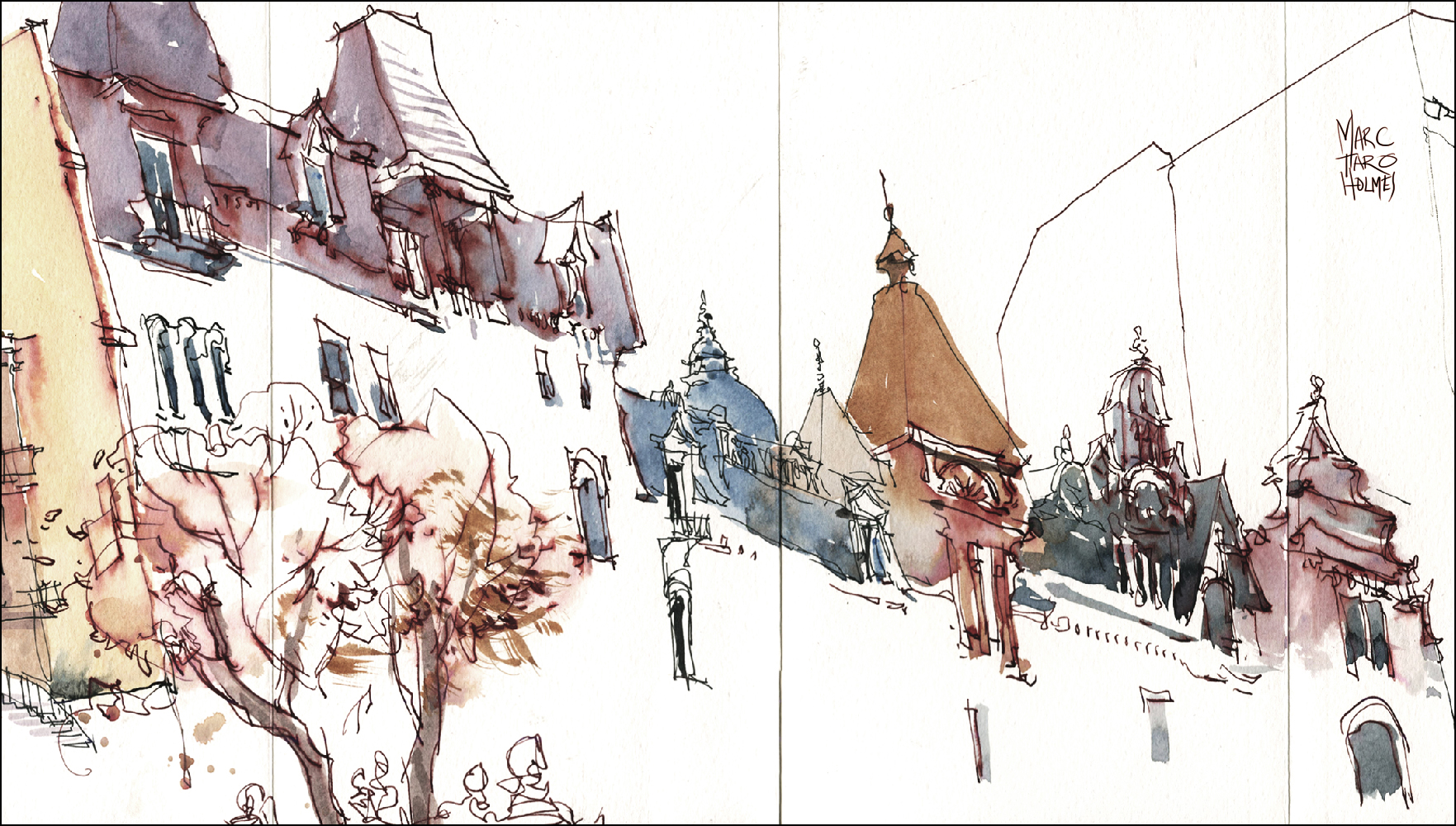
I was playing around with an accordion sketchbook – a 5×8.5″ format book with a single sheet of folded paper, forming a long ‘continuous’ ribbon of paper. (It’s not really a single piece. There are some glued seams in the paper – but you don’t really notice them). I got this specially made one at USK Barcelona – not sure where to really buy them in watercolor paper like this. There is a Mokeskine in this format – but I prefer a real water paper – sooooo – might have to make my own.
My goal was to try to make a really big panorama drawing, going the entire length of the book. I started my first sketch early and made it just over halfway before I had to relocate to meet the others.

This first drawing was done by moving down Sherbrooke and adding buildings as I moved west. I’m purposely not worrying about a ‘correct’ point of view. Each ‘block’ of buildings is in its own perspective and scale – but it adds up to a kind of floating view that zooms in on whatever interesting bits there are to see.
The second half of the book is drawn in Square Saint Louis. We were sitting in the middle of the park, so it was natural to stay in one place and wrap a 180 degree arc of view around the fountain centrepiece. Well, it’s meant to be in the center, but I sort of ran out of book. So half the arc is a little squished – but hey, this was just for fun so I’m not complaining.

The real goal for this day was to just be out in the sun, having fun drawing. No bothersome perspective, no measuring for accuracy, no particular care with color. Just using loopy Single Line Sketches and very vaguely thinking about Post and Rail Panoramas – but not in any disciplined way.
I was sort of challenging myself to see if I could make it to the end of the book – I like to have a little game, or goal post for each day. Turned out not to be that hard at all. There are only 11 spreads in this book (+ endpapers).
When you give yourself permission to use up a lot of paper, you can do it pretty fast. This was all done cover-to-cover in about 4 hours on location, with another hour-ish at home to touch up some color. There’s still the back side of the accordion to fill up someday – but I think this is fair enough for an afternoon’s fun and games :)


 Citizen Sketcher