Skip to content

Compostion: The Gradient of Interest

May 19, 2013

I’m starting to think about upcoming workshops – warming up for teaching this summer – so I wanted to refresh my memory on how I actually paint.

Whenever I’m trying to consciously think about painting, I take progress snapshots. Maybe some of you want to try this yourself? Just phone pics of the work is fine.  Shoot a snapshot whenever you take a break. It helps to go back later and see what you were thinking. Allows you to install the steps in your memory, so you’re just a little more likely to be organized the next time. And it can help you find the point when you over-work something.

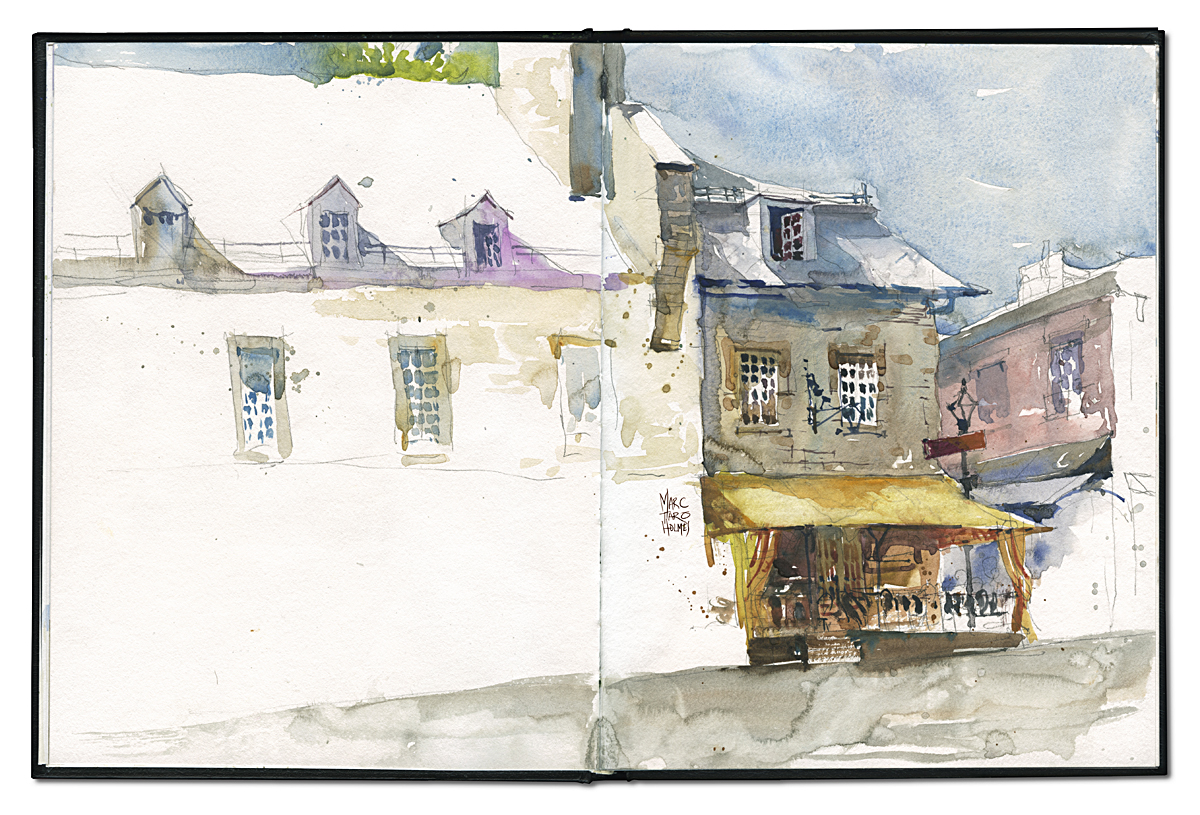
Looking back, I thought this page from the other week was a good example in a few ways.
13May07_OldMontreal_page02

Here’s what I was actually looking at.

13May07_process01

Kind of a good example what they mean by ‘simplification’ hey? They keep telling you to do that – simplify. But what does it really mean?  Creating Focus. Leaving out whatever is in the way of that single thing that drew your eye.

Clearly, I don’t want the truck in my sketch :)  that’s easy. But also I see immediately that the yellow awning and cafe below it is the interesting part of this view.  Not the people setting up their booth. Not the larger building, but the smaller one.

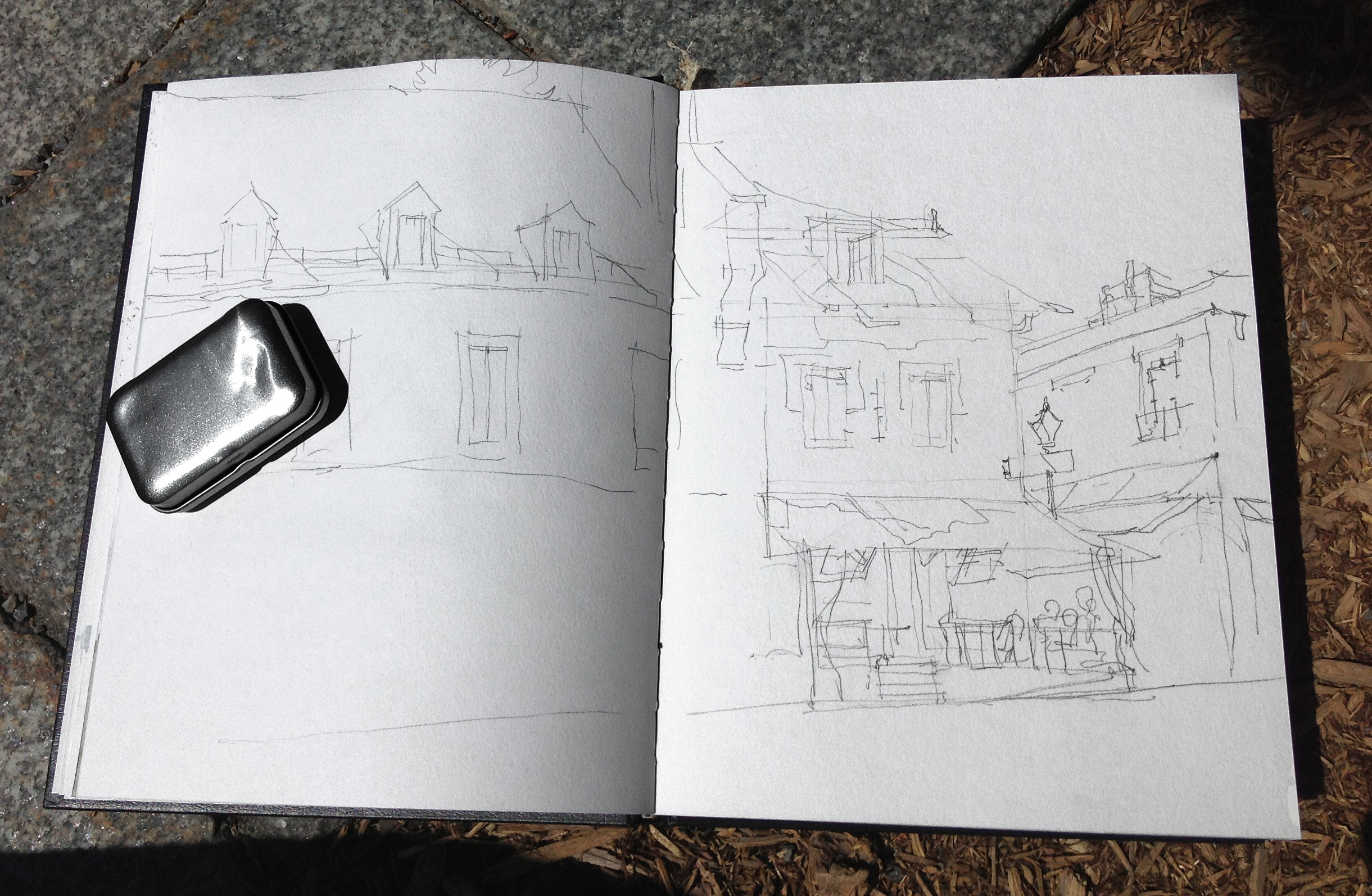
So even in the drawing, you can see the focus being created with composition.  Leaving out most of the blue building, but using it to be a big directional arrow pointing to the subject. Clustering all the detail – all the little active shapes – under the awning. Leaving out distractions – even tho’ I love lamp-posts and foreground trees! It was hard to force myself to leave that stuff out.
13May07_process02

I like to say to students – “spend half the time on the drawing and half on the paint”. People never want to do that. They want to get right to the color! But if you delay your gratification, you’ll be much happier. See how the shadow shapes in the roof-line are sketched in the drawing? The design is solved before I go to color. It’s great to be able to put aside the design thinking – so when you’re painting, you can just paint. The work is done, so you can play with the color.

So, this is the first pass – the wet-in-wet wash. This is what they mean, ‘work larger to smaller’. Only the big blocks of color. This also is when you let the watercolor mingle naturally.  This is why you’re not oil painting. Watercolor should be allowed to do it’s magic thing. Take advantage of the physics of water.

13May07_process03

Then finally, after an hour or more of delaying gratification – you get to draw the details! Maybe it’s just me – but it’s the detail that I love. I really want to just start noodling immediately with tiny tiny shapes. But if you do that, you’ll lose the ‘life’ – the freshness that make a sketch appealing.

These smaller shadows, and dark darks are when I start painting wet-on-dry –  so I can get a sharp edge when I want it. (Window panes!) And I’m using less water, more paint, so my shadows have solidity.

The eye loves three things – contrast, chroma (intense color) and detail. If they are not kept in the same place – the eye will wander – seeking information and entertainment. A tight composition keeps the darkest darks, the smallest details,  and the brightens colors in the same place.  The focal point.

See how each window gets progressively more interesting as you work left to right, then down to the bright awning, until suddenly you’re walking into a nice cafe! Looks like a great place for lunch :)

I like to call this the “Gradient of Interest”. All the elements working together to lead the eye.
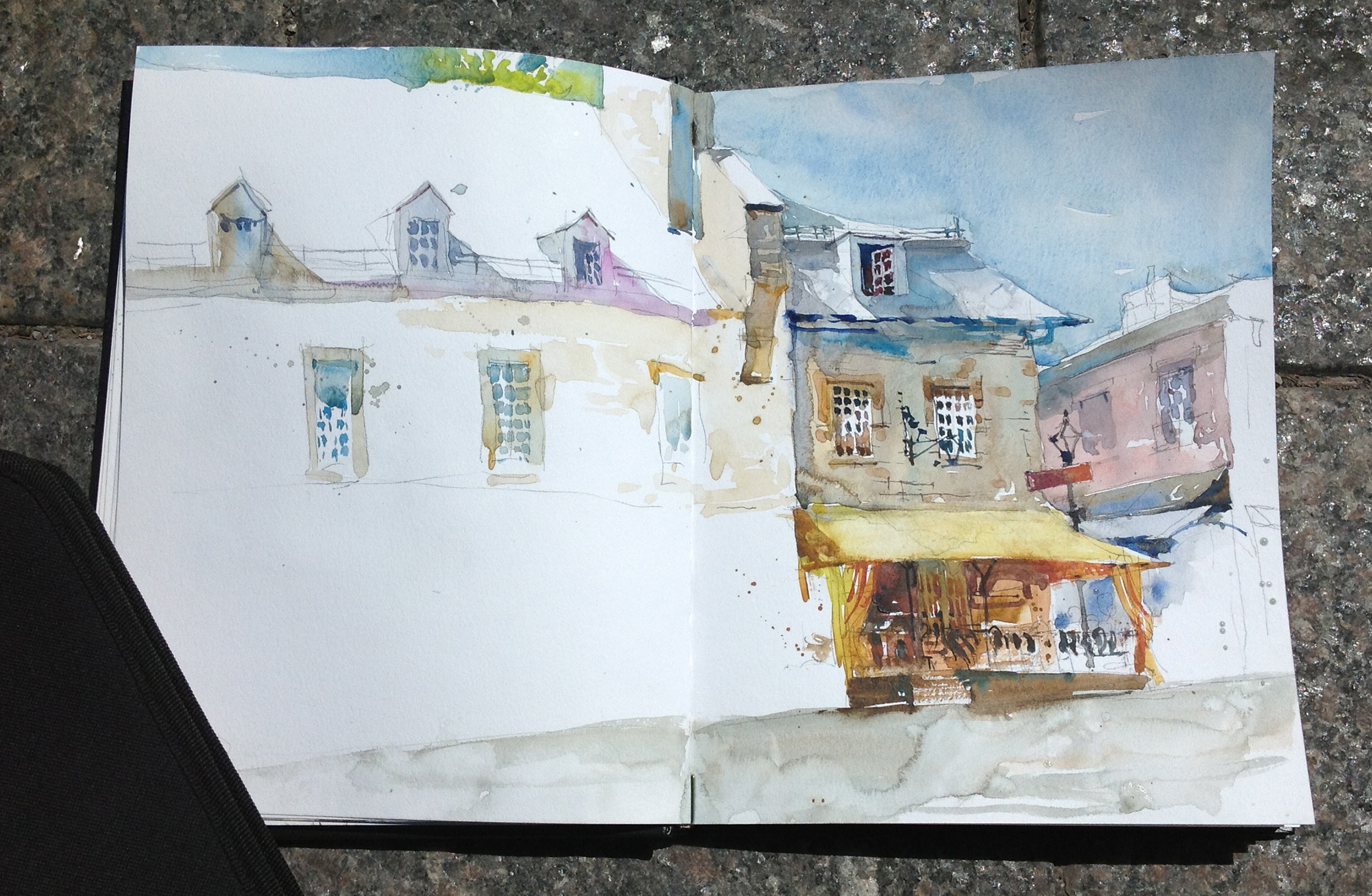
13May07_process04

Solo Sketchcrawl, Old Montreal

May 9, 2013

Just completed a big freelance project – drawing on the computer for seven straight weeks.  As a reward to myself, (and as a field test for my Sketching-in-Barcelona hot weather gear)  I took the entire day off to enjoy Tuesday’s 26 degrees. I can report – Sun Sleeves by Pearl Izumi really work. And I’m remembering how to paint in direct sunlight.

13May07_OldMontreal_page03

Its amazing how we went from watercolor-will-not-dry to watercolor-dries-instantly in only a week.  I’m not in any way complaining. It’s awesome that plein air season is here! These are all in and around the Old Port of Montreal. (Place d’Youville, Place des Armes, Place Jacques-Cartier). All places we might visit in our August workshop.

13May07_OldMontreal_page01

13May07_OldMontreal_page02


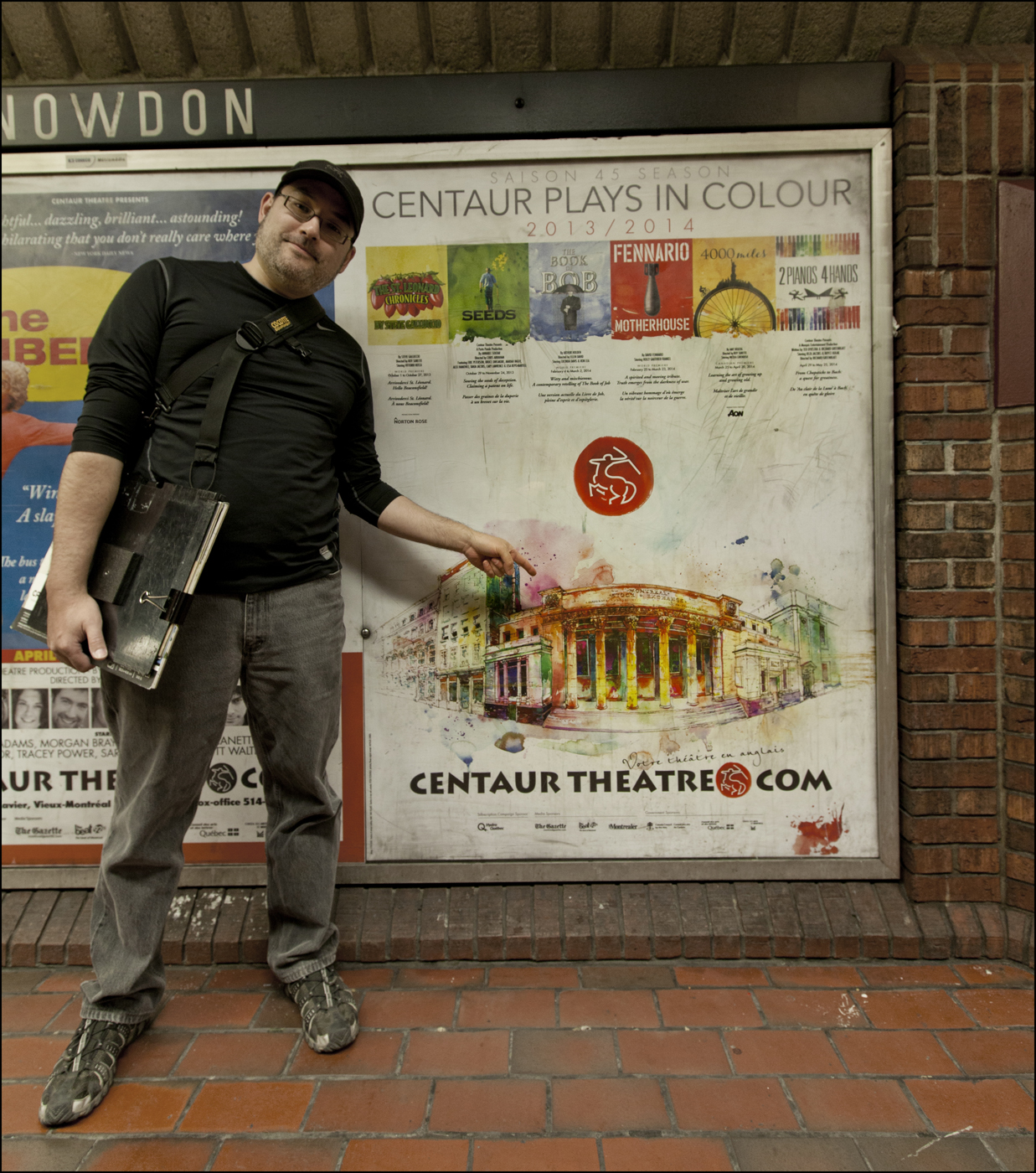
Oh hey! My painting in the Metro :)

April 28, 2013

12Apr28_ohhey

First painting day of spring

April 28, 2013

At last, at last! Winter finally shuffles off the stage. It’s been teasing us – gradually warming, but clouding over every time you think about drawing. I’ve been champing at the bit for weeks. Living in Canada is a serious disadvantage for plein air painters. We just don’t get enough days like this.

13Apr28_LachineSketchcrawl_01

13Apr28Lachine_working01

I’ve never been to the Lachine Canal – but you can trust urban sketching will eventually take you to every corner of your city. My first impression is, it’s basically the LA river, which is basically a drainage ditch. Maybe I’m being to hard on the old canal – perhaps it’s more scenic when the water is up and the trees leaf in.

One advantage of today’s low tide – you can see the urban fossils in the river bed. Bike skeletons stuck in the mud, encrusted with barnacles. I didn’t sketch those today – (L got some great shots tho – so perhaps some studio pieces will  happen). But this wasn’t that kind of day! Today is for color! Spring is here!

13Apr28_LachineSketchcrawl_02

Next month’s outing – May 26th – I think we’re going to go to the Tam Tams on the mountain near Parc and Mount Royal. That should be a great people sketching opportunity. If you’re in town, come join us.

13Apr28Lachine_chatting02

13Apr28Lachine_chatting01

August workshop sold out!

April 20, 2013

MontrealHorizontalbanner_SoldOut

SOLD OUT! – We are happy to announce the Montreal watercolor sketching workshop is now full. (Well, sorry for everyone who didn’t get in, but you know what I mean ~m) If you are interested in signing up for a waiting list please mail marc.taro(at)gmail.com and we will contact you in the event any current students have to cancel. We’ll make sure people on the waiting list get notified when we put on future workshops. (Plans are not set, but will be summer 2014, unless people in southern countries want to reach out to us for winter 2013).

Thanks! ~Marc and Shari

Interview with Richard Johnson, Graphics Editor National Post, Part 2 of 2

April 4, 2013

Part Two of a brief interview with Toronto sketcher Richard Johnson, graphics editor at the National Post

MTH: We resume our talk with Richard getting personal about his work as an military artist. If you missed Part One click back [here].

MTH: The Kandahar Journal is a bit…mmm…”extreme” as far as sketching trips go. A dramatic example of reportage. Can you talk a bit about why you created the project? It couldn’t have been your first try at field reporting, right? What made you think this was within your abilities? What brought you to the point where you presented the project to your employer?

Personally, by 2005 I found myself frustrated by the lack of news of the situation that our soldiers were facing. And I felt that the public had become immune to the violence in Afghanistan and that attention had been drawn away by the debacle of civilian death that was Iraq in 2007. But the Canadian mission in Afghanistan sent our young men and women home in aluminum coffins with such regularity that I wanted to know more and I thought that the use of art might work to get people’s attention. My employer at the time, which I won’t name – The Globe and Mail – would not support the idea. So I quit and took the idea to a newspaper that would – The National Post.

stinson940

[Sergeant Zack Stinson lost both of his legs and portions of both arms to an IED in Helmand Province, Afghanistan. Sketched at his bedside at a veterans hospital in Virginia, February, 2010]

MTH: Perhaps this is a similar question — but why such an risky project? Clearly you’re an accomplished artist, you could do anything with your art — be illustrator, designer, make a comfortable living right? — what brings you to take such extreme risks and hardships? It’s not an exaggeration to say you we’re in harm’s way on this venture? And I’m sure there were no 5 star hotels.

RJ: Not sure I can answer this very easily. It is not an easy choice, at any time. I have an excellent wife and a mess of children so I have lots at stake. But I care about soldiers. I guess that happened after Iraq when I saw what life was like for the very young men and women that we send into harms way, both on the front lines and when they come home. And I found myself with a skill that seemed to be able to  connect readers to a subject in a very different way. In the end it was just the right thing to do. But it is no doubt a very dangerous addiction.

MTH: An “inside journalism” question : Photojournalists are very concerned about image manipulation — specifically, that even the slightest amount of Photoshop — color correction , basic editing — simple changes for clarity — in fact invalidates an image for use in reporting. Famously, winners of annual photo journalist contests have had their prizes revoked, after it was discovered they did something as basic as removing a shadow. As I understand it, the issue is, that the photographer must be able to defend the photo as being absolutely truthful in every way.

So clearly, it’s impossible to make a drawing without personal bias, or with 100% accuracy. By its very nature a drawing is an artist’s interpretation of a situation, encapsulating their feelings about the subject.

So — in light of that — please discuss! Any thoughts on that issue?

RJ: I don’t pretend to compete with photographers. There are no shortage of brilliant photo journalists out there who believed like I did that people should know more. But with all respect to photojournalists, I think that the art connects with readers in a completely different way. Not a better way. But when you look at a portrait of a soldier that I have sketched you are looking at a period in time that we have shared one another’s company and gotten to know one another. In general I will already have a relationship of some kind. Because soldiers are a tough nut to crack. So usually I will have been on patrol or gotten to know them a little before I ever get to the point of sitting them down to a portrait. So I think it is that connection between the sketcher and the subject – through the pencil and paper which translates to such a strong response from the viewer, or in my case newspaper reader. One of the things Brodie told me was to “draw without opinion”. He believed that simply drawing for accuracy was enough, and that by reaching for accuracy and ignoring opinion what came through was the essence of the subject. I have attempted to follow that guidance.

Cpt.RyanSheppard.jpg

[Captain Ryan Sheppard poses for me in his lookout tent on the side of Ma’Sum Ghar near Bazzar-e-Panjwaii, Kandahar Province, Afghanistan, July, 2007]

MTH: Ok — enough of the heavy stuff! Can you just show us a few of your favorite drawings and discus why they were your best work from the project? Do any of them stand out?

P-Shafiquiah Khan.jpg

[Captain Shafiquiah Khan at ANA Base in Bazaar-e-Panjwaii, Kandahar Province, Afghanistan, July 2007]

RJ: This is one of a couple of portraits that I did of Afghan Army Officers. They were very intimidating to do, partly because these are some proud men, but mostly because I sketched them in an open courtyard area. Which would have been fine, but the whole time I sketched, I was surrounded by a dozen Afghan soldiers standing mere inches from my back watching every touch of the pencil on the paper. I don’t own either of these sketches as I gave them to the Afghan’s as a kind of goodwill gesture I guess. All I have are the photos I took of the work immediately after I sketched them. I had him write his name in Afghan script before I took the photo.

Cpl_William.jpg

[Caption – Corporal Jonathon Williams stands waiting as bodies are placed in body bags]

RJ: This was on another Quick Response Force operation. The QRF stood ready to deploy to aid the local police when they were attacked. These missions would happen daily. When we arrived at the police checkpoint, which had once been a school, all that was left to do was put the bodies in body bags and transport the wounded out. This and I think the image of Cpl Sypher behind the tank are examples of me working from photographs within hours of me experiencing it. I think that you can even see the sweat smudges on these pieces. I like this one because Williams hated journalists. I drew him anyway.

ANP Post-op.jpg

[Afghan National Policeman in recovery after team operation to remove shrapnel from his body. He doesn’t know it yet but he is the only survivor out of a half dozen police who were in a Ford Ranger when it struck an IED.]

RJ: This was drawn from a photograph within an hour of taking it. I followed the wounded policeman through the entire surgical process. This is the scene right at the end when for a moment it is just me and him in the room. I had never been in during a medical surgery anywhere, never mind one where the surgeons had to physically dig out foreign objects by the dozens. It was brutal and bloody and not as clinical and exact as I would have thought. But at the end the slab of meat was still breathing. When I wrote this story in the wee hours of the morning I realized I was shaking.

MTH: So, of course, you are an accomplished sketch artists. Is that full focus of your artistic practice? Do you have any plans to do studio work? I’m not aware if you paint, but I guess I’m asking if you have any plans to further develop the sketches that you bring home from the field. “Improving” them into what I’ll call, “finished paintings”? ( Edit: Of course, I drafted all these questions in advance of mailing Richard, but now that I’m reading the answers, this one was a pretty silly question. It implies that something more needs to be done with the sketches – clearly, these works stand on their own, recording events of significance. I stand corrected by his answer! ~m)

RJ: This may be a little awkward for your fellow Urban Sketchers to hear, but I don’t consider myself an artist in any way shape or form. I just draw. And once out of the field and back in the world I don’t continue to work on the material. The work goes in my art file in the basement under the laundry and that is that. I don’t have any hidden need to let out my inner angst on a canvas. Perhaps because I am too shallow, but mostly I think because by the time I get home the sketches have served their purpose. They are a means to an end, nothing more. Plus, life is busy.

Much of the Iraq work is now in the hands of the USMC museum in Quantico, Virginia, and much of my Afghan work from 2007 and 2011 is now held by the Smithsonian Museum of Armed Forces History in Washington, D.C. And I am involved with an exhibition of sketches and paintings of wounded servicemen called the Joe Bonham Project. It is currently touring the U.S. attempting to raise money and awareness.

Although I have no ‘artistic’ practice I am a bit of an art hooker. I will do anything for money. My day job at the National Post keeps me creating illustrations for all sections of the newspaper and I am a prodigious creator of information graphics as well. All of that keeps the bills paid and the kids fed.

MTH: Is there a book, or some sort of app/e-book  coming out based on the Kandahar Journal? (or any of your other work?)

RJ: There is a book of the Iraq work. It is called ‘Portraits of War’. It might still be available on Amazon somewhere. I can’t seem to find a publisher interested in another book about Afghanistan. I understand from them that the market is saturated with Afghan and Iraq memoirs right now. But I do have background plans for an e-book of the Afghan work. Sometime.

MTH: For fans of location drawing, what are your future reportage projects we could follow? What is next?

The journalistic world has changed a lot in the last decade since I first started this visual reportage. It is no longer enough to come up with a good idea and volunteer your services. And we are far from the time when the work came looking for you. In order to make a field reportage mission happen now I need to find a way to make it impossible for my employer to refuse, I do this by a combination of subterfuge, blackmail, minimization of costs (read working for free or paying for some things myself), by being a photographer, and being videographer, and being a blogger, and being a reporter and being an artist, and a damned tweeter. And then the material had better be usable across multiple platforms, instantaneously if possible. Yup, and it would help if you can post it to the web yourself as well, from anywhere. There are no longer any pigeonholes in journalism. You had better be able to do it all if you want to stay employed. So my next mission may take some time.

I started getting the itch to be on the move again some time in the last couple of months. I think that my DRAWN T.O. sketch blog is really just a way of stopping me from going nuts while I deviously build towards the next project. I would like to get back involved with some relief work in Africa similar to the stuff I did with the United Nations in 2009.

Here’s a link to a great ‘what’s in your sketching-kit?’ illustration Richard created in the final days before his trip last year: INFORMATION GRAPHIC – WHAT AN ARTIST TAKES TO WAR

MTH: What do you think of the Urban Sketching movement? (If you’ve even thought much about it :) Niche Group Question!) From what you’ve seen, and with your experience as one of the few professional reportage artists – are we on the right track with what’s happening in USk.org and the wider community of USk workshops, Regional Blogs and Flickr Groups?

RJ: I think that the Urban Sketching movement is phenomenal. It is such a supportive community. I wish that I had found it earlier. I love the feedback and interaction, and I thoroughly enjoy the rich mixture of skills that are available. And I never fail to be stunned by something every time I check out the blog or flickr feed. And I am impressed that so may people have seen the truth, the truth that artistic skill is not always necessary in order to capture the essence and the atmosphere. What is really important is seeing it and experiencing it. In many ways that first person intimacy can at times leapfrog whatever limitations your artistic skills may have. That it is possible to make that connection with the viewer, to put them where you are, regardless of your abilities. So I think that you are on the cusp of something huge, and that if you can find a way to harness all of us amateurs and have us look at key issues around the world, we might well change it. Think of Urban Sketchers at the seal cull in Canada, sketching the Israeli separation barrier,  in a Syrian refugee camp in Turkey, or in downtown Detroit. I actually believe that Urban sketchers could help the rest of the world see more clearly. How is that for a crackpot idea?

MTH: There is no question 13 – Anything you would like to add, answers to questions I didn’t think to ask?

RJ: Nope but I may have posed more questions than I have answered. If anyone in the USk community wants to know more this is my email address. rjohnson@nationalpost.com

MTH: Thanks Richard for your thoughtful, fascinating responses. I’m sure a lot of us will be following your work. Can’t thank you enough. Take care out there! Sketch Carefully!

If you want to start at the beginning of the deep archive of his military artwork – head over here: http://afghanistan.nationalpost.com/. Or you can find out more background at http://newsillustrator.com/, or follow on twitter @newsillustrator

Interview with Richard Johnson, Graphics Editor National Post, Part 1 of 2

April 3, 2013

Part one of a brief interview with Toronto sketcher Richard Johnson, graphics editor at the National Post

Richard does a variety of work for the Post, and on his own blogs —  but the work that really captured my attention is his sketching project The Kandahar Journal.  A long running visual diary of Richard’s three tours as an embedded sketcher with ISAF forces. After a short stalk on Flickr, Richard generously agreed to answer a few questions by email.

Nizan Valley ANA patrol

[Afghan National Army soldiers of the 6th Kandak walk from camp down into Mizan Valley on an early morning patrol, September 2012]

MTH: Hello Richard!  Can you start off with a brief bio — Just a little introduction — tell us what was your background in art, your training — and what brings you to be an artist who is involved in reportage through drawing?

RJ: I attended Duncan of Jordantsone College of Art in Dundee, Scotland, I was there mostly for the girls, but I picked up some drawing skills as well over the four years. My visual reportage career started almost exactly ten years ago when I worked as a Graphic Artist for the Detroit Free Press. My dislike of my immediate boss drove me to consider any option to get out of the office, so I volunteered to embed as an artist with the U.S. forces that would shortly be invading Iraq – in search of weapons of mass destruction. I really didn’t like my boss obviously. Much to my surprise, and his, my proposal was accepted and three months later I found myself along with a squad of U.S. marines crossing the border into Iraq on the first day of the invasion. I was the terrified looking guy with the sketchpad.

A few of weeks before I left for the Middle East I was fortunate enough to be able to spend a couple of days with Howard Brodie. Brodie had been a Combat Artist who had a career that stretched over six decades of sketching in some of the shittiest places in the world. I’d recommend that anyone interested hunt down his work. For me though he was like a god. He was in France during the Battle of the Bulge in WW2, went ashore with the USMC at Guadalcanal, was in Korea in the 50’s and was in Vietnam in the 60’s and 70’s. Brodie never carried a weapon and was eventually awarded the Bronze Star for valor. When not in the field he was to be found courtroom sketching. Charles Manson, Jack Ruby, the Chicago Seven he sketched them all. At the height of his skills while working for the San Francisco Chronicle he would illustrate Superbowl games from the sidelines. Try that I dare you. He died last year after suffering the repercussions of a stroke which he had while sketching USMC trainees in the Mojave Desert at 85-years-old. They simply do not make them like him any more. For me it was a bit like visiting God.

Mostly what I gained from my short time with Brodie was a reaffirmation of my belief that drawings have power. Looking at his work it is impossible not to be emotionally moved by his rendering of the subjects. Before I left I spent two hours drawing him while he glared at me for my temerity. One of the most intimidating sketches I have ever done.

Brodie.jpg

[Howard Brodie glares at Rich Johnson, San Luis Obispo, California, February 2003]

Brodie Image.jpg

[Sketch by Howard Brodie: Sgt. Joe Eaz somewhere in Germany. Sgt. Eaz confided to Brodie that he could never kill a man and that he instead always shot over the heads of enemy soldiers.]

A month later I stood in the Kuwaiti desert, the night before the invasion, shit scared watching Iraqi SCUD missiles pass overhead. Like Brodie the only weapon I carried with me were the prismacolors that he had recommended. I have never used anything else.

USMC - Cpl.RobertMartin

MTH: If you don’t mind starting with a very Urban Sketchy question – in the USk community, one of the core tenants is that we draw on location. There’s an undertone that we draw ‘entirely’ on location – though in fact there’s lots of reasons to do some touch up at home, or add some color after the fact. Things like the weather, or a truck parking right in your face can force you to finish a drawing in the pub.

But still – we strive to “draw on location, capturing what we see from direct observation”.  Can you say, to what degree your drawings are ‘entirely’ on location – and if that in fact seems important to you?

RJ: All of my work is done and created in the field. I have a set of rules in my head that I attempt to stick to. My first and foremost rule is to draw live and I do this in some of the most outrageous situations. Inside an armoured vehicle, in the back of a helicopter, laying in a ditch or on guard duty in the dark. But I don’t have the same fixation on ‘live’ as your USk group does. I mean I do, but for me the most important thing is the absorption of atmosphere that comes from spending time with my subjects. In my case, soldiers and their lives. And I have to live it in order to draw it. So when there are times that I can’t possibly sketch – walking behind a tank on a rescue mission; accompanying house-to-house searches looking for weapons; moving on foot patrols in the pitch dark; or on major operations – I take photographs and work from the photographs. But my second rule is that I work on this art as quickly as possible. Chiefly this is because I want to create the art when it is all fresh and new. So in my mind I have a 24-hour window. But mostly this is dictated anyway by the news cycle back in Canada. My work needs to get in the National Post newspaper, or up online, so my speed is driven by that deadline on the other side of the world. Even my sketches from photographs have that look of live sketching because they have to be immediately hurried.

Also, I’d say that ‘working from photographs’ back in the world seems very luxurious, but the realities of fieldwork might have me working through the night inside a humvee cab with my laptop hooked up through an inverter directly to the vehicle batteries. Then most likely you’ll find me filing my story and art at three in the morning via my portable satellite dish, usually while squatting in the dirt, with a red light on my head, cursing my editor as he asks me dozens of inane questions. There is never any doubt in my mind that I am ‘entirely’ on location.

Nothing I have posted on flickr was drawn from a photograph.

Cpl. Sypher Tank Walk.jpg

[Corporal Jason Sypher scans the walls with his M-240 as he walks behind a Canadian C2 Leopard tank during a Quick Response Force rescue operation, Arghandab Valley, Kandahar Province, Afghanistan, July, 2007]

MTH: Why drawing? In this world where we have relatively inexpensive, high fidelity, mostly portable camera gear — in your opinion, what makes creating hand drawn lines worthwhile? What is it the makes you invest further time and effort beyond the technological, mechanically captured image?

RJ: After my six weeks as an artist with the USMC in Iraq I was struck by the massive public response to the work. It made me realise that there was power enough in the drawings to make people respond viscerally to what they were seeing. I received dozens and dozens of hand written letters thanking me for the work. I think that was the point when I realised that the art had the power to turn heads and change minds, or in broadsheet language – the sketches had the ability to stop people in their journey through the paper and make them read and potentially care about subjects they had become immune to reading or caring about.

Barringer.jpg

[USMC Sergeant Jason Barringer sits on a riverbank waiting for US Navy divers to find the bodies of two of his men who died while attempting to secure the opposite side of the canal, An Numinayah, Iraq, March 2003]

MTH: I found your work via one of your Flickr posts. The first thing of yours I found was the Kandahar Diaries project at the NationalPost.com. Can you give us the capsule summary of the project — where did you go, how long in the field, how many sketches, etc?

RJ: The Canadian area of operations included a pair of dusty river valleys that come together south of Kandahar City in Kandahar Province. The area between where these two seasonal rivers intersected was called the Horn of Panjwaii. South of the Horn was the Rigestan (Red) desert. The desert below and the villages and waterways inside the horn were a main thoroughfare for Taliban fighter and weaponry coming in from Pakistan. The Canadian task was to interdict these shipments, lure the Taliban into a fight, and then use superior force of arms to kill them. This was the Canadian mission for close to five years. My Kandahar Journal mission mandate was to capture the faces and daily lives of Canadian forces who were engaged in fighting the Taliban in Southern Afghanistan.

I went on three separate missions to Afghanistan writing for the Kandahar Journal. On each trip I was out between six-to-eight weeks. I went wherever the soldiers went.

Sgt.YannickPiche.jpg

[Sergeant Yannick Pichet probing with his trench knife for a suspected IED during a foot patrol through the villages around Combat Outpost Najet, Kandahar Province, Afghanistan, 2011]

End of Part one: Come back tomorrow for the second half of our interview with National Post field sketcher Richard Johnson.

If you want to start at the beginning of the deep archive of his military artwork – head over here: http://afghanistan.nationalpost.com/. Or you can find out more background at http://newsillustrator.com/, or follow on twitter @newsillustrator

Workshop Announcement – Naples Italy May 30 – June 2

March 29, 2013

An urban sketching workshop
with Simo Capecchi, Lapin, Caroline Peyron and Laura Scarpa

May 30 – June 2, 2013

This second edition will offer a deep immersion in the city of Naples to all the sketchers that have always dreamed to visit South of Italy. Locations will be selected among private houses and gardens that normally are not open to the public where we will meet local activists and artists that have a story to be recounted. Participants will be guided to discover Naples by different approaches to urban sketching. Field sessions will be leaded in turn by Simo Capecchi, an architects that likes to paint; Laura Scarpa, a comic artist that has always kept a graphic diary;  Caroline Peyron, an art teacher and artist;  Lapin, a french illustrator and indefatigable urban sketcher.
Goal of these Neapolitan days is to experience that, while we draw from real, we should go beyond a simple aestethical or naturalistic result. Psychological and social investigation, but also personal sensibility and imagination can enrich location drawings that depict, reflect and elaborate reality. We observe to understand and to create.
Watch this past edition slideshow.

workshops / instructors
Urban perspectives with Simonetta Capecchi
Vintage cars and dinosaurs with Lapin
Ligh and shadows with Caroline Peyron
Tell the story with Laura Scarpa

TO REGISTER, OR FIND OUT MORE: check the USK Workshops blog (HERE)

USK:MTL Dim Sum Sketchcrawl

March 24, 2013


Met with the Montreal Urban Sketchers for Dim Sum (and sketching), followed by some drawing in Chinatown. It is *almost* warm enough to draw outside in Montreal. I have high hopes for next month’s sketchcrawl.

13marc24_Sketchcrawl_Chinatown01

13marc24_Sketchcrawl_Chinatown02

13marc24_Sketchcrawl_Chinatown03

Sketches are in the moleskine, pencil noodles, color in pelikan gouache (pans), and a little ballpoint pen accent. About 15 minute drawings outside then colored over a bubble tea and bbq pork buns.


DimSumLunch

Summer Workshop: Watercolor Sketching in Historic Montreal

March 16, 2013

BlogBanner

I am happy to announce our Urban Sketchers Workshop: Watercolor Sketching in Historic Montreal. This summer, August 2-4, 2013, Shari Blaukopf and I will take up to 30 artists on a tour of some of Montreal’s best sketching spots. We’ll each be doing two ‘paint-along-with-us’ demo paintings, Friday and Saturday, and an afternoon of mentored group sketching on Sunday. I hope you’ll be able to join us!

Check out the details (and how to register!) on the Urban Sketchers workshop page HERE. A percentage of funds raised will go to supporting urbansketchers.org and the USK Symposium (this year in Barcelona – where we will also be demoing 4 times in two days!)

You can head over HERE for an after-action report from last year’s workshop in Portland.