
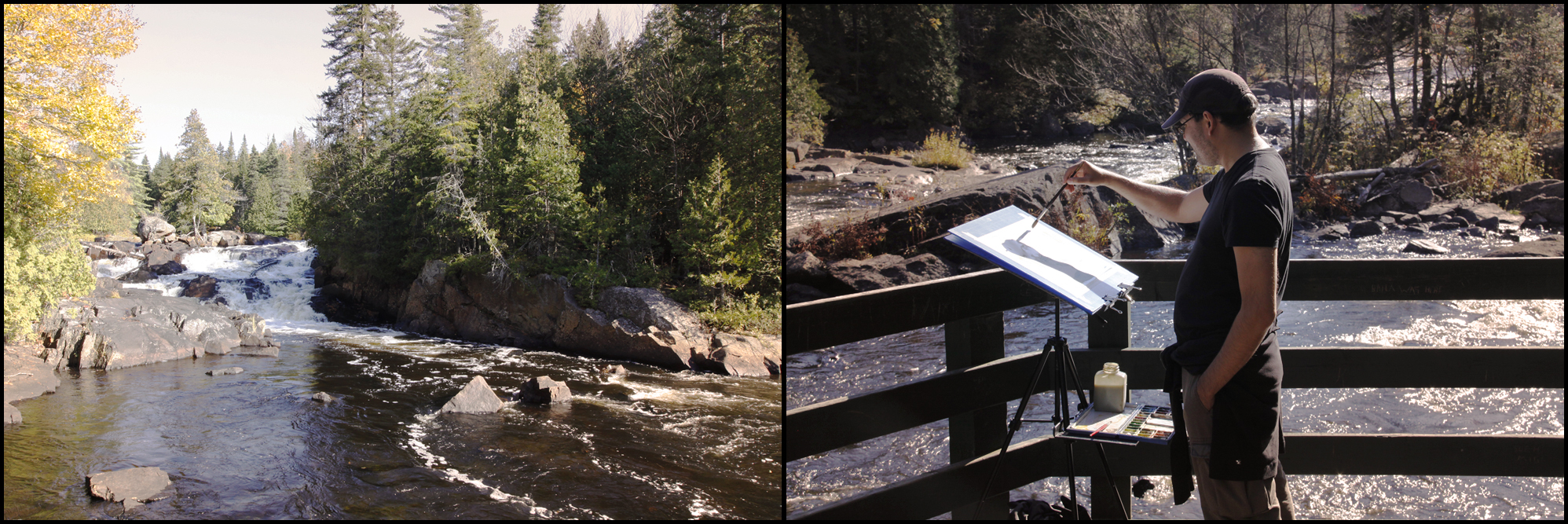
The fall colors seem to have come and gone whilst I was chained to my computer drawing various things I can’t show you. We made a last ditch attempt to get out to see Mont Tremblant before leaves were gone entirely. Was a lot more green and gold than I remember it. Shouldn’t there be some maples in here if it’s Canada? In any case – was good to get out – and challenge myself with some moving water. I have to say – damn hard to paint waterfalls. Moving water is going on the list to try again. Oh, and before someone asks – yes, Diablo Falls is 10 minutes away, and is much more exciting! Has a better name too. I can’t figure out what ‘Croches’ means. And google is not much help. “Did you mean…”
So yes, the painting I did at Diablo kind of melted in the spray up there. Didn’t turn out well at all :) So it shall never be seen in the light of day! Hahaha! (like I said, I need a round two with this moving water stuff).
Goodnight Lisbon!

Liz Steel an I were out sketching the front entrance of the Mosterio Dos Jerónimos at high noon. It was so hot watercolors would dry instantly on the page. These marble structures are an education in reflected light. The combination of brilliant sunlight and white cobblestone bouncing light from below create these pale violet shadows. (Which I’ve cheerfully exaggerated). In other places around Lisbon white walls will take on pink and orange tones from the light bounced off tile roofs and brightly plastered apartments.
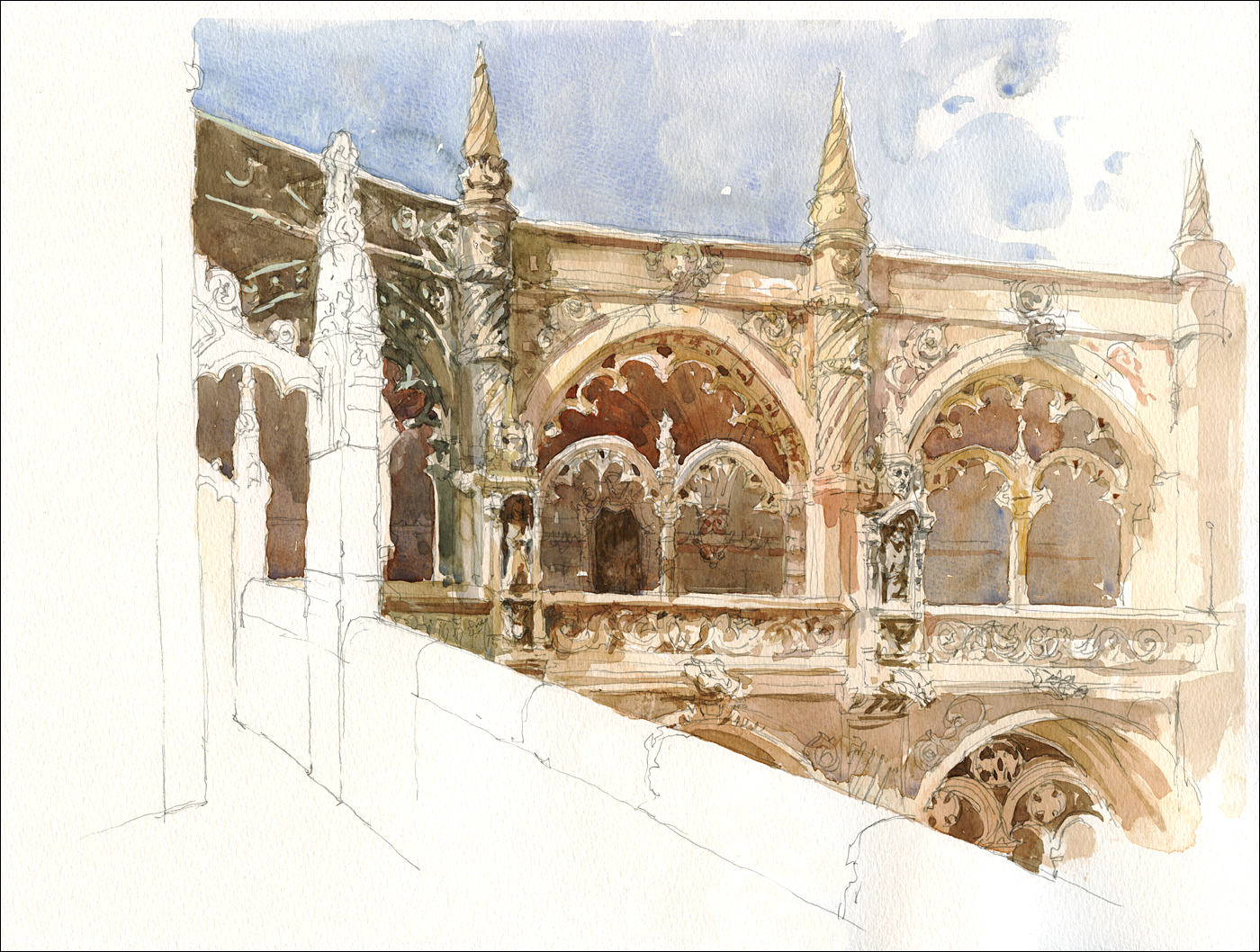
The next day we returned to do the interior – I am enjoying myself most here – beautiful warm sandy stone, covered in intricate carvings over all surfaces. Who could ask for a better time than drawing inside the monastery :)

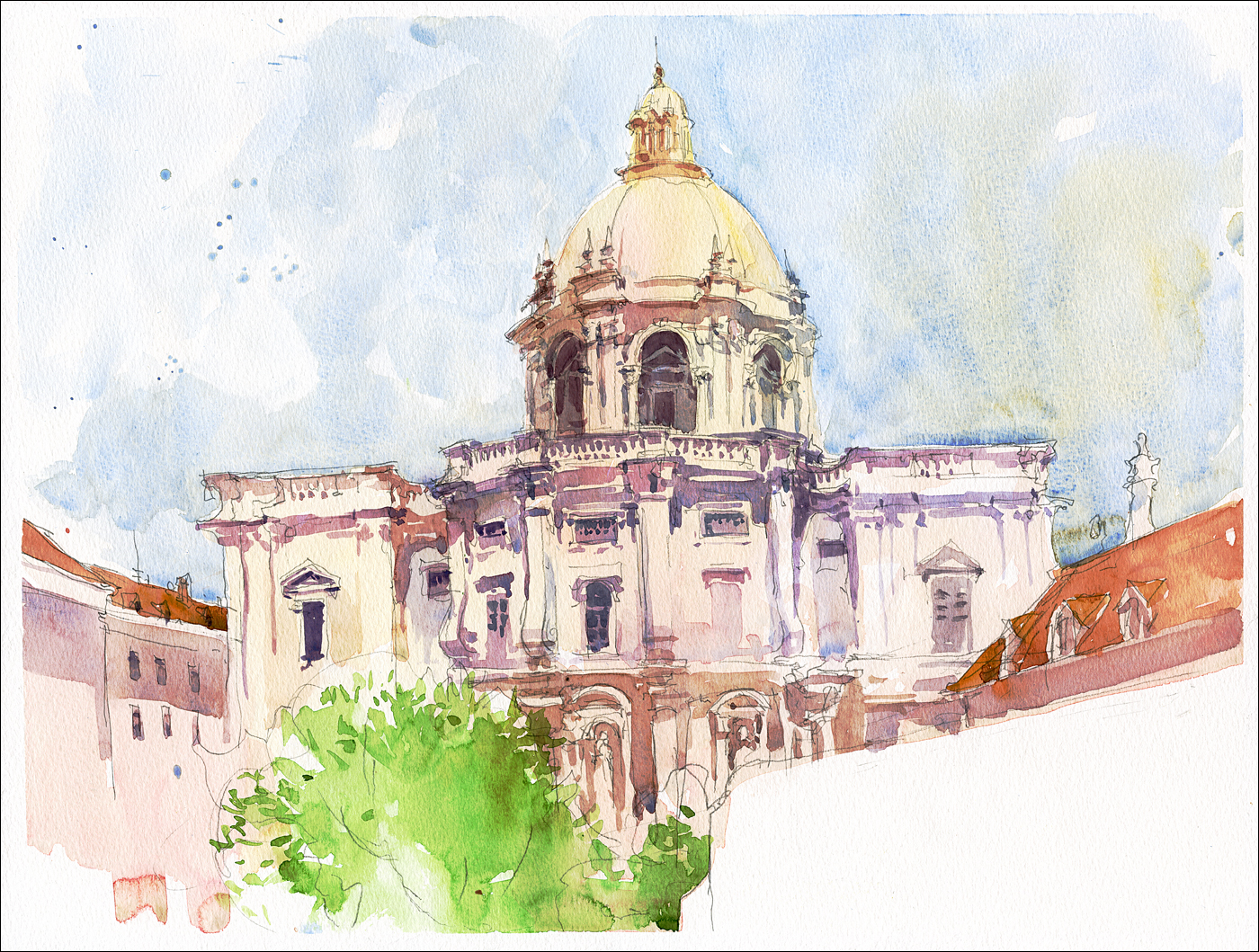
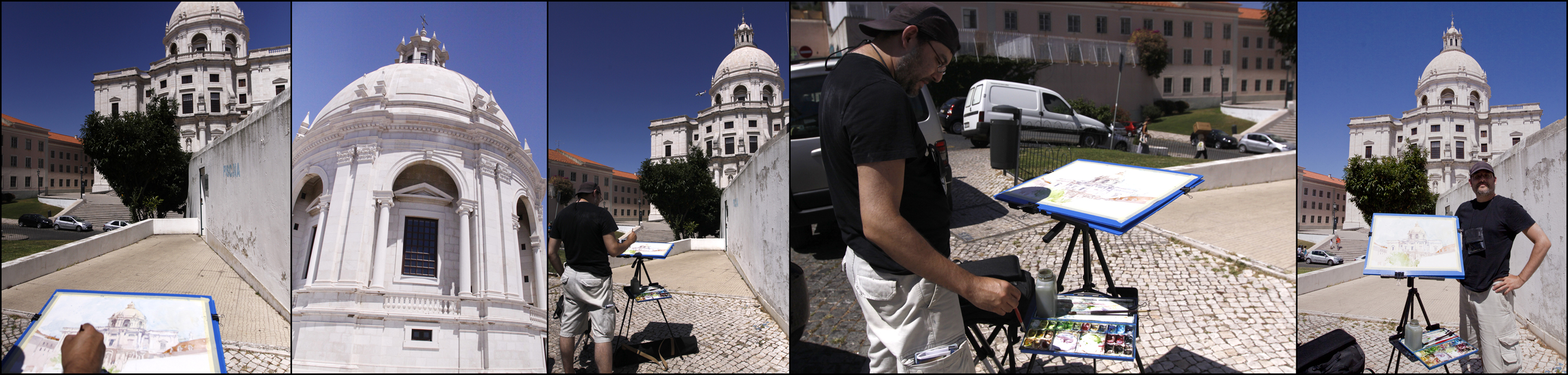
Back in town, painting the monumental Santa Engrácia. This immense dome dominates the entire Alfama area. It can be seen from nearly every street corner. The nearby streets host the ‘thieves market’ – a colorful bazaar that might as well have been named for merchants selling ‘antique’ tiles and architectural fragments swiped from various restoration projects. The square around the Engrácia is actually quite barren – this one tree provided a little break from the surrounding marble desert. It is however, quite magnificent inside – a vast lofty space filled with slanting light.
I feel this sketch is kind of a breakthrough for me. It’s the first in while that I feel is a ‘painting’ vs. a color drawing. As well, I think this one captures the colored shadows so unique to the city.

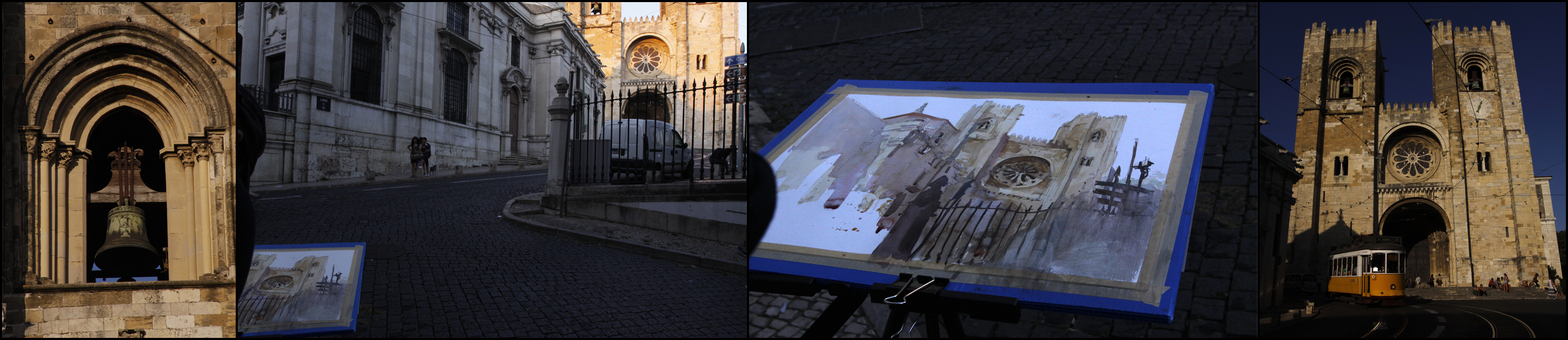
And finally, the Sé. We arrived late in the afternoon to find the blocky towers of the city’s oldest cathedral painted with warm evening light. It has the worn face of an old peasant. The stone has been patched and repaired over the years. There is no profusion of statuary or gilt ornament. It feels as if you’re transported to the middle ages.
This was the one time I struggled with watercolor refusing to dry – as I was working in a area of deep shadow. But the granular washes left behind seem to have some of the feeling of the old stone. So that’s the kind of happy accident you get from working on location.
So that’s goodbye for now to Lisbon. I hope I get a chance to go back. Especially as we now know so many artists there!
Exploring Lisbon

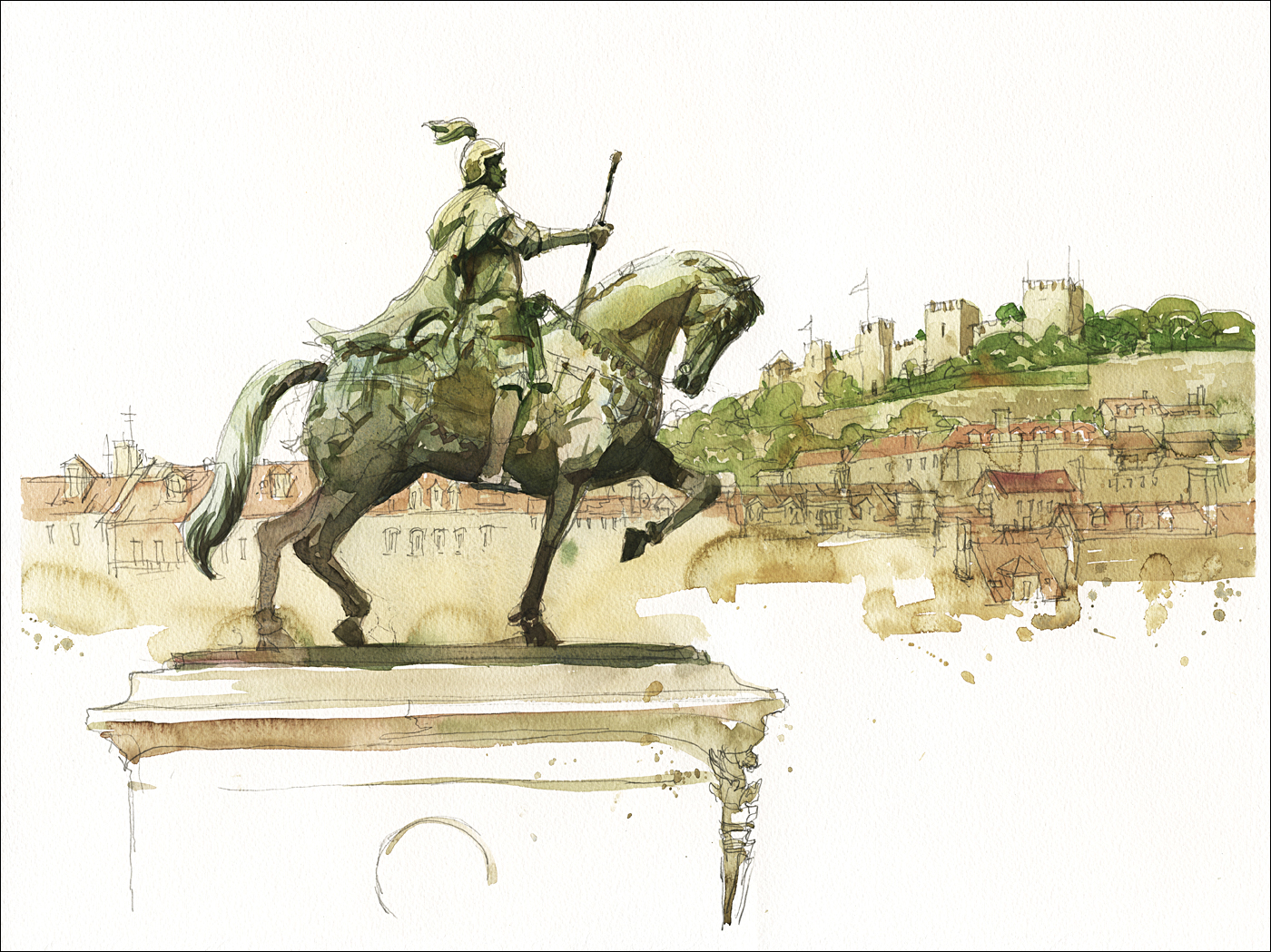
This is King Joao the First (1383-1433)- riding up to the Castello de Sao Jorge. You’ll find him in Praça Da Figueria, just east of Rossio.
I can’t emphasize enough how great it was to paint every day for the entire week. It just seemed like the paint went down easier and easier every day. I could feel things resolving in a single wash, that I’d normally have to glaze and blot and worry over. I feel like I learned as much this week as I have this year.
But by the end I felt like I was seeing the underlying structure and not getting sidetracked in the surface detail too quickly. Oh and how I love the tiny tiny detail. That’s my video gaming design mentality I think. When in doubt, more gnarly bits! Less is not more – More is More! Fortunately Portuguese architecture is not lacking for fascinating detail.
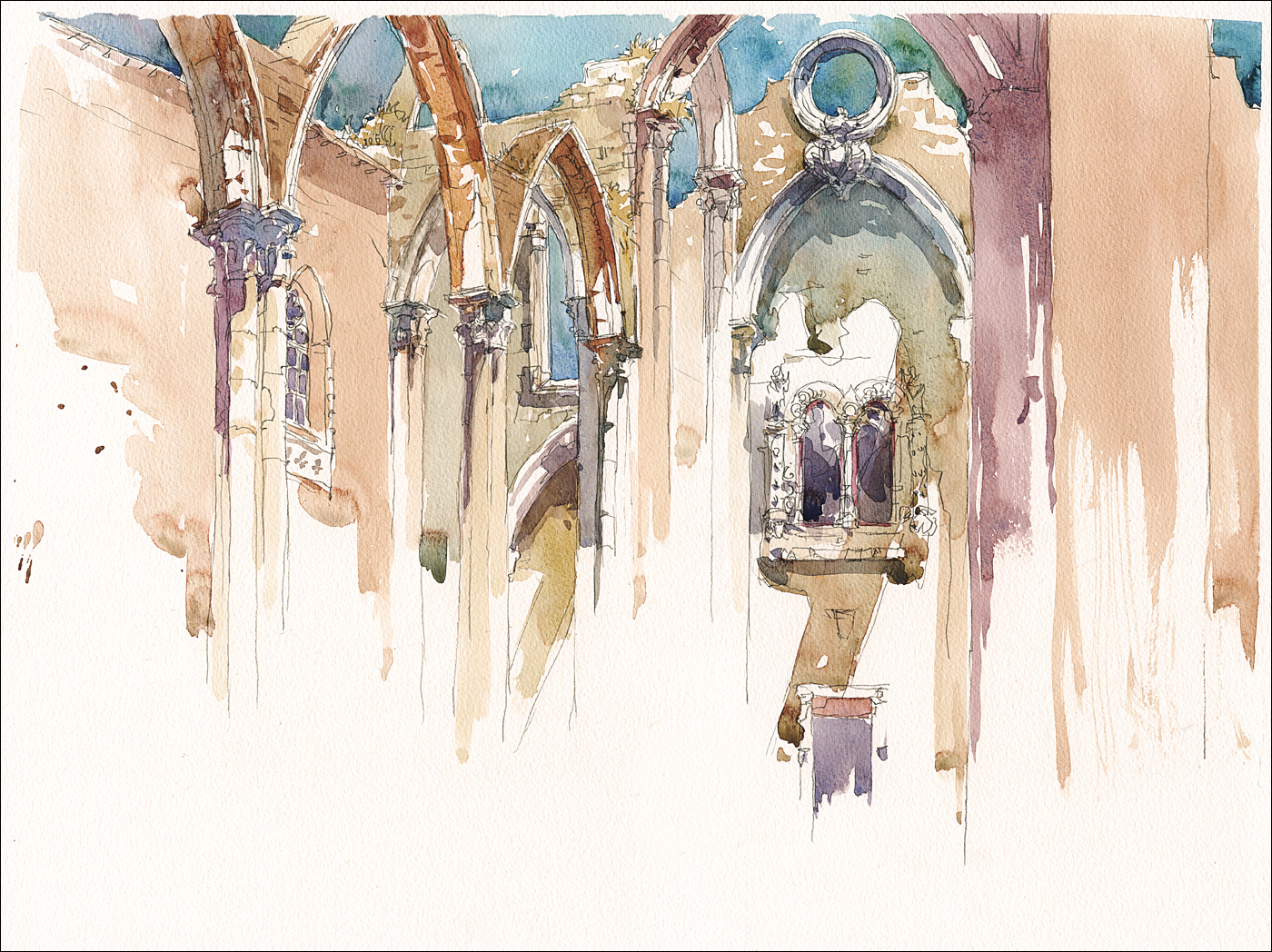
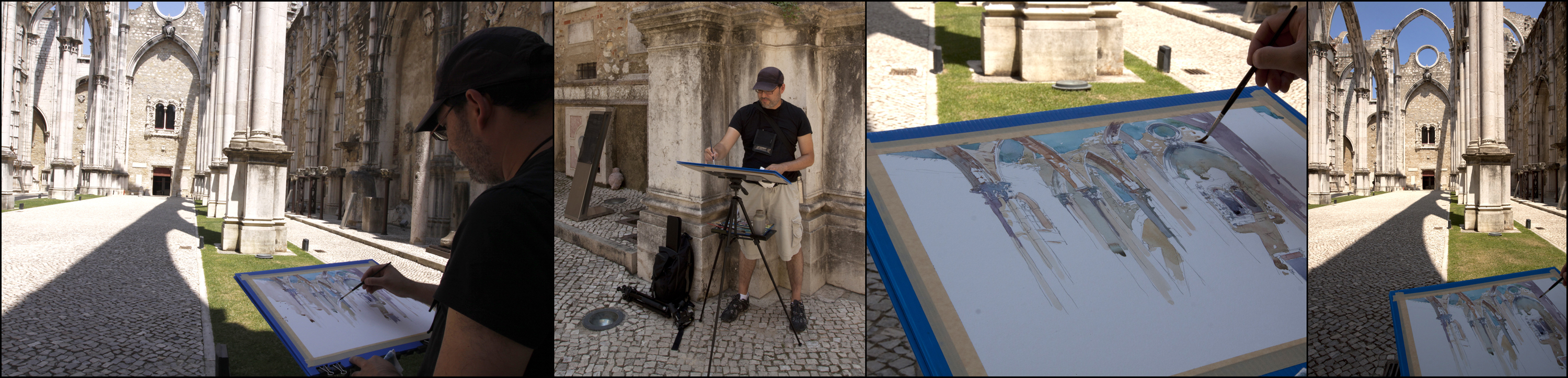
Igreja do Carmo. A picturesque museum, many beautiful artifacts housed under graceful arched pillars open to the sky. The roof rained stones down on the terrified congregation during the 1755 quake. No doubt right as they were praying for transport out of the doomed city. You have to appreciate the irony as you draw the elegant forms the disaster left us.
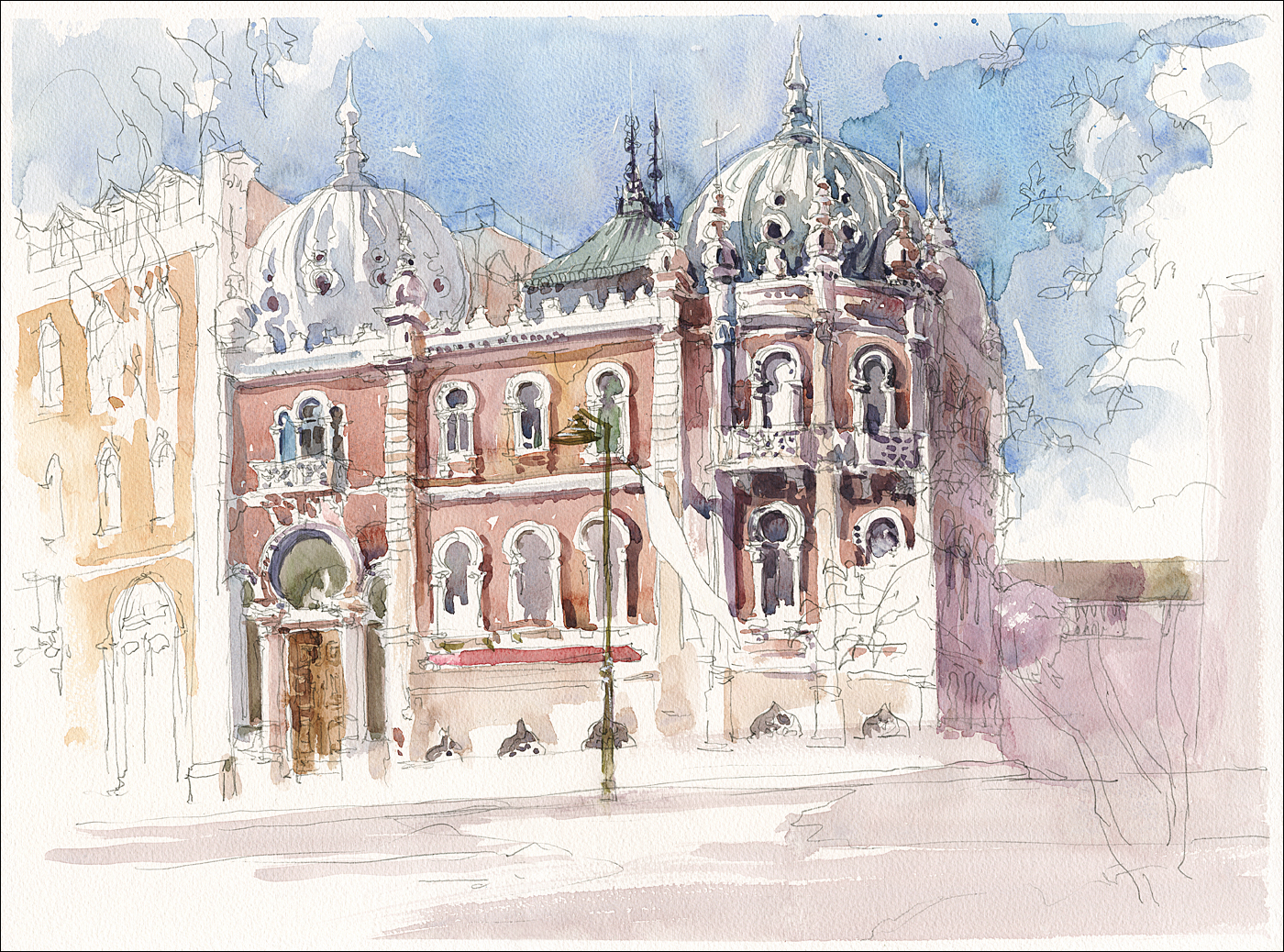
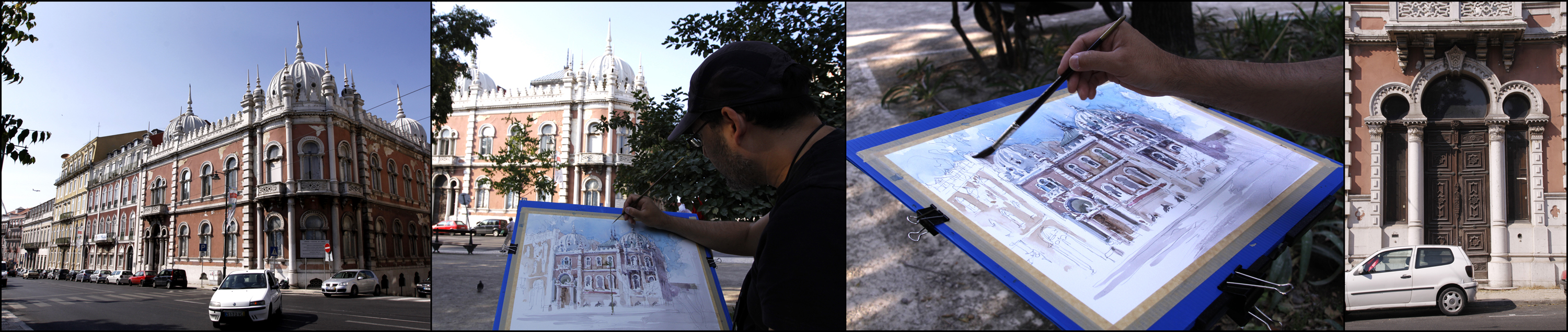
I don’t know anything about this place – I think it might be the Palácio Ribeiro da Cunha, on the north side of the Praça do Príncipe Real. (Google confirms, yes). It’s certainly a bizarre bit of construction. A byzantine wedding cake of a building topped by three scoops of ice cream. Couldn’t pass this one up. It was also right near the gallery showing paintings of Mauritania by USK correspondent Isabel Fiaderio.
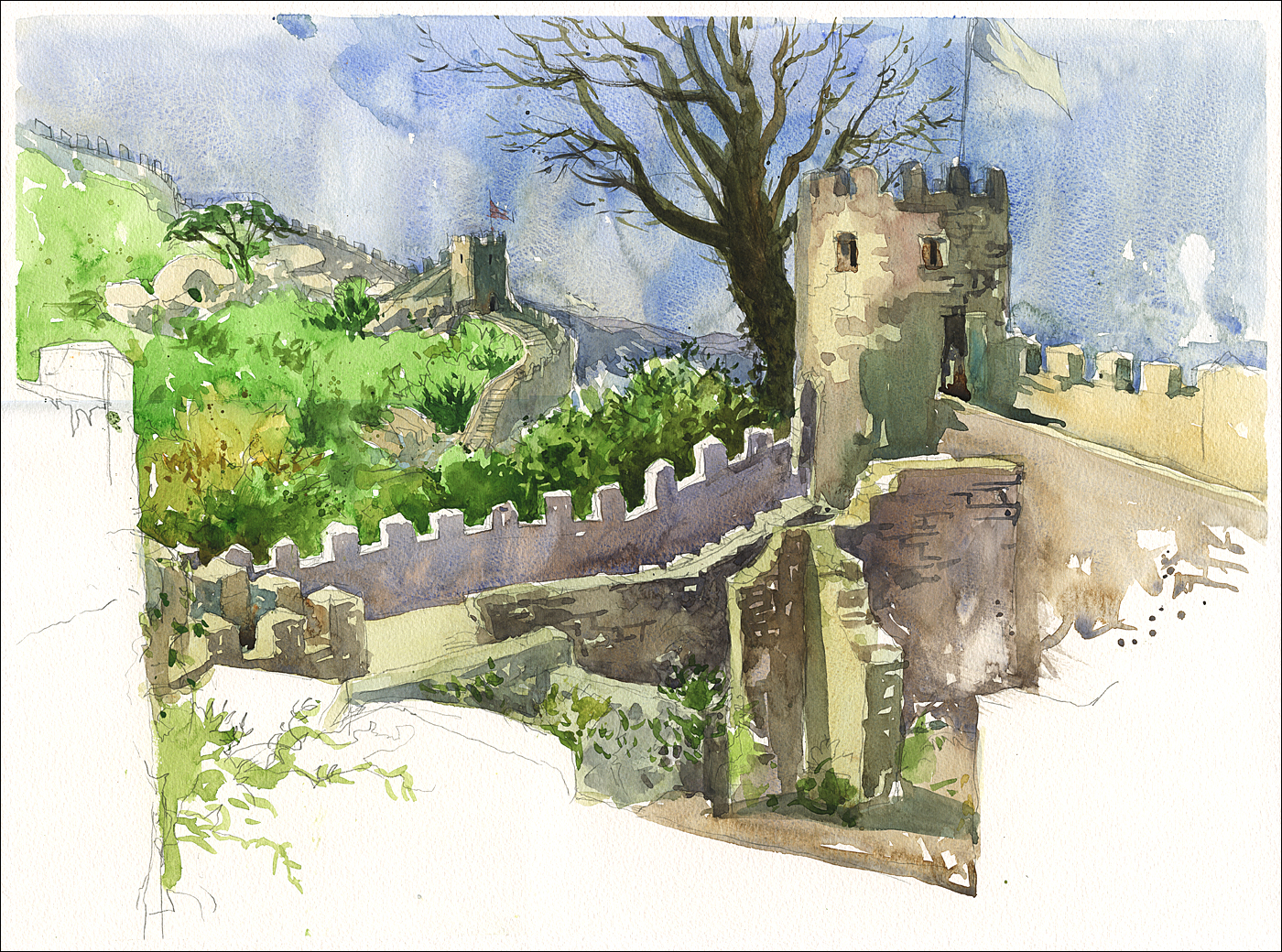

This is a side jaunt to the ruined castle high above the town of Sintra. 40 min by train from Rossio station, then a tortuous (and pricey!) mini-bus up some winding roads. I toughed out Lisbon’s hills, but this one looked a little more serious. I could see how the castle defenders could make short work of anyone marching uphill. A magnificent view up here, and in late July, one of the hottest places I’ve ever painted.
Sintra as whole is a bit over-rated for my tastes. (Jacek tried to warn me!) Kind of a sugary storybook pretty feeling to the place. The monuments are certainly spectacular – but seem somehow to be trying too hard to impress. It’s a spring break town for Baroque princes. Though, I didn’t make it to Quinta da Regaleria, despite being told it was the most grotesque of the local highlights. I’d give that a try if I get here again. You can pretty much skip Palacio da Pena. IMO, not worth the price of admission. You can see the effect it had on young Walter Disney. (The story is, his father worked there and it became the inspiration for Disney Land).
In any case – the old Moors castle was my favorite spot. Much superior to the tourist trap housed in the Castelo in Lisbon. If you want to see crusades era castles, go here – not the one in town! Standing on this wall, you can really feel the history.
OK – I saved the best for last – next post – Mosteiro Jeronimos, Santa Engracia and the Se. One of which is turned out to my favorite painting I’ve done to date.
Pics or it didn’t happen!
Just a small sampling of people we met at the workshop. There’s a whole stack of snapshots on [my flickr].

James Richards, Jacek Krenz, Kasia Krenz

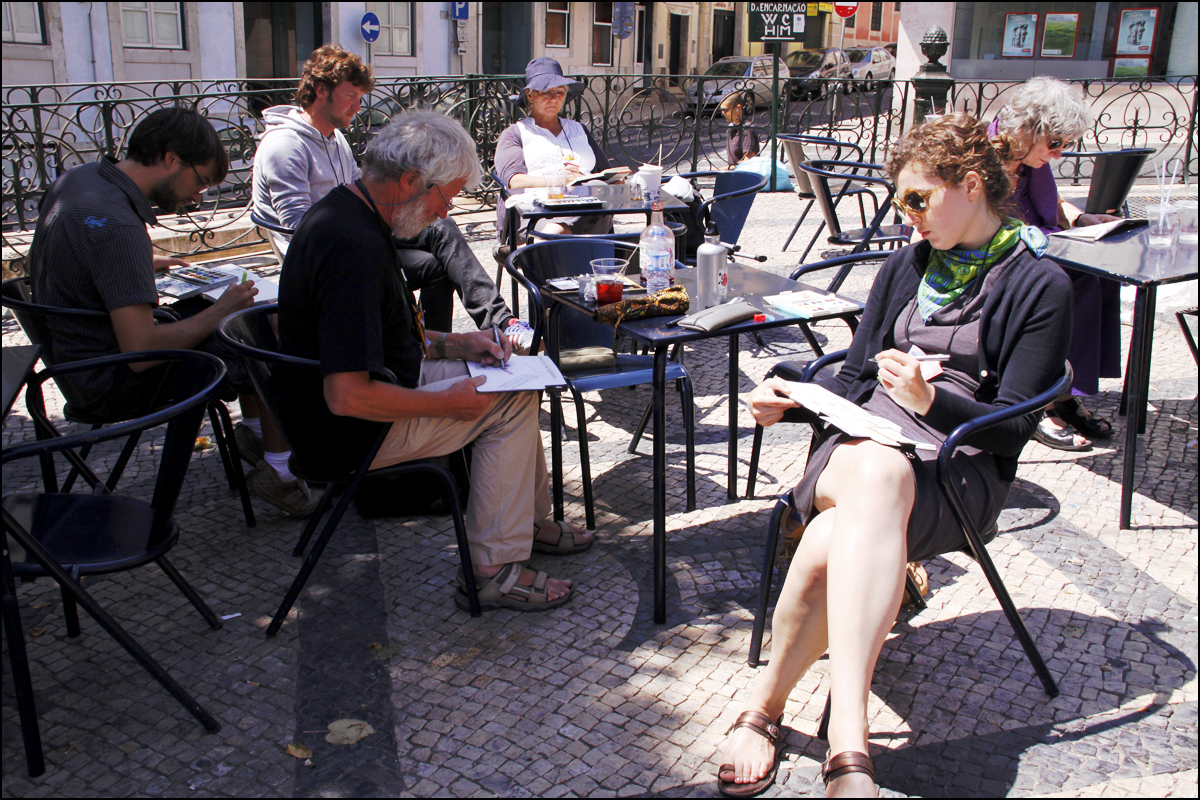


Jason Das, Catarina Franca, Florian Afflerbach


Triumphant return from Lisbon!
Ok, that’s a fairly grandiose headline. But honestly, I feel pretty good about the trip to Lisbon. I had a great time , stayed focused, and did a lot of painting. Around 6 hours a day for the 10 days.
The symposium was truly a superb experience. Very well organized by the local USK group. They clearly put a lot of work into the event.
We did three days of demos, classes and lectures, and then stayed on for another week to explore further. But of course, the best part of the week was meeting so many sketchers and correspondents from USK. Too many to list everyone we drew with – it seemed everywhere I turned was another famous sketcher.
I couldn’t imagine a better setting for a drawing workshop. Lisbon’s city center is easily navigated by walking (thanks to the nearly complete redesign after the earthquake in 1755. Apparently the first use of the modern urban grid). We heard some squawking about the hills before we came – but anyone who’s walked around San Francisco or Montreal wouldn’t find it a problem. We didn’t bother with the lifts or trams.
Just to get started – here’s a couple of my demonstration sketches. It’s kind of funny – I was drawing and talking the whole time, but I found I didn’t have any peripheral vision outside the easel and the subject. I was never sure if anyone was around paying attention, so I just kept narrating my process anyway. I’m sure there were times I was painting by myself and lecturing to the air.
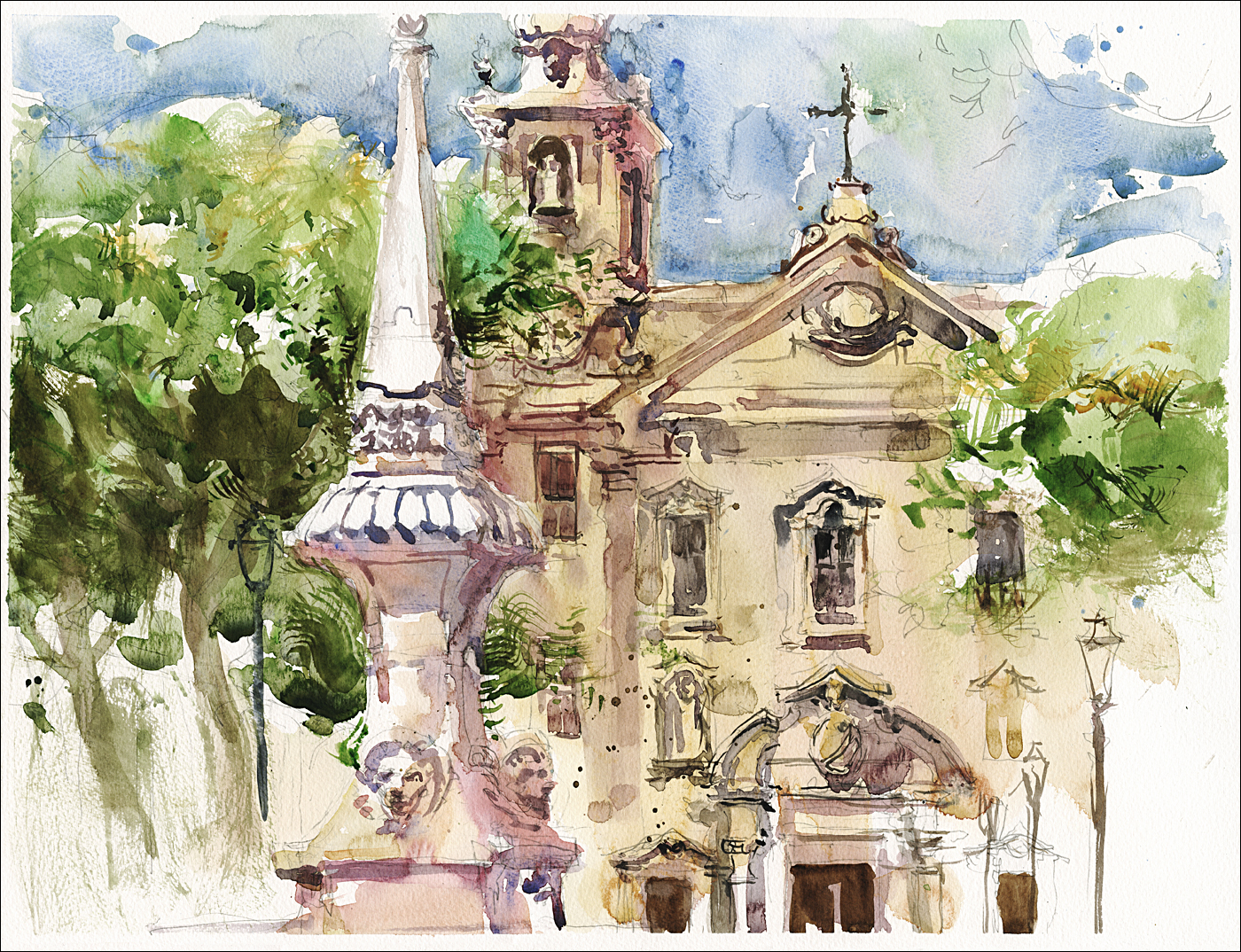
In order to make sure students got a wide variety of subjects, we were each assigned a fixed drawing location for all three days. So I had three shots at drawing Largo Sao Paulo. Just as well – my first take was kind of a static composition (very frontal), the second went into the fundraising auction, and I managed to bring home one good one on the third day. Though, it’s not uncommon for me to draw a place more than once anyway. I never get it perfect the first go round.
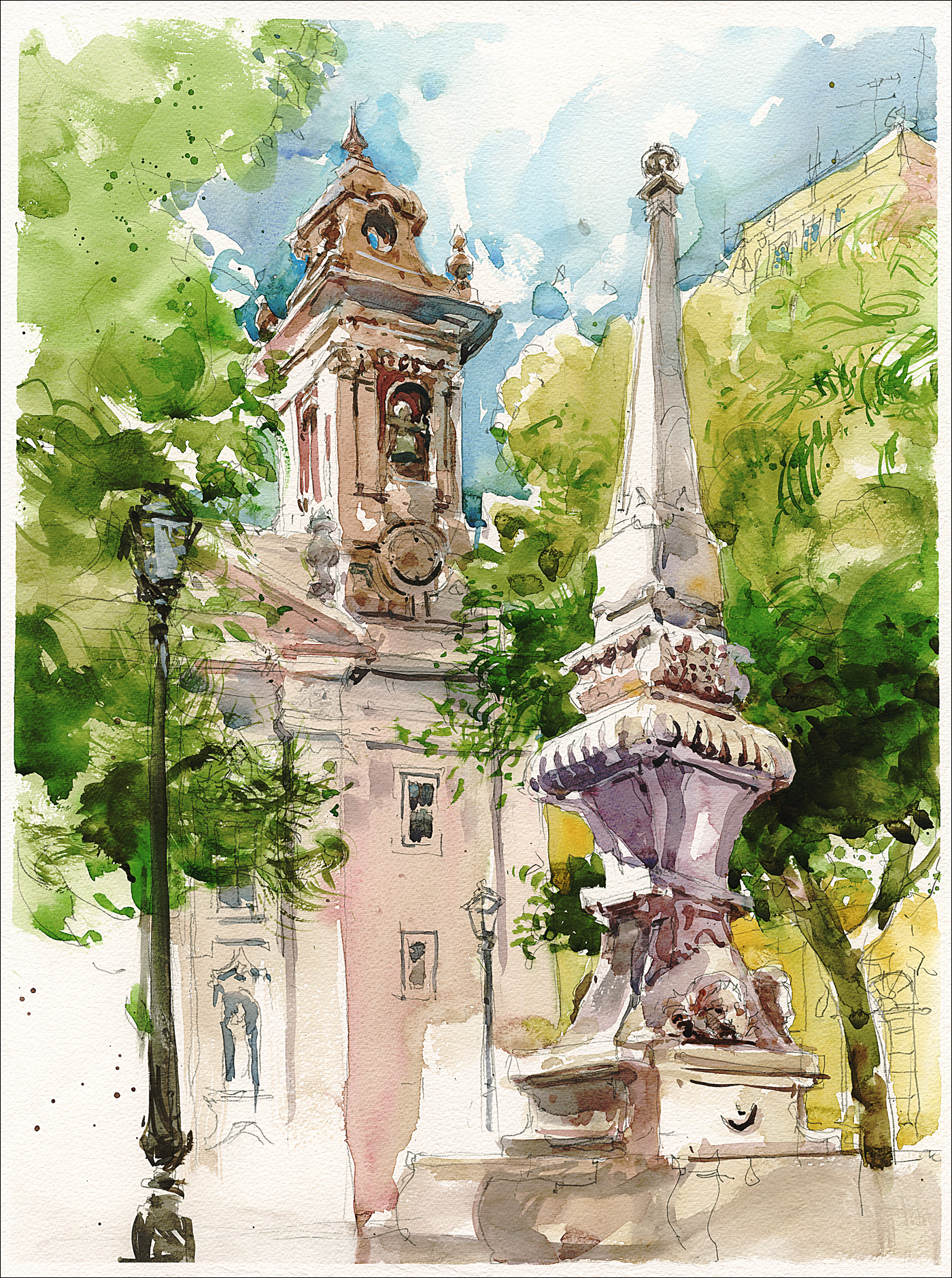
It was odd to have to narrate what I’m doing in real-time. I’m not always conscious of what I’m going to do next – suddenly I’m just doing it, and have to backtrack to think why.
It really helped over the next few days to have articulated the painting process out loud. I found it easier to stick to a planned approach. I think you’ll see the improvement over the next couple of posts. I highly advise anyone who’s “in training” to try painting three pictures a day for a week and just jot some notes about how you approached each one. It’s really rewarding to feel yourself getting tuned up.

So before I get onto the ‘personal breakthrough’ paintings from later in the week here is: “Wot I learned at the USK Symposium”.
Each of us was allowed to spy on two other sessions. My favorite was a perspective drawing class with Gerard Michel and Florian Afflerbach. It was really tremendously useful. Just to be reminded to actually place the horizon line, and that the vanishing point has to be on that horizon somewhere. Somehow I hadn’t internalized that previously – kind of always just fudging where lines recede. Probably due to my preference for drawing rooftops and not store fronts.
It was great to see that these guys who can out-draw me consistently are actually using the measuring I’ve been too lazy to apply. The scales fall from your eyes when you see – it’s not magic – they actually know what they’re doing! They’re not taking short cuts, but being disciplined about technique. (A bad word when I went to art school).
Well, it’s usually that simple right? Work Smarter, Not Harder!
Gerard had a few stunningly simple tips that I started using immediately.
- Use the edge of your sketch book as a ruler. (Duh! So practical! So smart!)
- Draw straight lines in segments. One smooth linear wrist movement, followed by repositioning your wrist and repeating a smooth wrist move. Like your hand is a ratchet. Not attempting to magically keep your whole arm straight going across the page, elbow in the air. Perhaps this will need a video to describe better someday.
- Hold your page up at eye level (blocking your face, superimposed over your field of view) and just raise and lower it a few times to get a great comparison between reality and your drawing. It’s amazing. Try it out!
Florian showed how he does small accurate drawings in a big huge sketchbook. He sometimes uses only 1 page of each two page spread – using the extra facing page across the fold to fit in the vanishing points. Gerard mentioned how he’ll sometimes place a scrap of trash on the ground a few feet away to mark a virtual vanishing point that’s too far off the paper.
Geniusii! The pair of them.
I find I ‘edge up’ to learning things by trying them every few months – and each time I get a tiny increment better. This was one of those times. These first two sketches from Rossio Square are nothing earth shattering – but they’re the start of my brain going “Oh wait. so THIS is how perspective works?” I think it was pouring over those guys’ sketchbooks that helped stick the lesson home. They get it right every time! I highly recommend spending some time on their flickr streams.
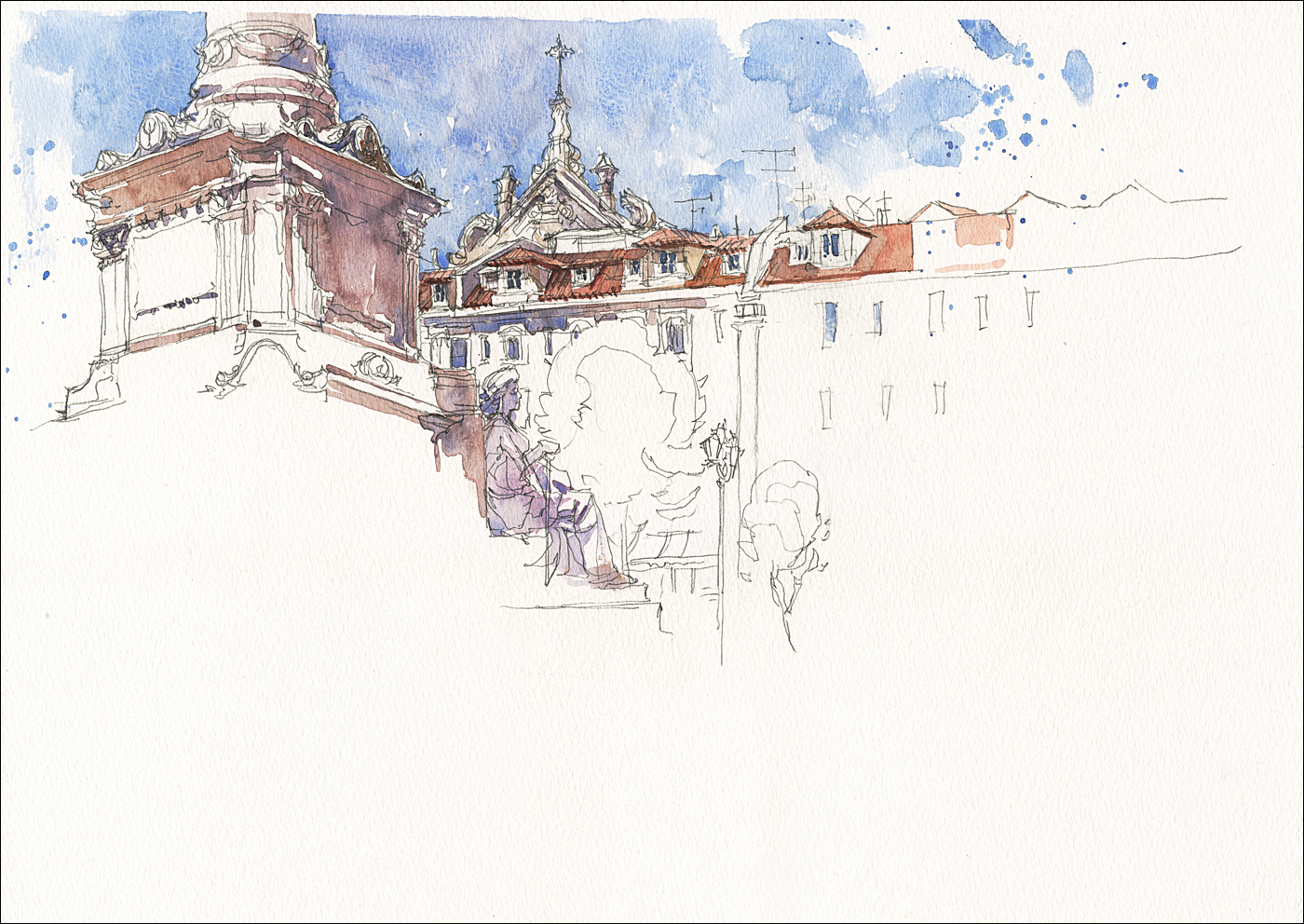

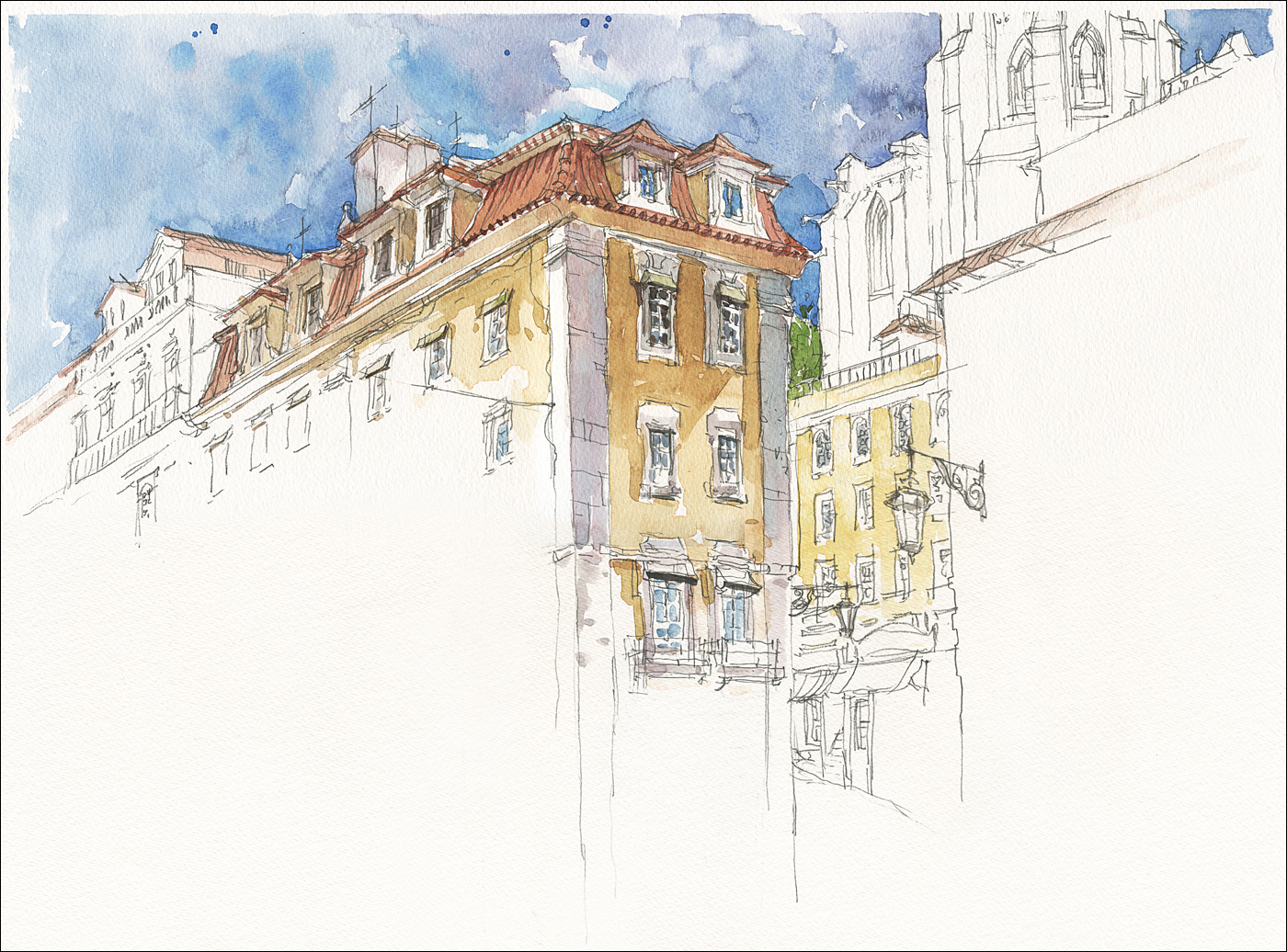
Next up – getting past colored drawings. The best is yet to come :)
It’s going to be the United Nations of sketching
I couldn’t resist passing this along. I’m looking over the people signed up for my sections of the sketching workshop. Just my section has 54 people over three sessions coming together from places including; Australia, Netherlands, Portugal (of course, our hosts), Spain, Germany, Sweden, Canada, USA, England, Brazil, Switzerland. And that’s just the ones that have posted info in their bios. It’s really an unprecedented event in the history of drawing!
Gearing up for the Lisbon Symposium
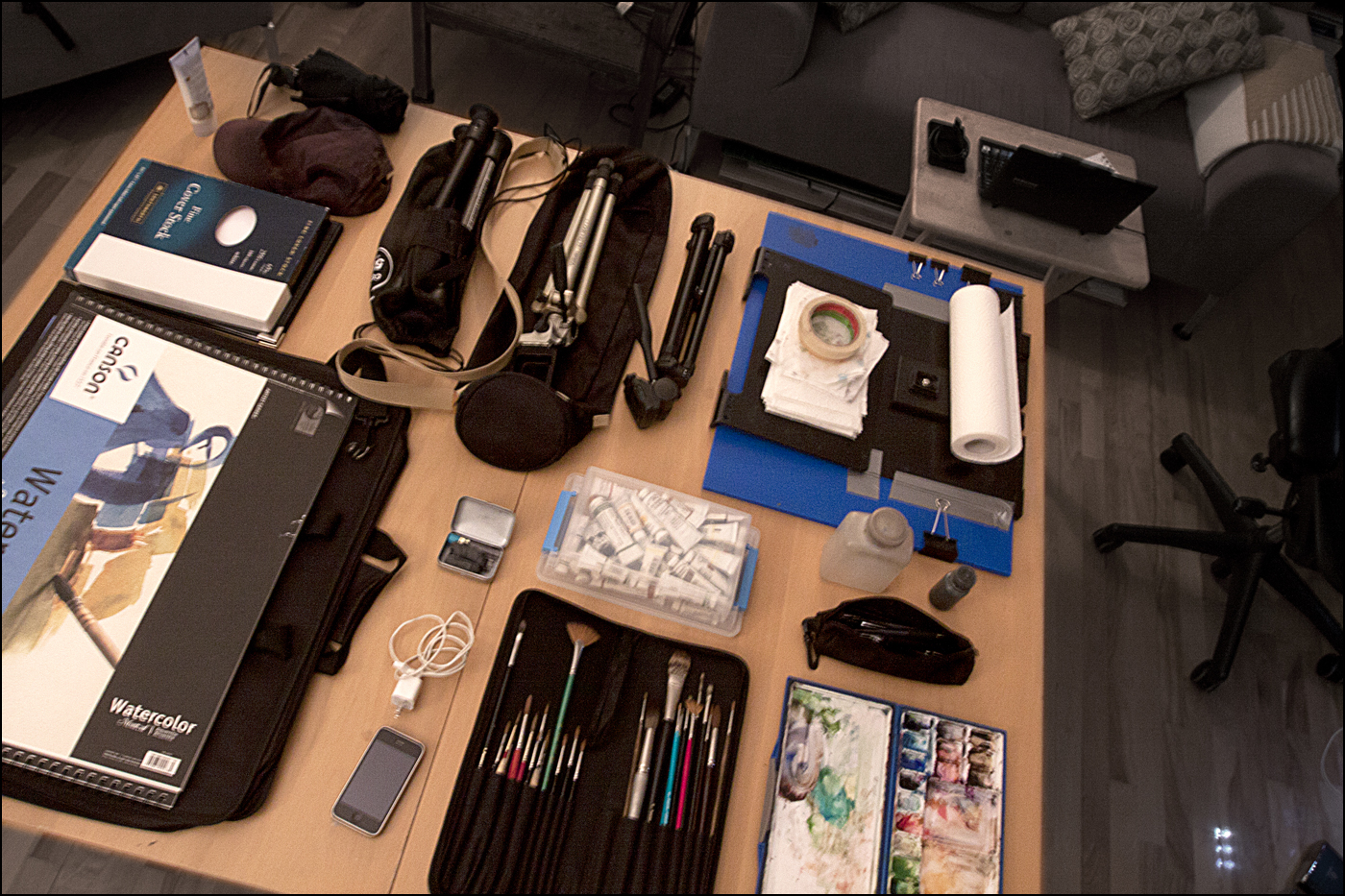
Gearing up to head to Lisbon for the Urban Sketchers Symposium! This is kind of overkill for a painting trip – but I’ll be there for 10 days travelling around and painting.
It’s really; More paint that I’d ever need. Too many brushes. A dozen unnecessary backup pens. Three times as much paper as I expect to use, and the iPhone.
I’m going to work larger this trip – thus the attractive sheet of blue coroplast duct-taped onto my watercolor easel. It’s actually a pretty nice surface for taping down loose sheets. I used to use blocks in the field – but as I go larger, they simply got too heavy. This is ugly – but as light as possible. And water proof. (The ‘easel’ is the black plastic slabs under the paper towels. People always ask – it’s an E. Michaels En Plein Air Pro – which is just two small surfaces that attach to a camera tripod).
The other tripods are my WalkStool (invaluable!) and a nice ultralight from Velbon. It’s unique as it’s super light weight, but for some crazy reason is designed for an 8 foot tall photographer. So it holds the iPhone up out of my way while capturing a timelapse. That is if I don’t get involved in the painting and forget to use it :)
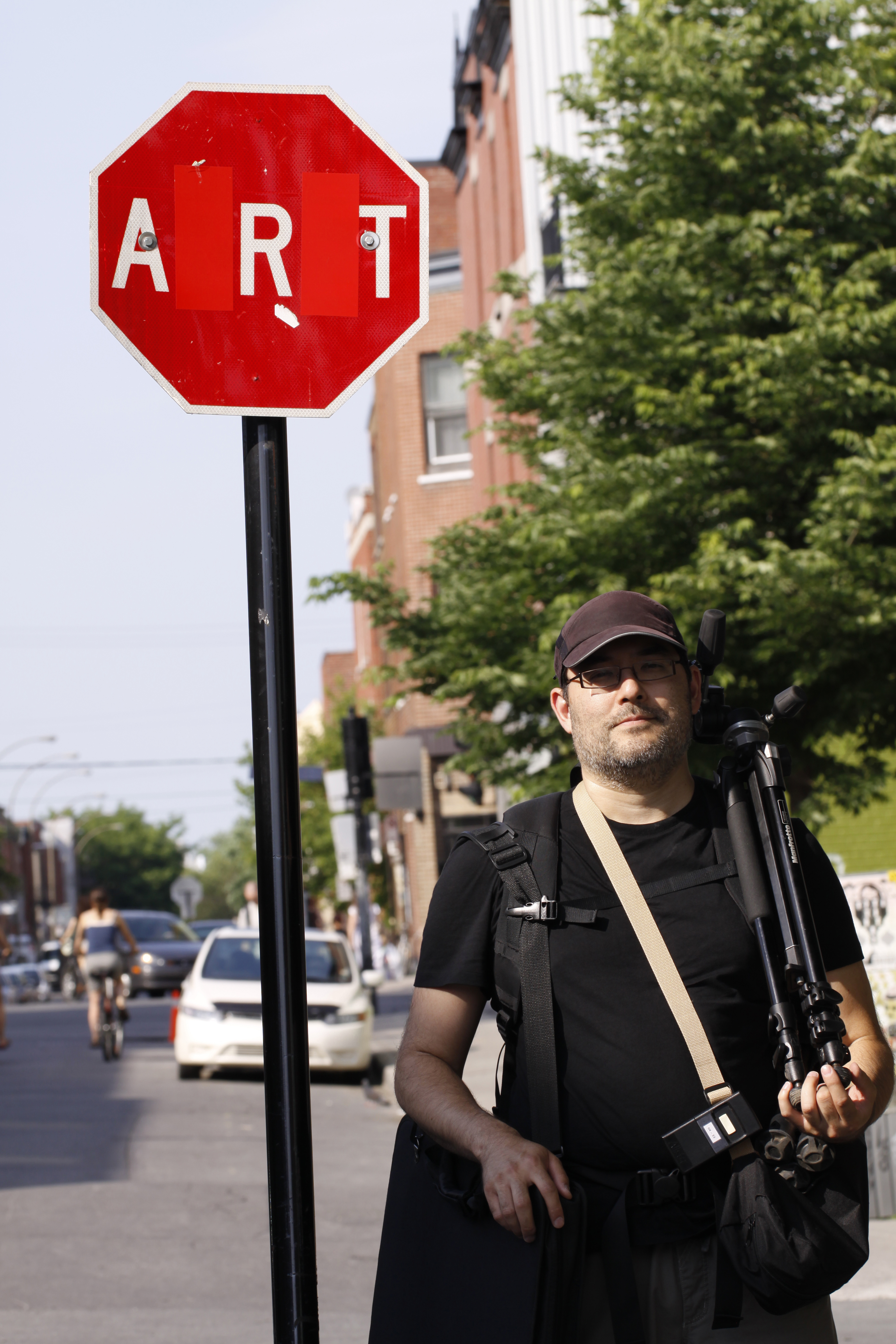
This is a Quebecois inside joke. Someone is re-purposing our French Stop signs with reflective tape over the A*R*T in ARRET. Good one! whoever you are :)
Rue Saint-Denis in the Rain
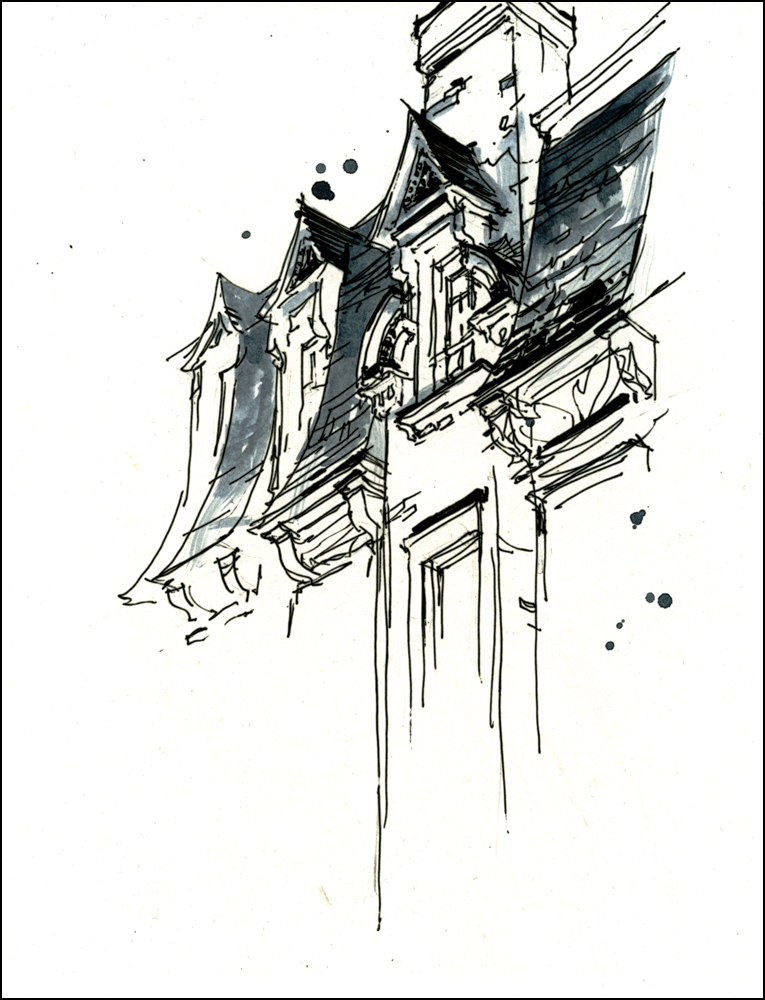
Couple of very rapid sketches grabbed while waiting out a sudden downpour. (Colored when I got home – a rare cheat!) This happens to be in the Latin Quarter on St. Denis, but really these cupolas are typical of the walk up buildings all over central Montreal.

Every house, no matter how mundane – depanneur (corner store), run down apartment, little boutique – they all have their own decorative touch. It might be these peaked cupolas or a small minaret, a stone carving, or an extravagant balcony. The streets are full of feisty little row houses. Nobody wants to be boring in Montreal!
McGill Campus
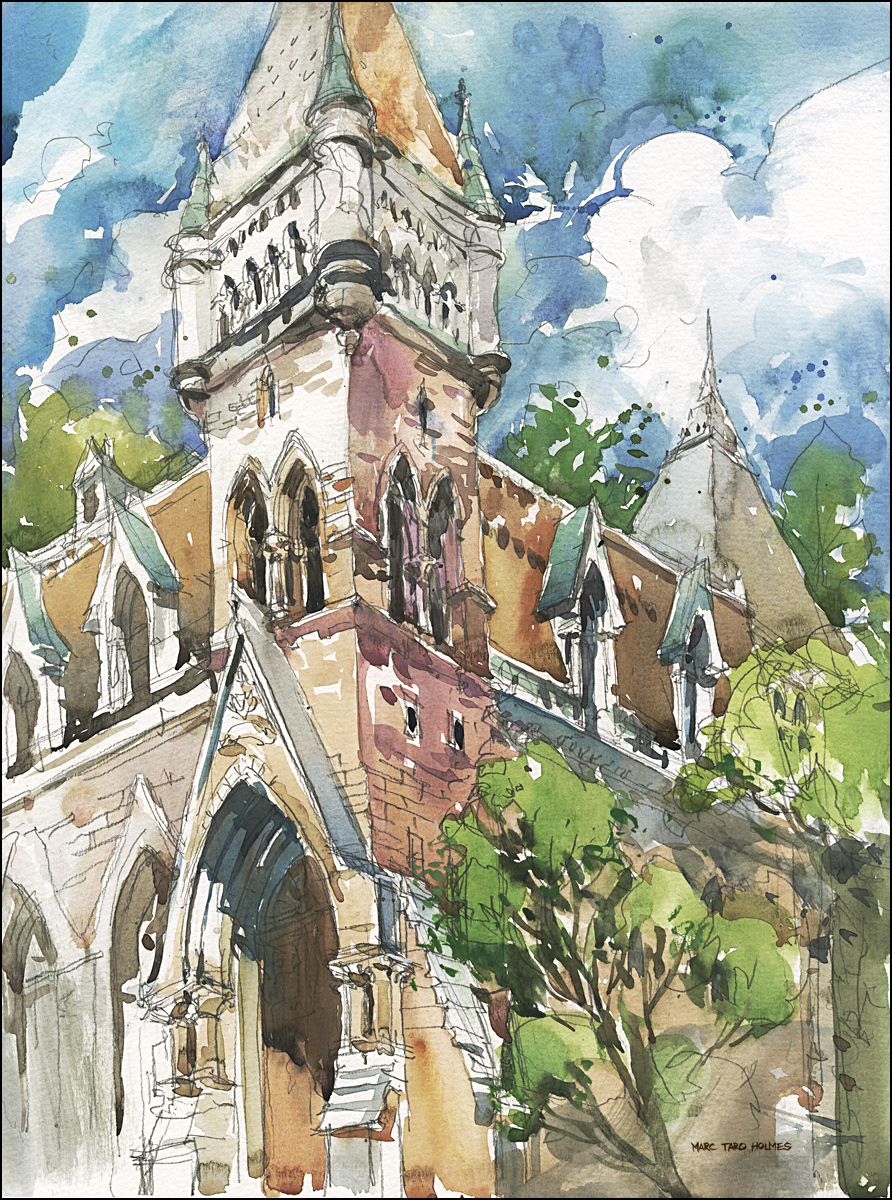
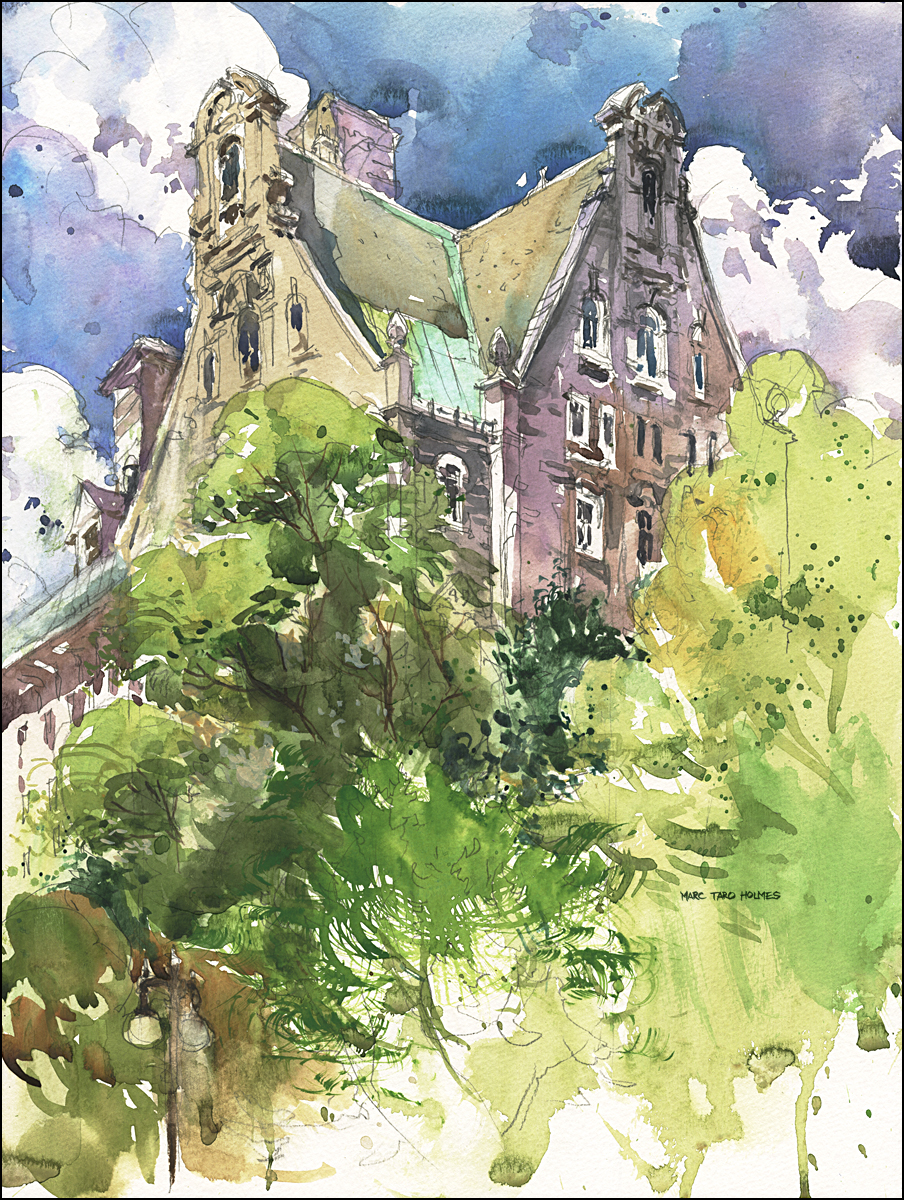
The main McGill campus just a few blocks north of the exact city center of Montreal. (The main gate is on Ave. Mcgill and Sherbrooke Ouest). I’ve always enjoyed walking through its quiet green spaces surrounded by the ivy covered halls of learning. It’s a great place for sketching – close to all the services downtown, but away from the bustle. (At least in the summer when the students are on break). There are plenty more interesting structures here – so this is just a quick tour – I’ll be back for more!
Not quite Canada Day at St. Joseph’s Oratory

Our actual Canada day (July 1) was grim and grey – which is perhaps suitable to our temperament. So I saved up a painting trip for today instead. I don’t know why everyone says Canadians are so friendly. I find us to be a rather pragmatic lot most of the time. BUT – I digress.
Here’s a watercolor of St Joseph’s Oratory. This white marble edifice is imperiously situated at the top of a steep climb up the north west shoulder of our mountain. After those steps you feel suitably penitent when you arrive for mass. They have a special wooden staircase for those who prefer the traditional method of climbing on hands and knees. I saw at least one visitor availing themselves of this orthodox route.
The huge dome on the cathedral is said to be the third largest in the world. But sadly – the interior is quite restrained, (done in a 1960’s flavor of modernism) and does not grant you an uplifting view of the inside of the lofty dome. It seemed oddly understated compared to the baroque grandeur of some of Montreal’s other cathedrals. Perhaps the place is so large I was actually on the wrong floor? Not sure. But for today, my best view was certainly the magnificent approach to the cathedral. Looking up at it from the entrance, hundreds of yards below – it’s quite an edifice.


 Citizen Sketcher