In which Holmes Creates a Painting in the Rain, or: The Case of the Vanishing Castle

We arrived at Ithaca New York later than we had hoped, due to no greater misadventure than leaving Montreal too late in the day. Ongoing activities being so pressing, Holmes had been up to the wee hours inscribing books – which are even now being dispatched to the far corners of the earth.


After meeting our group of temporary Ithacans at the strictly functional Trip Hotel, and finding them a most congenial battalion of scribblers, we attempted a late night scouting mission. Despite the pitchest dark, and an unusual density of spiders clinging to the guard rail of the Thurston avenue bridge, we were able to confirm a suitable view of the Triphammer falls.
Imagine our dismay the following morning, after an insipid packaged breakfast at our inn, to find the day morosely overcast and insistently raining. Worse yet, the subject of our investigation, the ruined foundry, was not found to be artfully crumbling onto the gorge – but in fact – vanished without trace. No doubt spirited away by diligent engineers, myopically choosing public safety over what is eternal in art.

Not in the least dispirited by this turn of events, Holmes set to work with a briskly applied will, exclaiming that he had always meant to conduct an experiment watercoloring in the rain, and this vanished castle debacle was to be his opportunity.

I will leave it to you, dear readers, to determine – is the evidence of continual drizzle visible in the work? Holmes himself feels, even if it could be considered somewhat smeary by critics, the vicissitudes of nature do not detract in this document of the day.
It should also be said, the thorough soaking visited on the genuine cotton rag paper (provided by the Italian, Fabriano), allowed the work to be pressed below a stack of (inscribed) books overnight, granting a perfectly flat sheet by the second morning.

For the remainder of the expedition, Holmes continued to infuriate one and all with his antisocial manner and continual scratchings. Adding tirelessly to his encyclopedic collection of oddities found in leaf-strewn campus courtyards and dusty regional museums.


For whatever reason this unrelenting chore included a forced march one hour away (and another back) to observe the methods of the glass workers in Corning NY. A task I am unclear as to the value of, but which seemed satisfactory to the artist, for reasons he may disclose in the upcoming weeks.
Pre-Order Bonus signed copies of The Urban Sketcher with print : Sold Out! Thank you everyone!
I’m very pleased to say, we’ve shipped a huge stack of books. They’re going all over the US and Canada, but also to Spain, Italy, Australia, South Africa, and Singapore.
To everyone who ordered before Oct 22, I will be contacting all of you. At the time of this note I still have a lot of email to work through. Thank very much for your support, ordering the book in advance. It means a lot to me, seeing all the places in the world the book is going.
For all of you all over the world – here’s a view of Montreal in the winter, from the window of the art department at UQAM. (Where I go sometimes for life drawing). You can see why I want to visit you in all those nice warm countries.
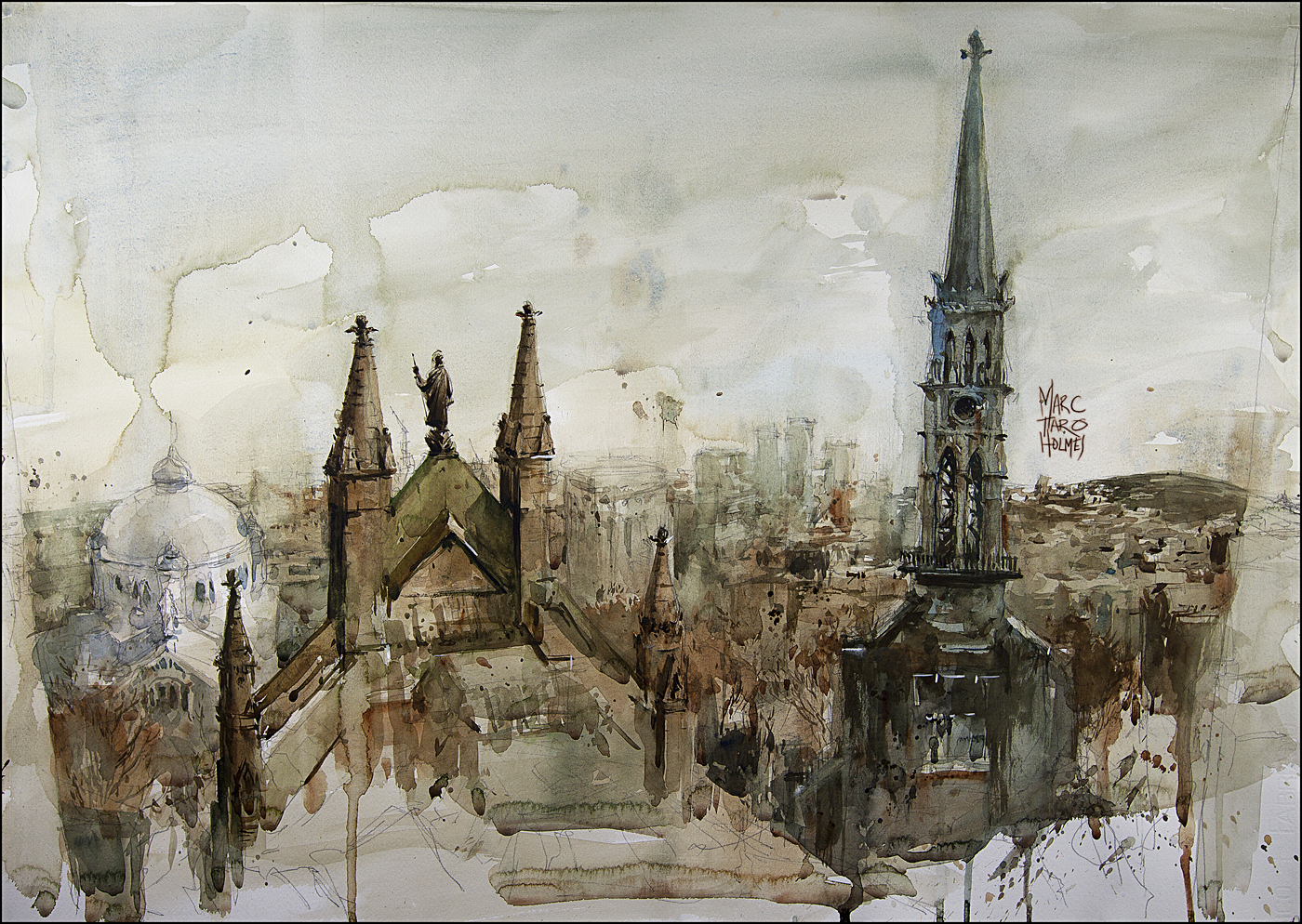
This was one of the last things I did for the book, and it didn’t actually make it in for various space and time reasons. But it did get a second chance at life – it’s hanging (soon) in the Canadian Society of Painters in Watercolor ‘Open Water’ show in Toronto. (Oct 28-Nov 21, John B. Aird Gallery, 900 Bay St., Toronto, Canada).
Please note: You may still order a signed copy of The Urban Sketcher! However my pre-order bonus deal (free shipping, and collector’s print) is now closed. We have shipped out 100 of these special copies.
If you would still enjoy a signed copy, from here onward, due to the practical realities of postage and my cost to order US books in Canadian dollars, it must be at full cover price plus shipping. Just email me and we’ll sort out the rates from Montreal to wherever you live.
One more thing – many people have asked, “Where should I order the book to give you (the author) the best value?” It’s tremendous so many people want to know this! In truth, I make the most profit if you buy the e-book from North Light. But, I’m sure you mostly want the paper copy – which can be found here [The Urban Sketcher]. But I also get a little bonus if you use this Affiliate Sales link on Amazon: [Order from Amazon

Ok – off to scan the images from Ithaca (well, and to go to the post office) ~ Marc
It’s fall in Montreal, but we’re going to Ithaca
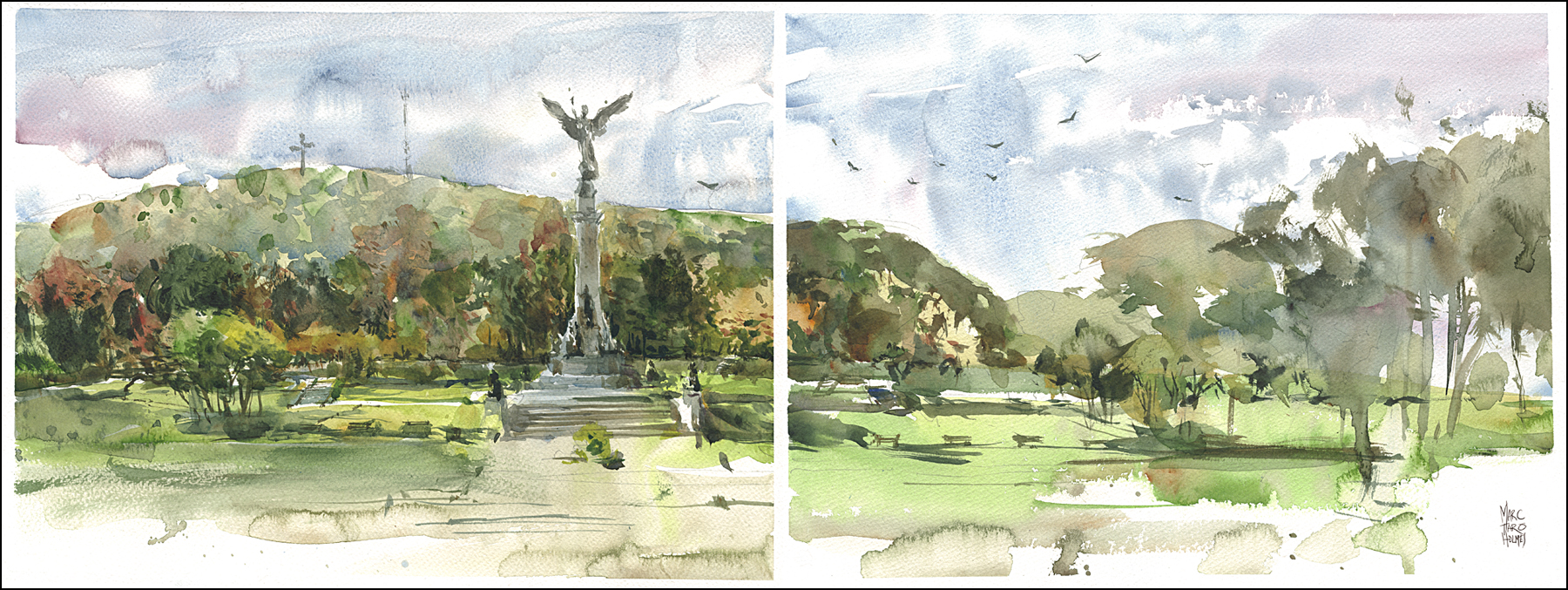
These are from a few days back, when the leaves were just turning. This was the last awesome day of the year. 25 degrees, sun and a light breeze. I had no choice but to ditch work and go painting. It’s very likely this was the last great painting day of the season.
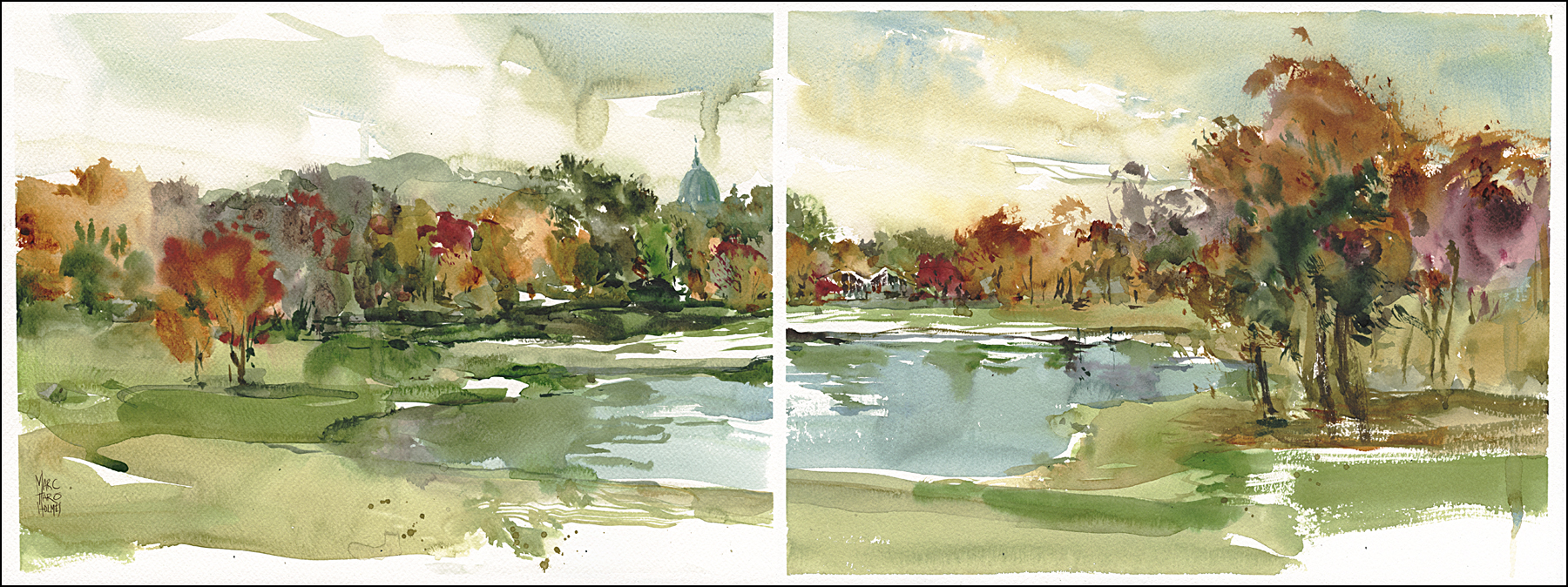
This weekend we’re headed to Ithaca NY for some more fall colors. There should be sketchers converging from NYC, Toronto, Montreal and Kitchener/Waterloo. If you’re anywhere near the area and you’d like to come painting, here’s a MAP showing where we will be, when.
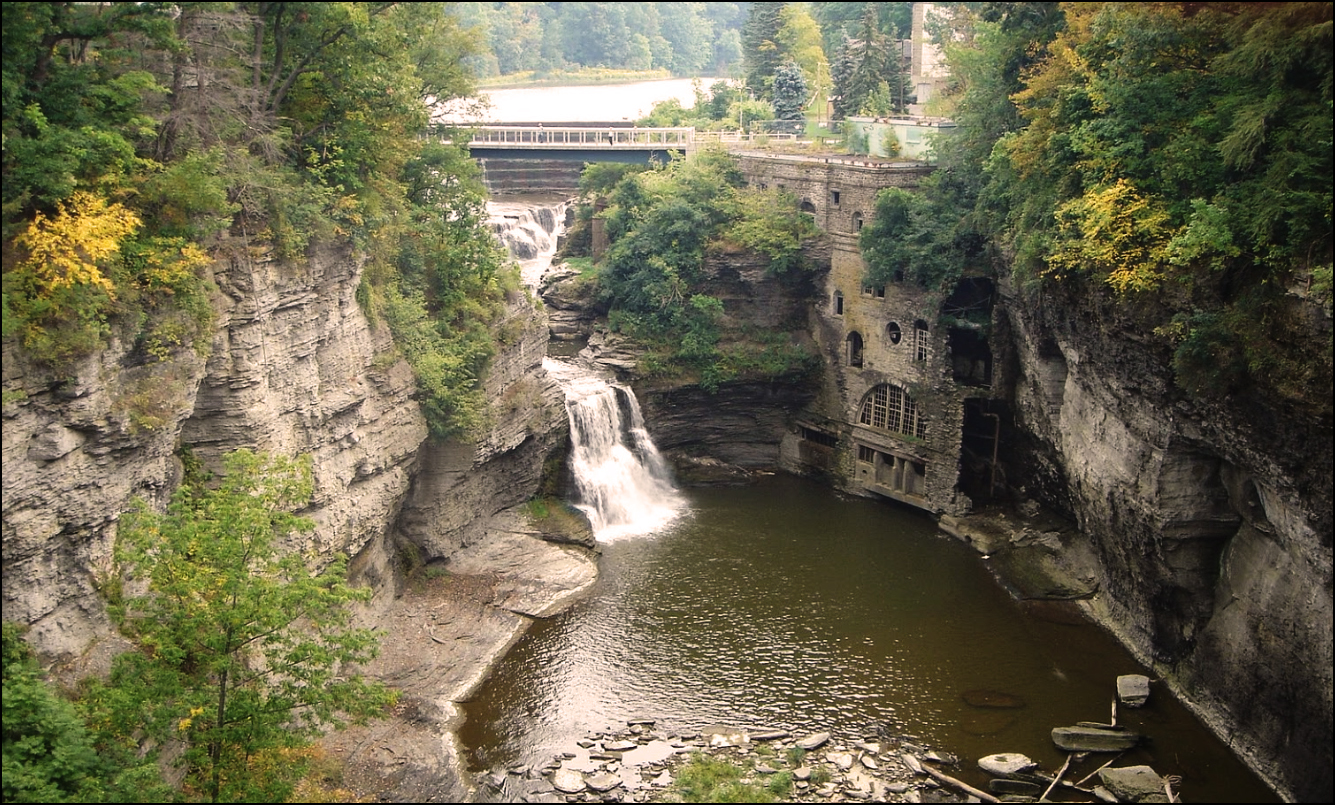
This is Triphammer Falls. One of the locations I hope to sketch while we’re there. Watch this space to see what we get!
Copies of The Urban Sketcher going out the door : About half way through my author copies

Hot off the presses. Tonight I’m signing books for the people that pre-ordered directly. Just mail me if you’d like a signed copy with artist print. Or – for the best price: Order from Amazon
Everything old is new again : Getting excited about Dipping Nibs
Everyone who sketches has a love of pens. We all have a collection of our favorites, the ones that feel right in our hand. I’ve certainly laid down a lot of miles with my personal trifecta: a ballpoint, the Lamy Safari, and the Pentel Pocket Brush (replaced these days with the Kuretake #13 plus Sable tip add-on).
But.
I think I might be ready to retire my manufactured pens, in favor of dipping nibs. These little tin nibs are just so flexible. (Pun intended).

The great thing about nibs – they come in so many sizes and shapes – you can get a whole range of drawing styles for a few bucks. My mainstays (right now) are: a new Japanese crowquill called a “G” nib (used for fine lines). A weird Brause nib called 361 Steno or ‘The Blue Pumpkin’. It’s a larger nib featuring a gunmetal blue finish. It seems to be a bit more flexy, offering a large range of tapering marks. And some chisel tips from Brause in 1 and 2.5 mm, used for bolder brush-like marks. These chisel nibs are the grandfather of the new ‘Parallel Pen’ you may have seen on the market.
Most of these were in the back of a drawer for 20 years, so I have no idea where they came from. But these days they are all available on JetPens.com. Or, if you prefer to shop locally, just look for a stationers with a calligraphy section.

The first thing you’ll notice, drawing with a dipping nib, is the nice range between thick and thin marks you can make. They’re much more responsive than a fountain pen. For me, the next huge discovery is how easy it is to switch colors on the fly. And to jump around between water proof and water soluble on the same drawing. I have a little fleet of jars with different custom ink mixes. It’s like alchemy, combining colors to get a favorite shade.
Yes, you could just carry a fat handful of pens (like my online crush Andrew Tan), but you’d need quite a few fountain pens to cover all the combos of nib styles, colored inks and solubility. I enjoy the elegance and efficiency in this minimal kit of pen nibs.
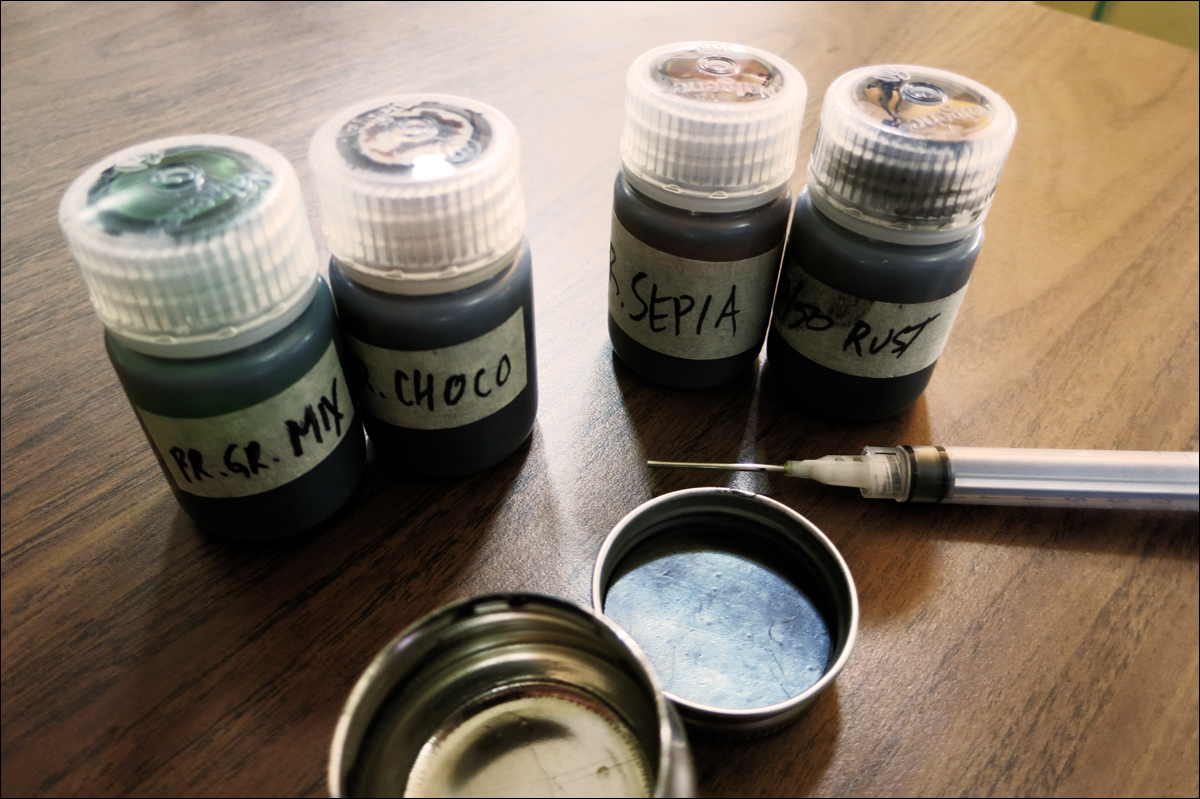
Shown here: 1 oz (30ml) Nalgene jars (leakproof). Syringe with large bore needle for measuring out ink mixes. ‘Clip-on’ oil painters medium tin that can go right onto a sketchbook or drawing board. I have four of them, from the Guerilla Paintbox brand – these have a rubber seal to prevent leaks.
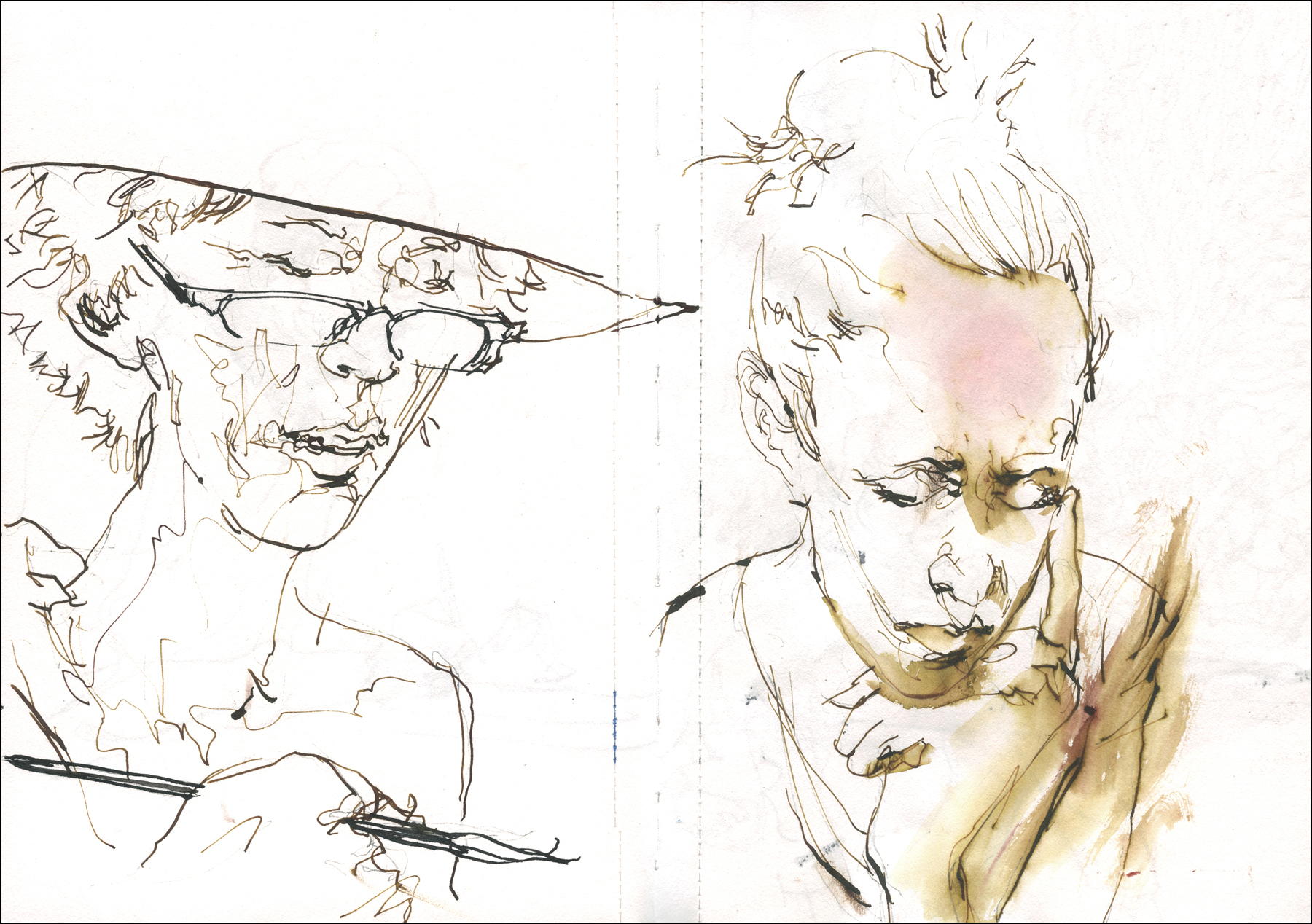

Doing these ‘research drawings’ side by side with some traditional Lamy pen work had me saying “Time to toss out all the modern conveniences!”.
The only thing holding me back is the issue of mess. There is a much higher risk of ink spots, drips and stained fingers. And perhaps one day a serious spill. But you know, I think the risk is worth it. There is an energy to a messy drawing that I enjoy. I don’t want it to be perfect. If I wanted that, I’d go back to my previous career in digital art.
Next pen drawing outing (not sure when that will be – let me know if you want it soon!) I’m going to try Kiah Kiean’s ancient Chinese trick – filling a bottle with gauze, which is then saturated with ink. I want to see if this makes it spill proof. I’m not sure if it’s going to interfere with loading the pens with enough ink. More on that soon-ish.
~m
Dawson College Watercolor Class Demo : White on White
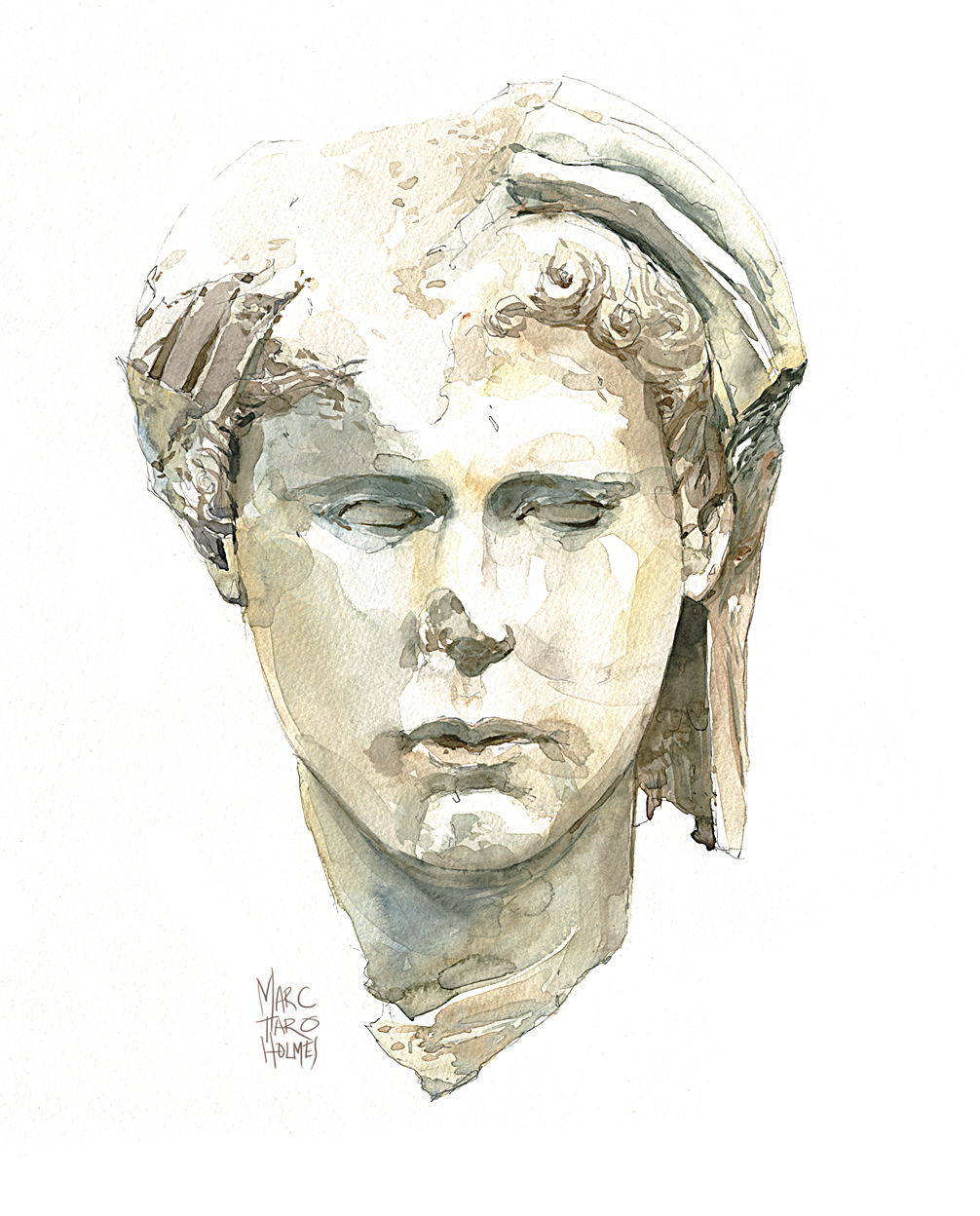
I’m at Dawson College right now, doing a watercolor demo for the illustration class. This was my dry run. I like to do a version of a demo the night before, to improve my chances in front of an audience.
This guest appearance is something I’ve been doing for the last few years (2013, 2012). I hope it goes well. I had to be here at the ungodly hour of 8:30am. The first thing I’ll tell them is, as a professional artist, you will never have to be up at 8:30 again. Except that’s a total lie, as I was doing it all week in Brazil. But I digress.
I like doing this lecture. It’s just a brief demo, but it’s been helpful for me – doing it once a year. Clarifying how I talk about the three steps in the Light > to > Dark, Large > to > Small painting process I call ‘Tea, Milk, Honey”. (More info on that here and here).
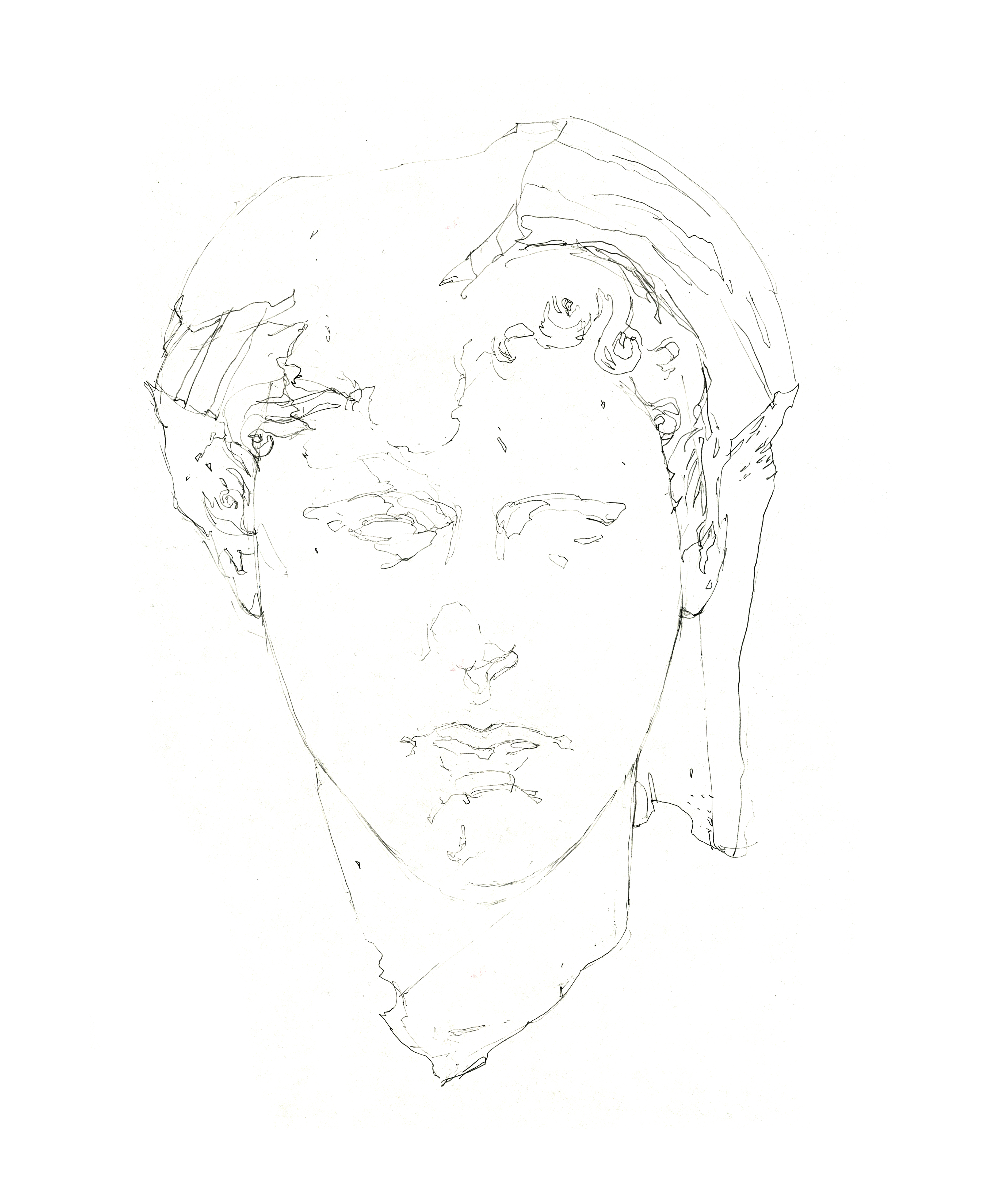
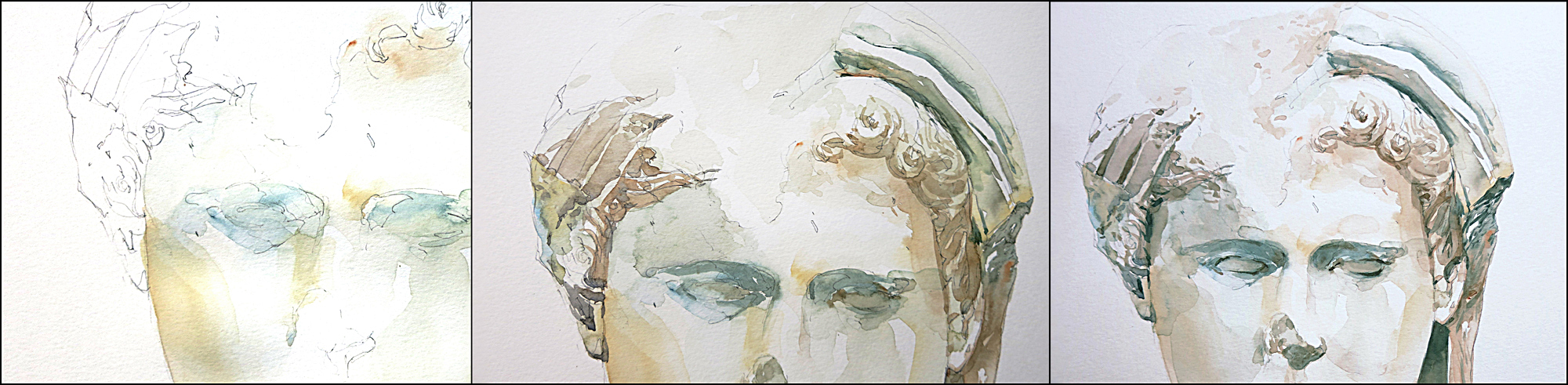
Here’s an attempt at recording the three steps, Tea, Milk and Honey. Apologies for the image quality in these shots.
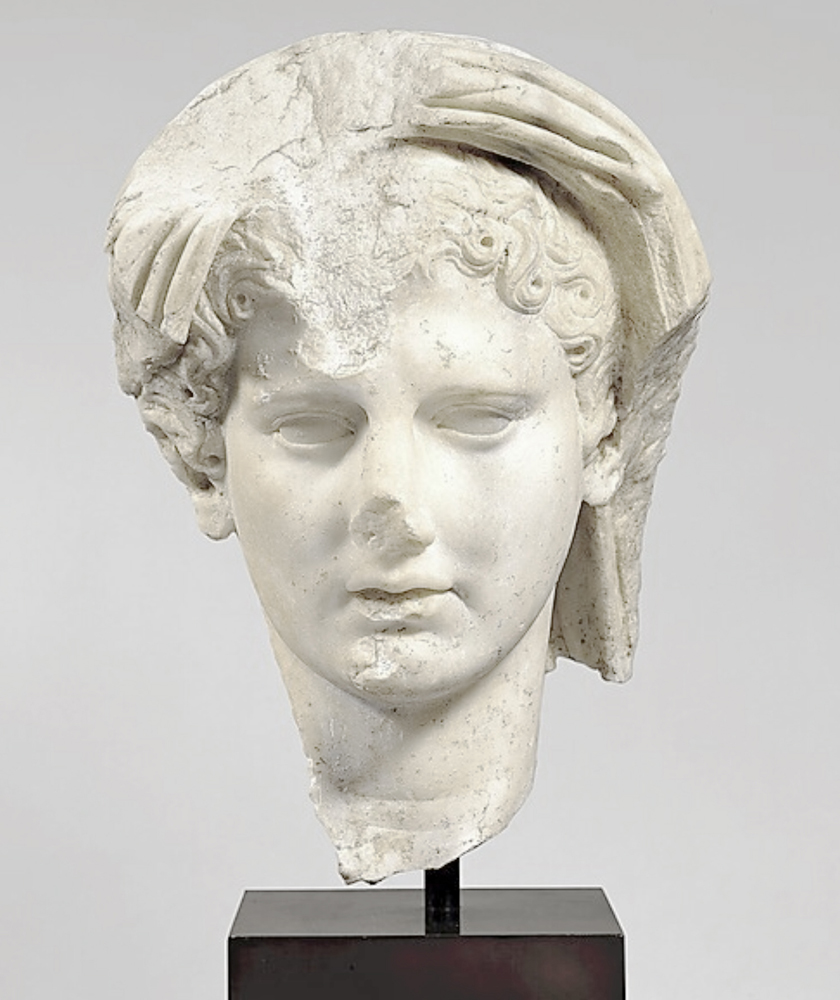
Here’s the reference image I grabbed off the googles. The assignment the students are doing is ‘White on White’. A classic art school project designed to test a beginner’s abilities. You have to have a light hand, building up tone carefully, or you quickly go too dark. I found it quite tricky myself – as I’m normally trying to push watercolors darker than is natural. For this high key image I had to modify my Tea Milk Honey process to be more like Tea, Tea, Strong Tea :)
As you can see, I’ve ended up with a lot more color than in the reference. I couldn’t help it! At the end of the day, what’s the point of making a painting, if you can’t splash a little paint around. This kind of sculptural study would probably be better as a pencil drawing assignment. I did studies of white eggs and crumpled sheets of white paper as a student. I seem to remember we did it in charcoal. In any case – it’s a nasty trick to pull on a beginner in watercolor! Watercolor is hard enough without trying to be tonally accurate.
But – they are illustration students, not mere fine-art dandys and I know from my own illustration work, that precision is important at times. This is just the sort of training you need to build up the hand skills.
~m
Urban Sketchers Montreal : Sketchcrawl at Atwater Market
USK:MTL just recently did our Every Fourth Sunday Sketchcrawl at the Atwater Market. Was a gorgeous fall day. And I don’t use the word gorgeous very often. I’m starting to think it’s the being outside that I like, even more than the sketching. That and the great people :)


Peter Scully and his Sketching Maps

USK correspondent Peter Scully is doing this wonderful thing, where he puts up hand drawn maps to great sketching locations.

I think this is the best idea ever. I absolutely want to print out his sketched maps and follow the routes looking for hidden sketching treasure.

Follow his blog to see what other brilliant ideas spring forth from his ginger head.
Watercolor Sketching in Rio de Janeiro : The Three Big Shapes
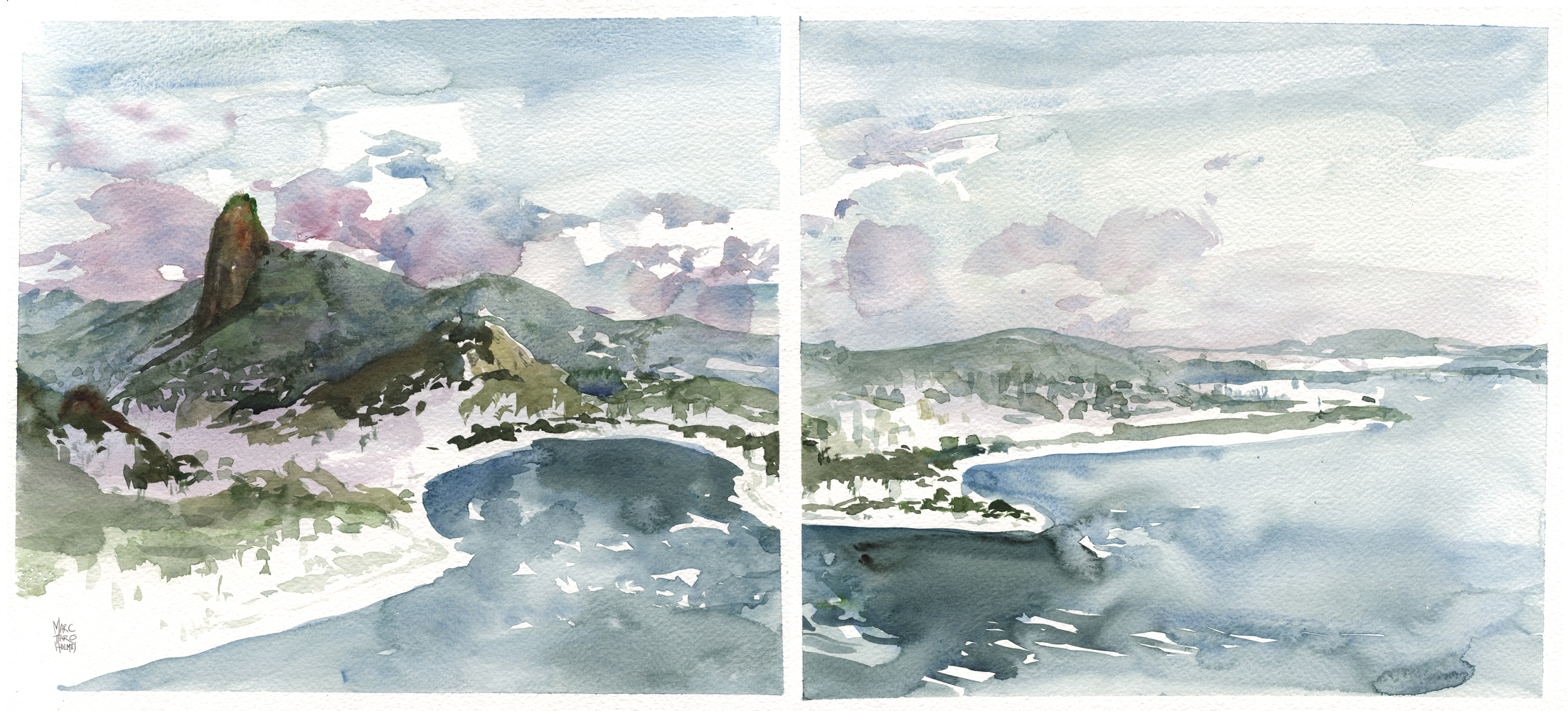

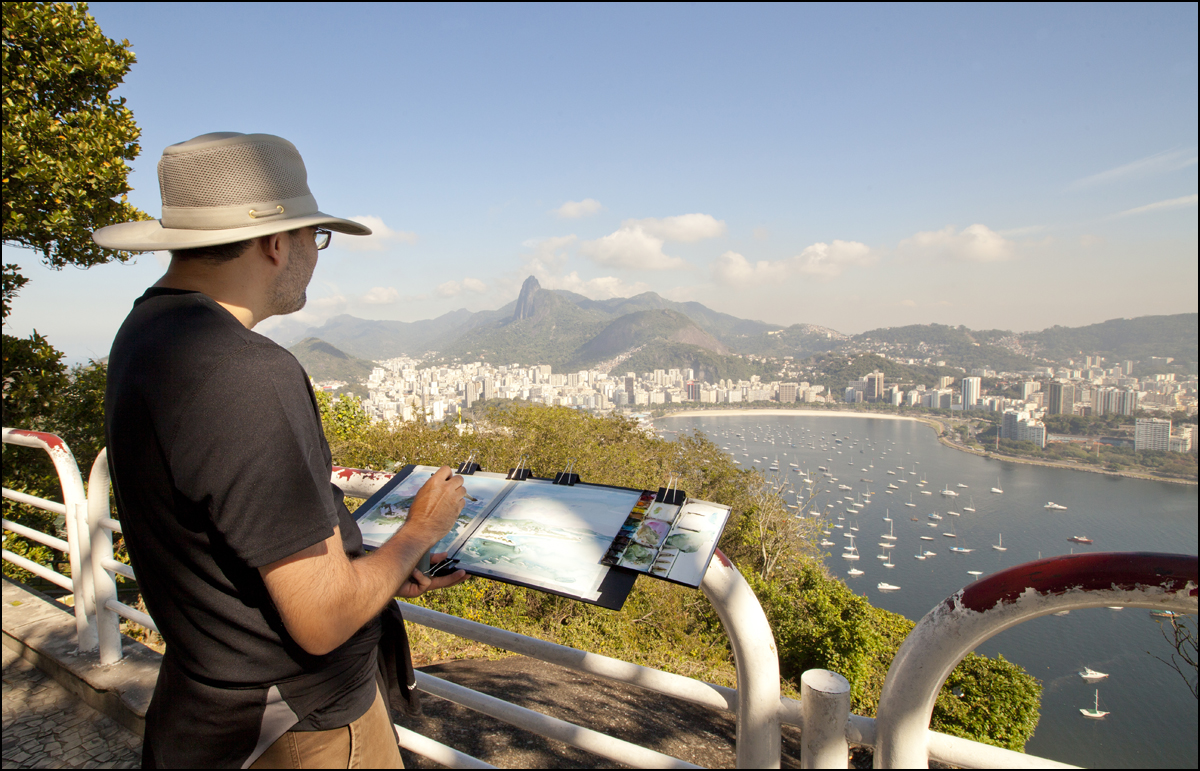
Rio de Janeiro. This town seems impossibly picturesque. The combination of mountainous coast and teeming metropolis. A landscape like nowhere I’ve been before.
A view like this has to be painted with a keen eye toward simplification. What are The Three Big Shapes? (This is one of my code phrases. Mantras I use to keep myself on track). Here, they are Land, Sea and Sky – with the white city being the shape left behind.


This one is my all over favorite sketch from the whole trip. This is winter in Brazil! As a Canadian, this is rather incredible. As the day warmed up and the sun moved, we got Land Sea and Sky in a different set of colors.
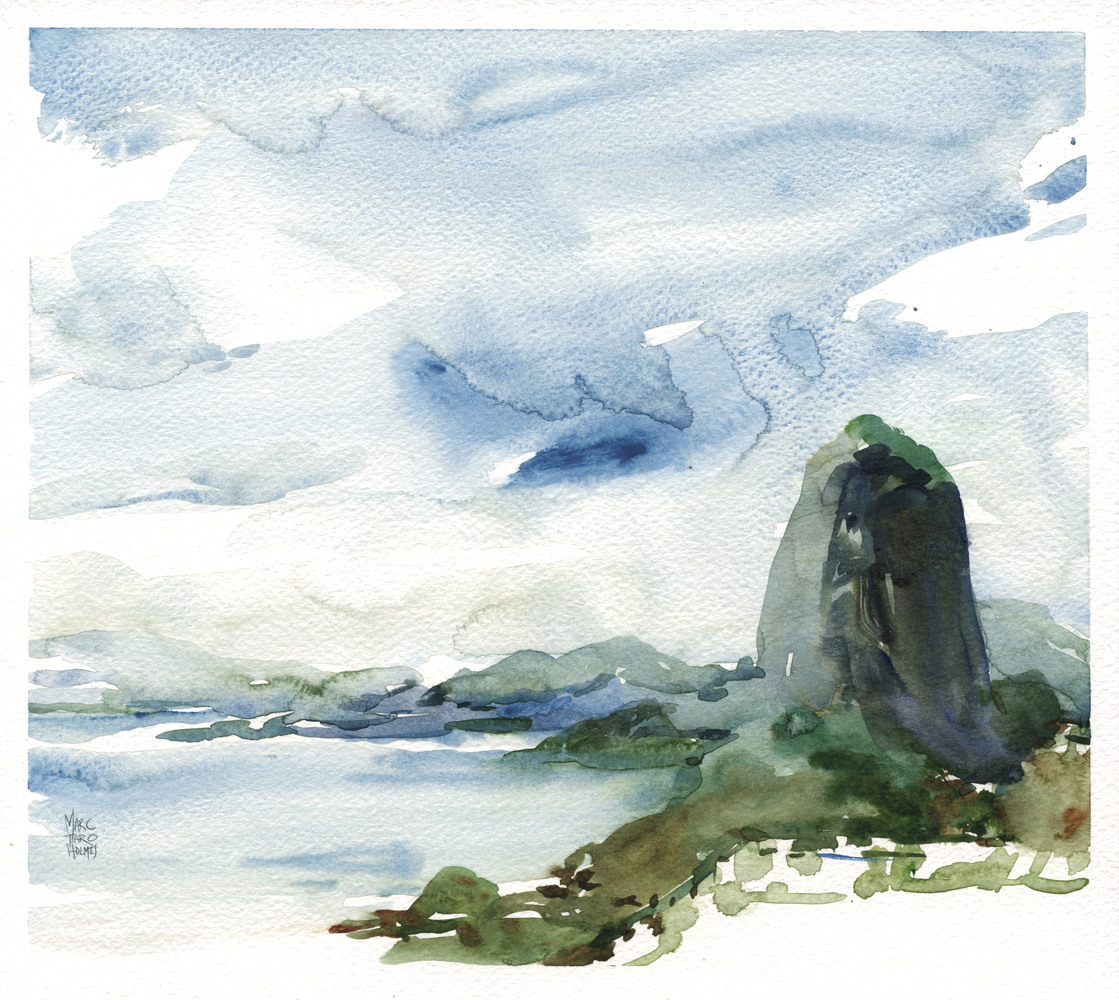


The best thing about traveling and painting with the group. Well, there are many best things – the great company, the shared motivation to paint, paint, paint – but also, being able to look over at a friend’s paintings and see – wow, that’s what I need to do! Exactly there! My rapid sketch of Sugarloaf mountain (above) was cribbed right out of Omar Jaramillo’s sketchbook.

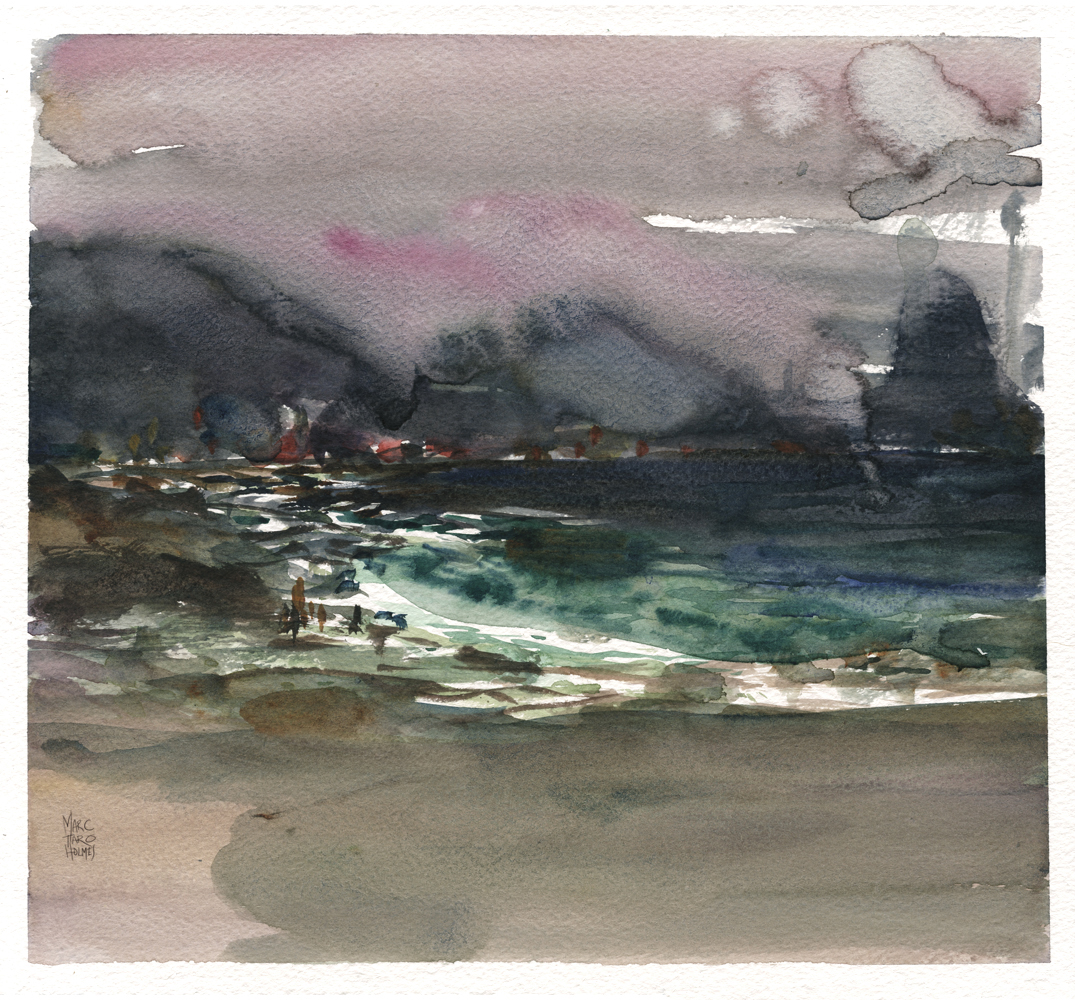
This last one, a fun experiment. We were walking back from a long day sketching, and Linda Permann dared us to sketch one more – on the beach, in a puddle of streetlight, looking at the dark water. Isn’t that awesome? Sketching buddies that won’t quit, even when the sun goes down. I honestly had no idea if this was possible, so I’m quite happy with the way it turned out.
Every one of these sketches from Rio is something I’ve never seen before. That is what I love the most about urban sketching. Experiencing something new wherever you go.


Sketching Paraty, Brazil : Silhouette and Subdivide

The second stop on our tour of Brazil was the little town of Paraty, where the USK symposium was held. Paraty is a port dating back to colonial times. I hear it was the launching point for ships full of gold heading to Spain. Today there is continual boat traffic taking visitors up and down the coast on sightseeing cruises.
The part of the town used by tourists can’t be much than ten square blocks. The whole thing has been restored with cute white plaster houses, clay tile roofs and cobblestone streets. There are three big churches for this tiny village, but otherwise it’s all gift shops, small galleries, restaurants and hotels. Beyond a series of chained off streets keeping out everyday traffic there is a normal Brazilian town with the businesses you’d expect in a tourist destination. Bike rentals, the boat tour operators, t-shirt shops and hostels.
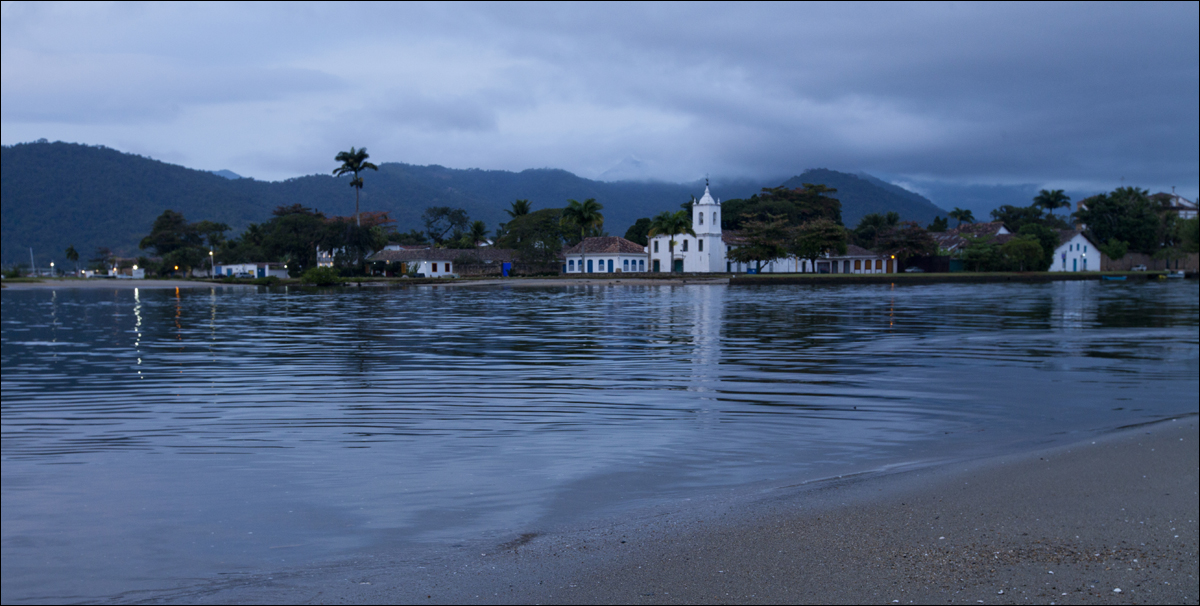
On the tourist side, everything is a kind of artificial quaintness. On the real world side, it’s a little more gritty. Normally I wouldn’t pick this town for a sketching location. You’re not going to see any ‘real life’ going on here. But for our purposes, it was an ideal setting. We were able to wander around at all hours, getting from spot to spot in minutes, essentially taking over the entire town for our private sketching party. Quite a different experience from last year’s symposium set against the hustle of Barcelona.
This made it the most productive USK event I’ve been to – in terms of getting my own sketching done outside of my ‘work day’ teaching.
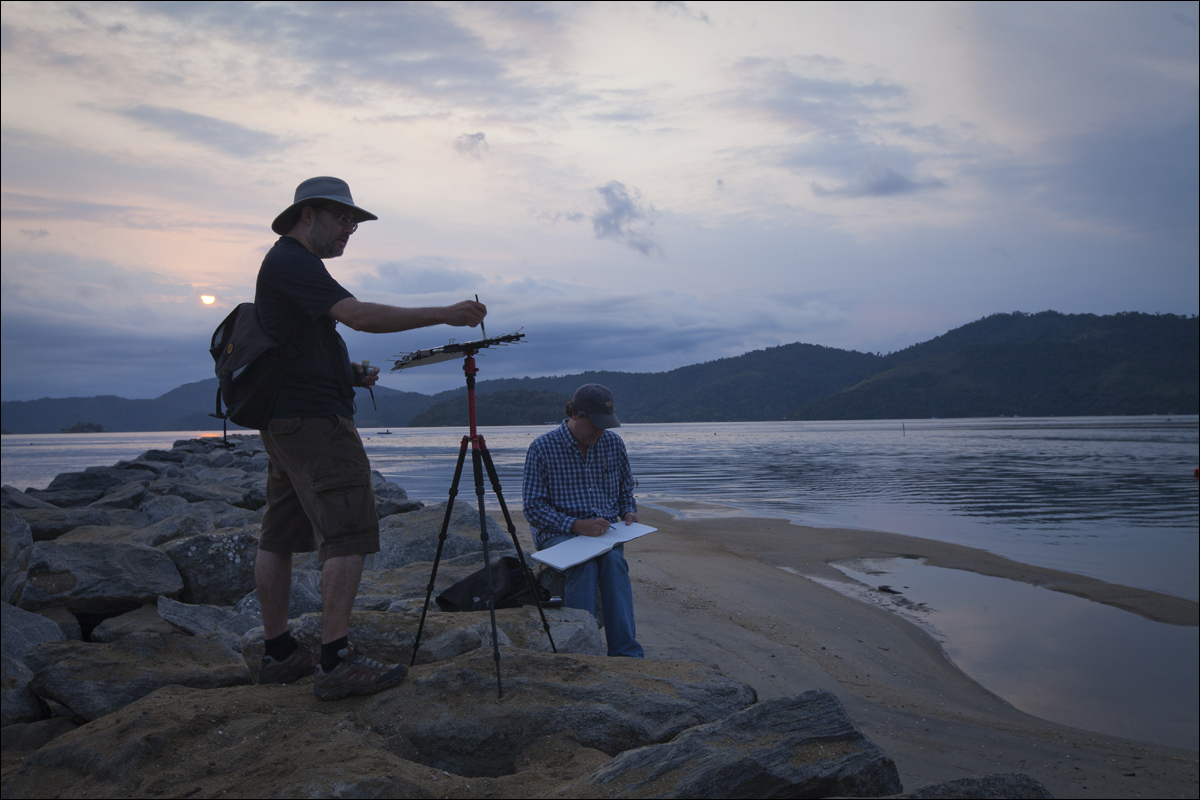
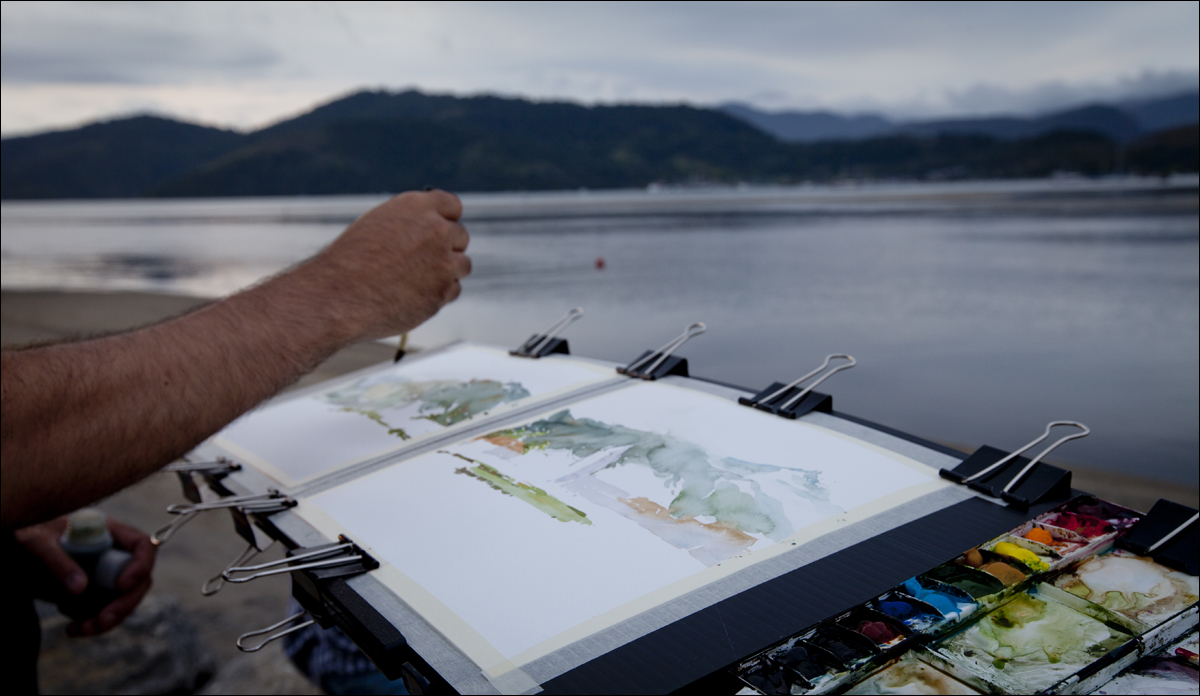
Each morning of the workshop some of the keener painters would be up early. We had about a hour between breakfast and first classes to get a sketch in. Some of the extraordinarily keen would get up before breakfast and paint, then stop back for those Brazilan cheesey puff ball things that the hotel puts out every morning.


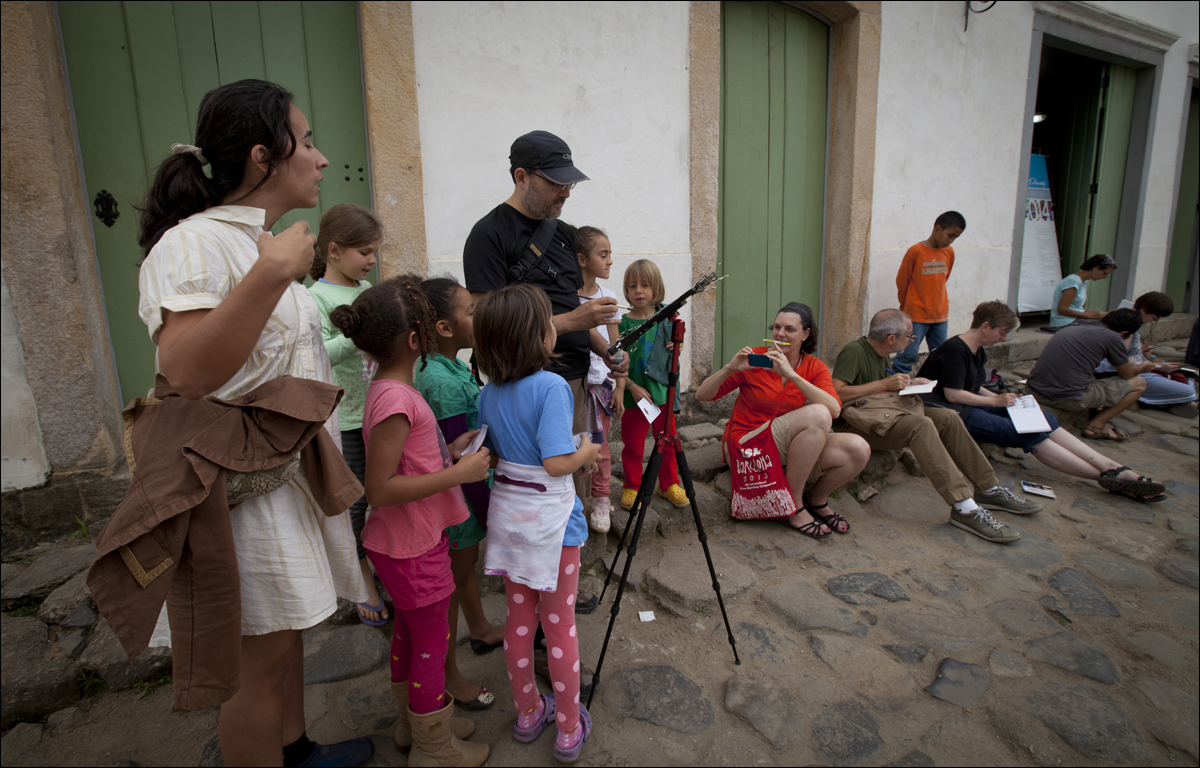
The first day many of the international instructors ended up sketching right outside the hotel, just sitting in the street and catching new people as they got up and out. Eventually we had half of the symposium sitting in the street, getting right down to why we were there – obsessive sketching!
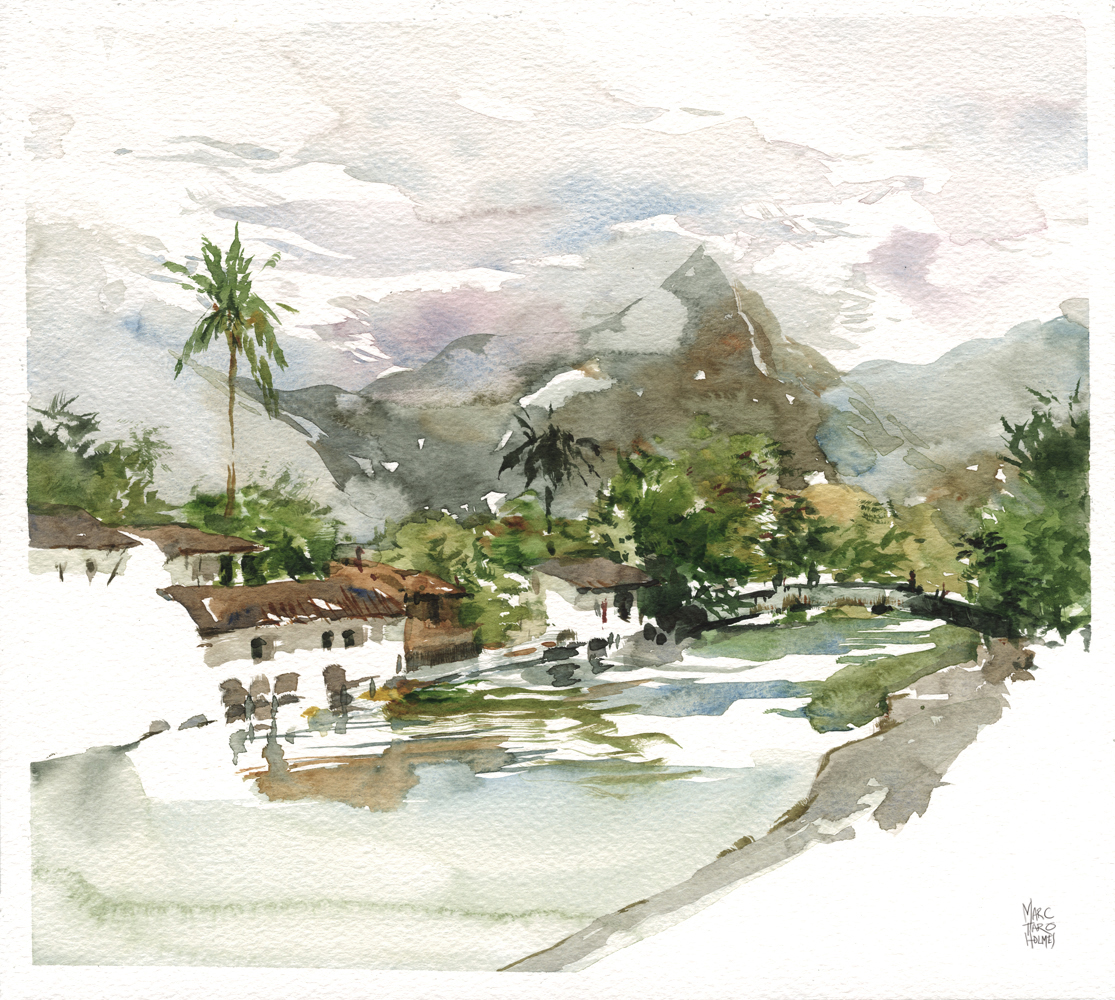

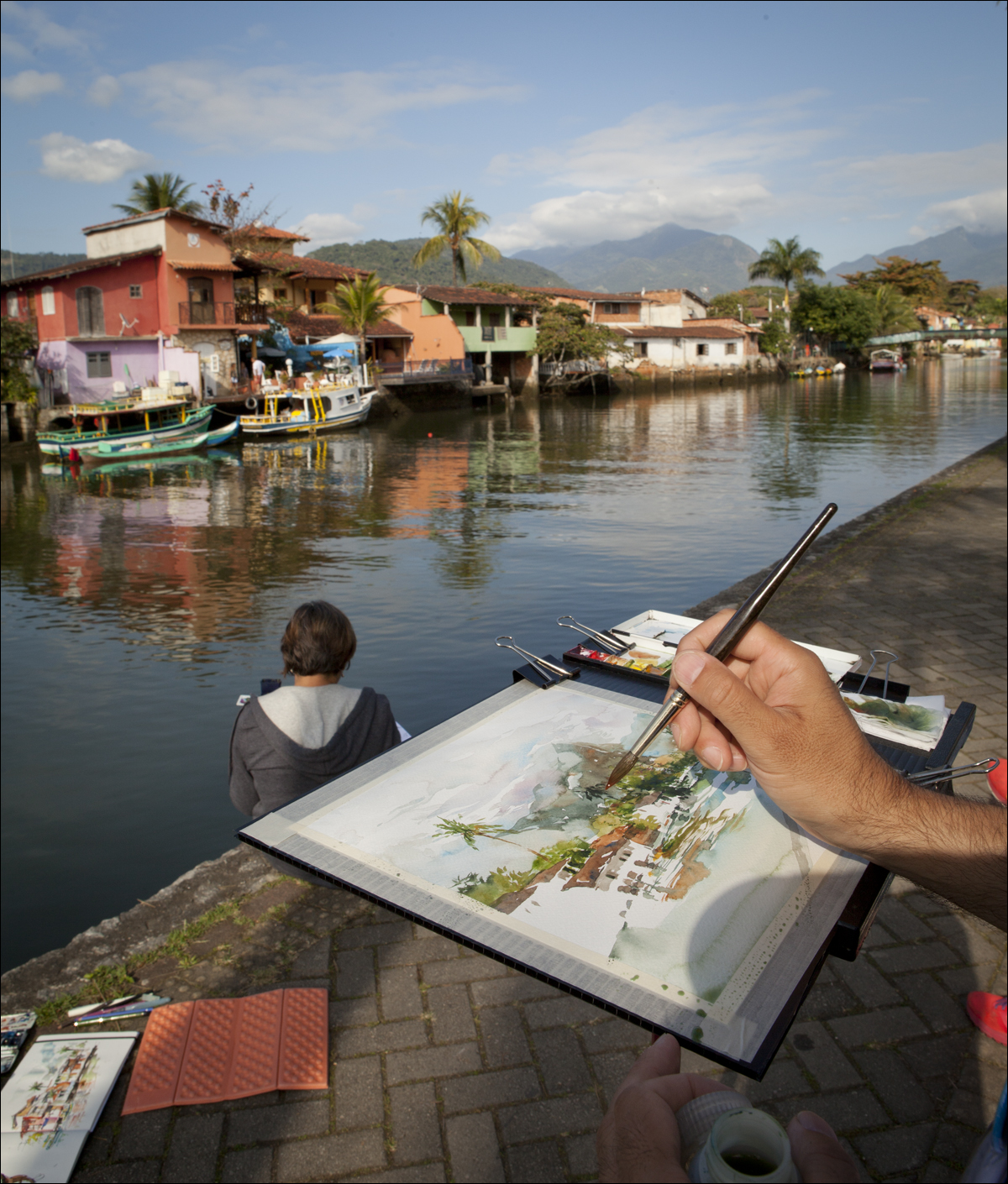
One of the fun stories from Paraty. Local people passing by on the way to work would naturally ask what was going on. This day we could say we had sketchers on the bridge from India, Scotland, Iran, Sweden, Australia, the USA, the UK, and Canada – painting together, learning from each other and having fun.
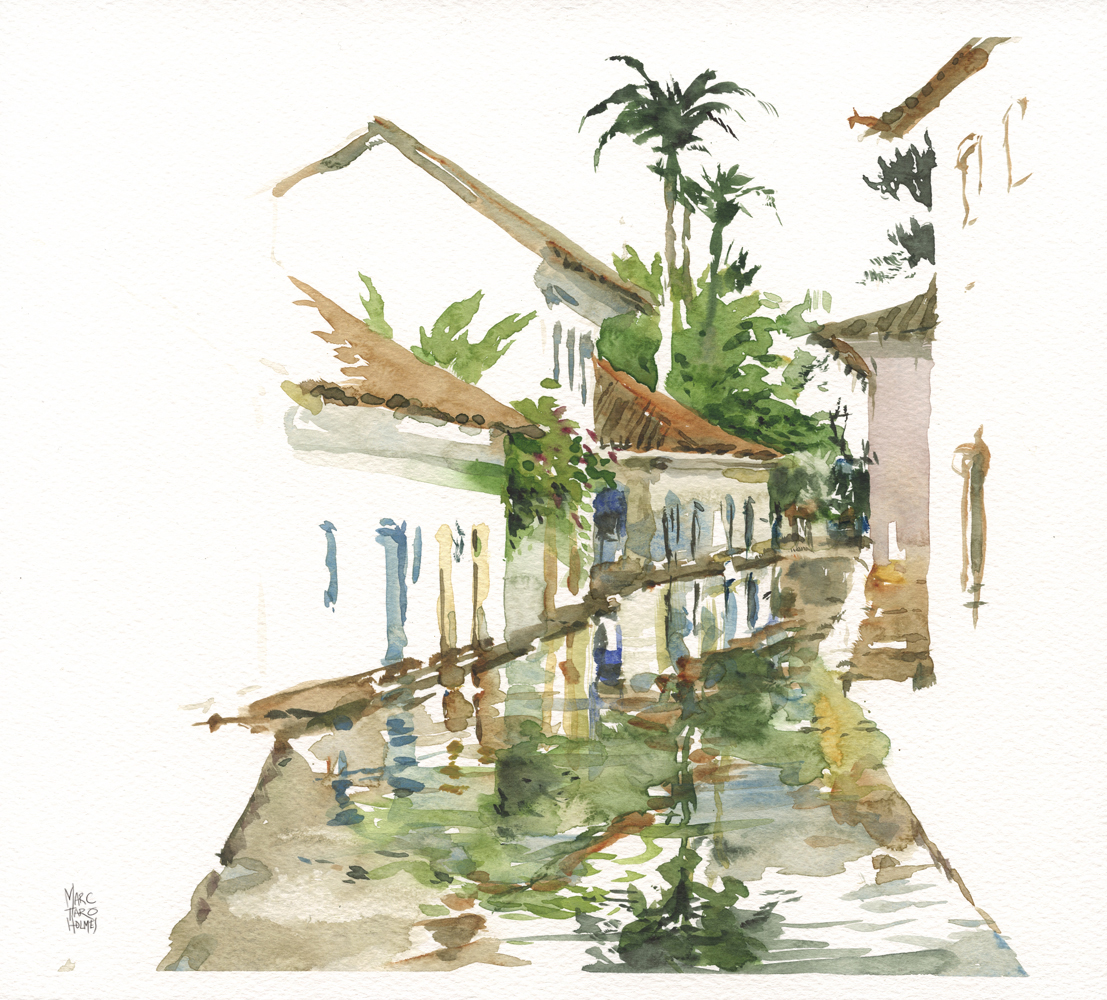


Sketching out in the world, you are always seeing something unexpected. The streets flooding with sea water at high tide was fairly unexpected. But so was this horse strolling through the flood. What happened next was less unexpected. What would be the worst thing a horse could do while splashing by you in a muddy street? Yes, that happened.
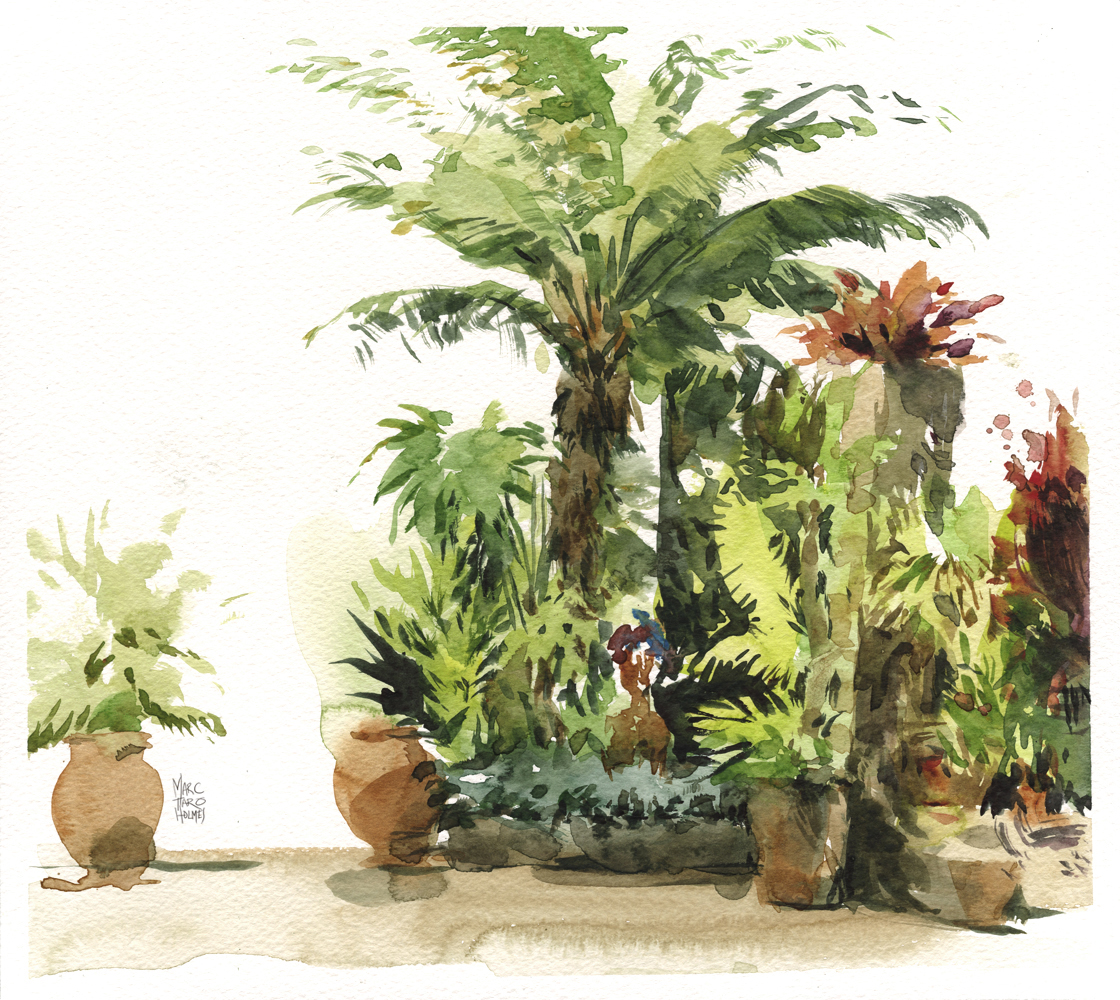
This is my first sketch done in Paraty, in the courtyard of our hotel. I think regular readers of my blog will see what I mean by the phrase Silhouette and Subdivide. It’s all encapsulated in this image here.
(For the history of this thought process, go back to my Direct to Watercolor series of posts).
The common strategy behind all of these rapid sketches is to look for the largest silhouette shapes in front of you – such as the broad leaf palms or the egg shapes of the clay pots. Place them down in a single brush stroke. Once you have the composition (it only takes moments to make a few big shapes), you can then look at each shape and see how it can be subdivided with the darker tones of shadows.
This is the logical followup to the ‘colored sketching’ exercise Tea, Milk and Honey that I teach beginners. After you TMH over a few dozen (well, maybe more) sketches, you’ll find you don’t really need the drawing any longer (if you don’t want). My how-to book on Urban Sketching goes back further, to the very beginning of this learning curve, starting with how to see silhouettes and shadows when drawing.


 Citizen Sketcher