Tilting at Windmills : Painting Quebec History

This one is from back before the book release started to envelop all my available time. It’s from my summer watercolor sprint. The work I did just before heading to Brazil.
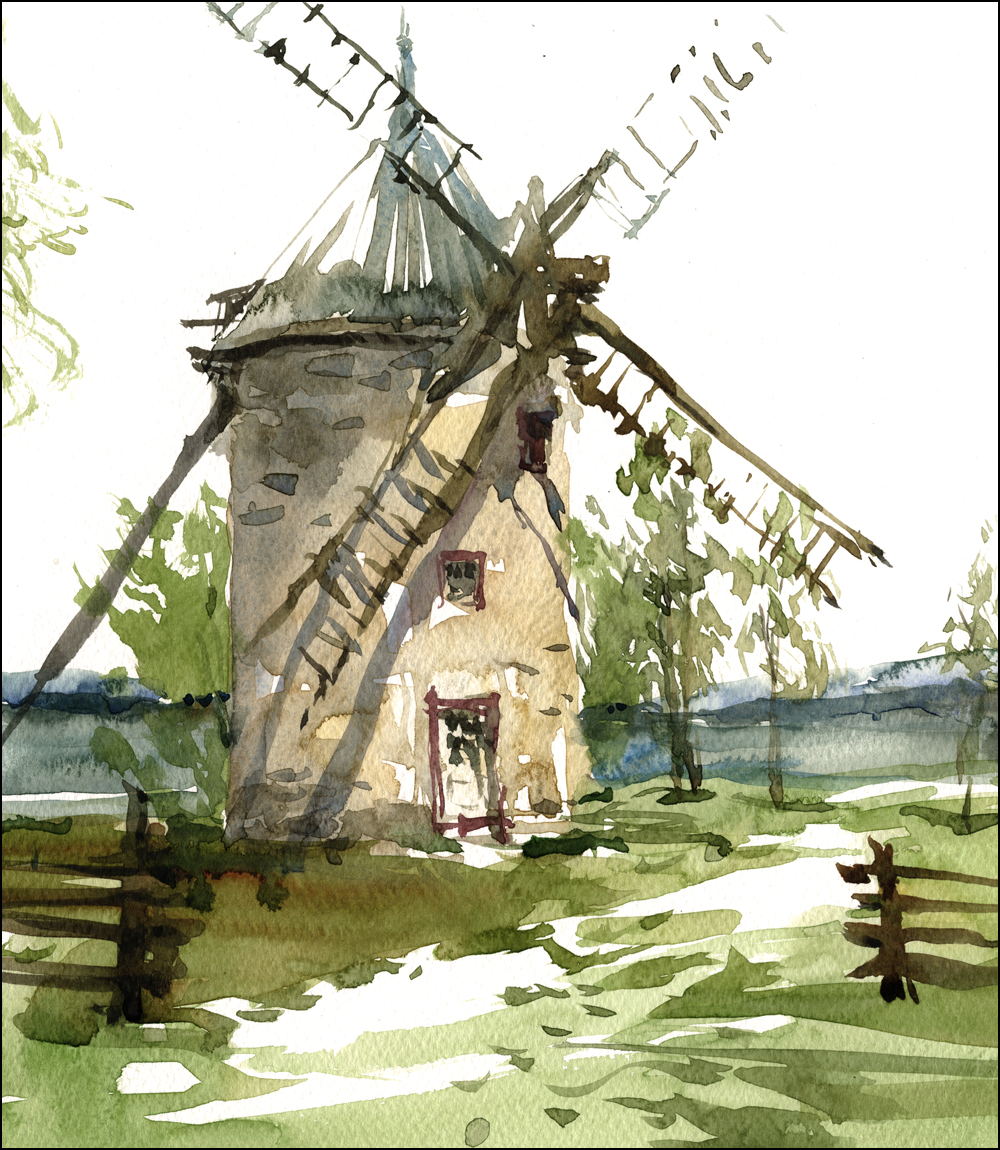
This quaint windmill is on L’Île-Perrot in the Pointe du Moulin – a tiny park on the south east tip of the island. In the summers they have a bit of historic recreation going on here, but I missed the costumed docents for the year. I did however, meet a genuine Voyageur.
While I was painting, a fellow beached his canoe. As I sketched, he proceeded to unload about 500 pounds of gear, and carry it, then his canoe, up the bank to the parking area. It was worth striking up a conversation to find out what was up. He told me he was just back from three months canoeing the great lakes – a few weeks of that being lost in terrible weather – trying to follow routes established by his grandfather. Not for any reason, other than to be closer to his heritage as a Quebecois. He was quite the physical specimen. Looked completely the part of the rugged outdoors-man. I didn’t doubt any part of his story, and was impressed to have met him.
That chance meeting is exactly why I love painting out in the world. You can never say what’s going to happen on a given day.

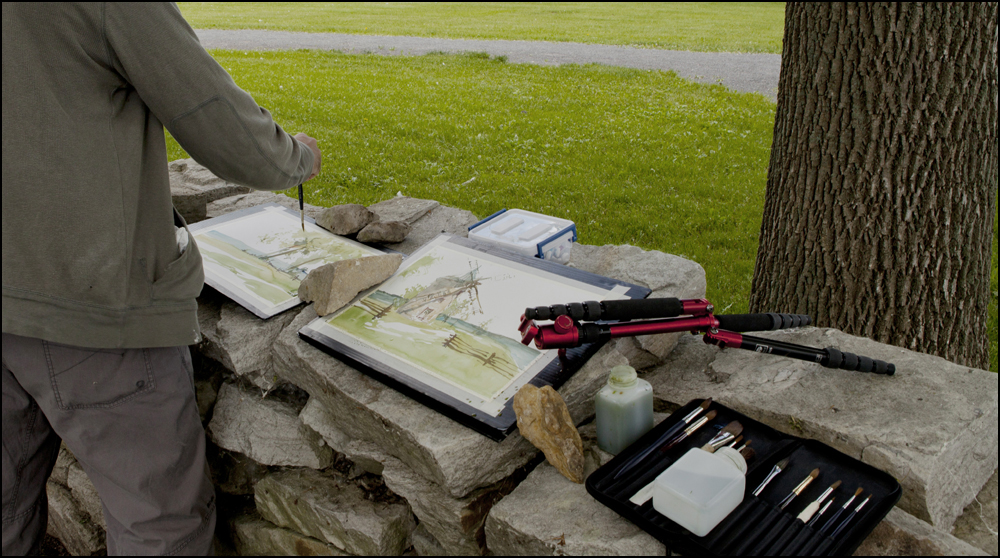
This outing, I’d forgotten one key part to my tripod. (The threaded bit where the drawing table attaches). Fortunately I could use this stone wall as a table. I did have to pile rocks on the drawing boards to keep them from blowing away. I think the unsteady work situation added some excitement to the brush work. That and all the spiders coming out of those rocks. I was careful not to jump around like a little girl while Mr. Voyageur was anywhere near by.
Webinar about The Urban Sketcher
I’ve just done an online lecture for my publishers video network (artistnetwork.tv). They’ve posted a recording of the webinar. [HERE] If you’re curious what’s in my book The Urban Sketcher, you can listen to me talk (while you see my powerpoint slides). I do a walk though of all the concepts in the book. It is, I will fully admit, a sales pitch – but I’ve tried to be entertaining.

I should also mention – they have a discount code, which is active for the next 28 days), use HOLMES10 at checkout! (Only on North Light Store, here).
How to shoot a Sketcher : Photographers at a sketchcrawl
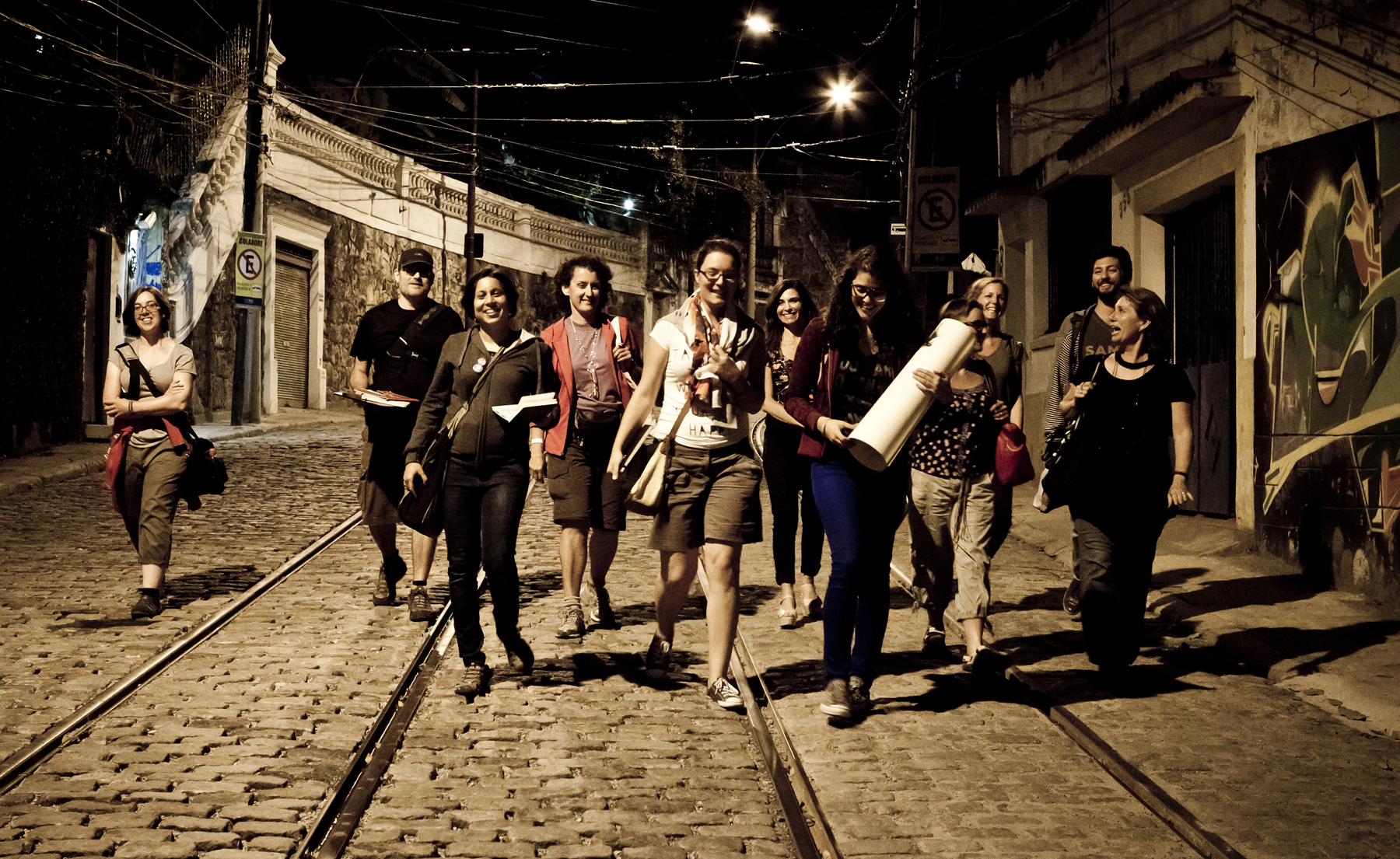
I have the great fortune of being married to a photographer. It’s really the best thing for an Urban Sketcher. To have a partner who is always available to photo your events. I expect I’m not the only one who has a friend that doesn’t sketch, yet would still enjoy coming out to a sketchcrawl.
Here’s a set of photos from Laurel Holmes’ coverage of Simo Capecci’s workshop in Paraty, Brazil. We can use these to show some tips on shooting sketchers, and sketching events. These kind of shots aren’t always high art – but they’re the kind of reportage sketchers love to see after the fact. The documentary footage of how the drawings were made.
You can read about Simo’s class on Reportage, in her own words over here.

The Establishing Shot: Set the scene – show the sketchers arriving on location. Give people a sense of the adventure, and the time and place.

Stalk the Instructor: Naturally, it’s important to get some footage of everyone, but try to be focused on the instructor (at least during the intro lecture). It gives you shots that emphasize the key concepts being taught, and it’s nice PR for your instructor, who is often a volunteer at a USK event.

Sketcher’s Eye View: Looking over the shoulder, to see what the sketcher is seeing. This works especially well when paired with the sketch later. In some cases you can even get the drawing in the shot as well as the subject.


View of the Sketcher: The reverse angle is great too. A portrait of the sketcher at work, with some implication of what they’re interested in. Hard to get when the subject is far away, easier in this example. This can be done with two shots pasted side/side as well.

Teaching Moment: Get the instructor and students in some one-on-one interaction. It’s a good memory for the student.


The Crit: Always shoot the Critique – the time when people are sharing and learning from each other. Usually these are good documents of who was there on the spot, and how much work was done.

The Sketcher in Portrait: Ideally, you’ll be able to get one of everyone – sketchers always look so studious! Try to wait for good posture, and not catch us squinting, please and thanks :)
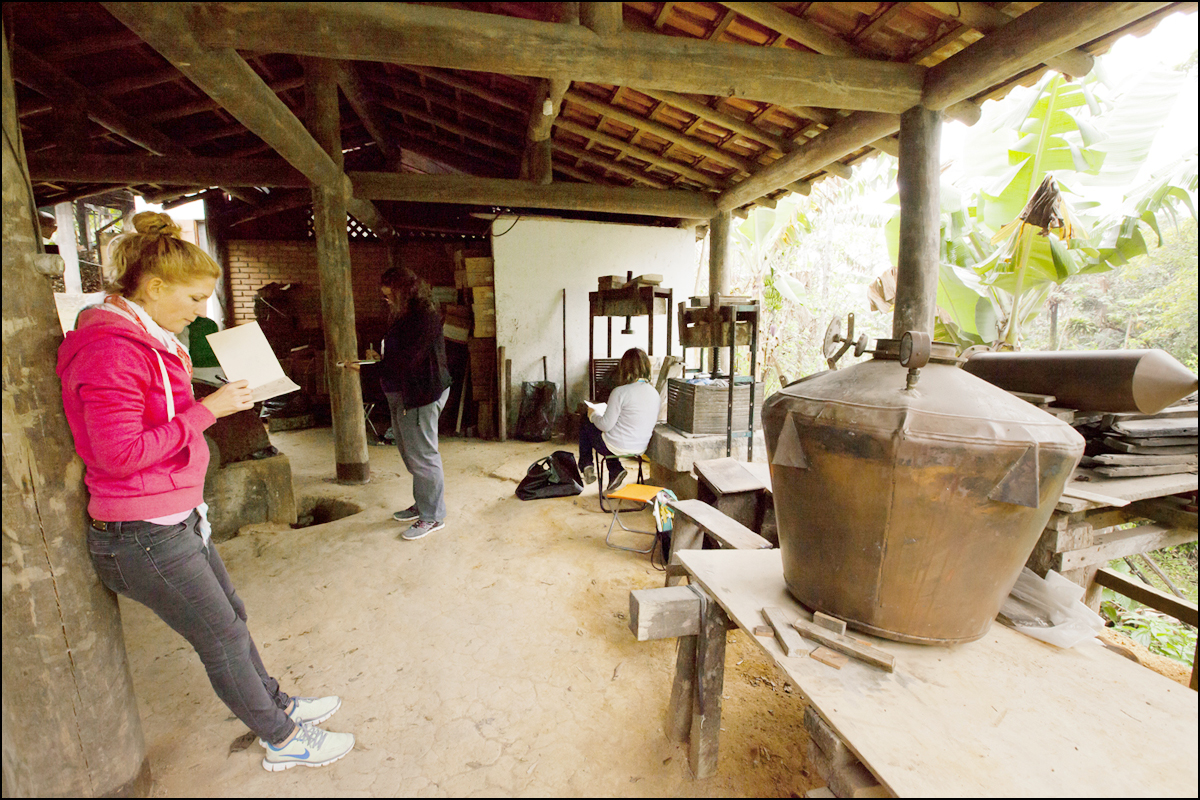
The Wide Shot: If you can get a few people in, with the context of what we’re sketching, it helps to underscore that Urban Sketching is a team sport.
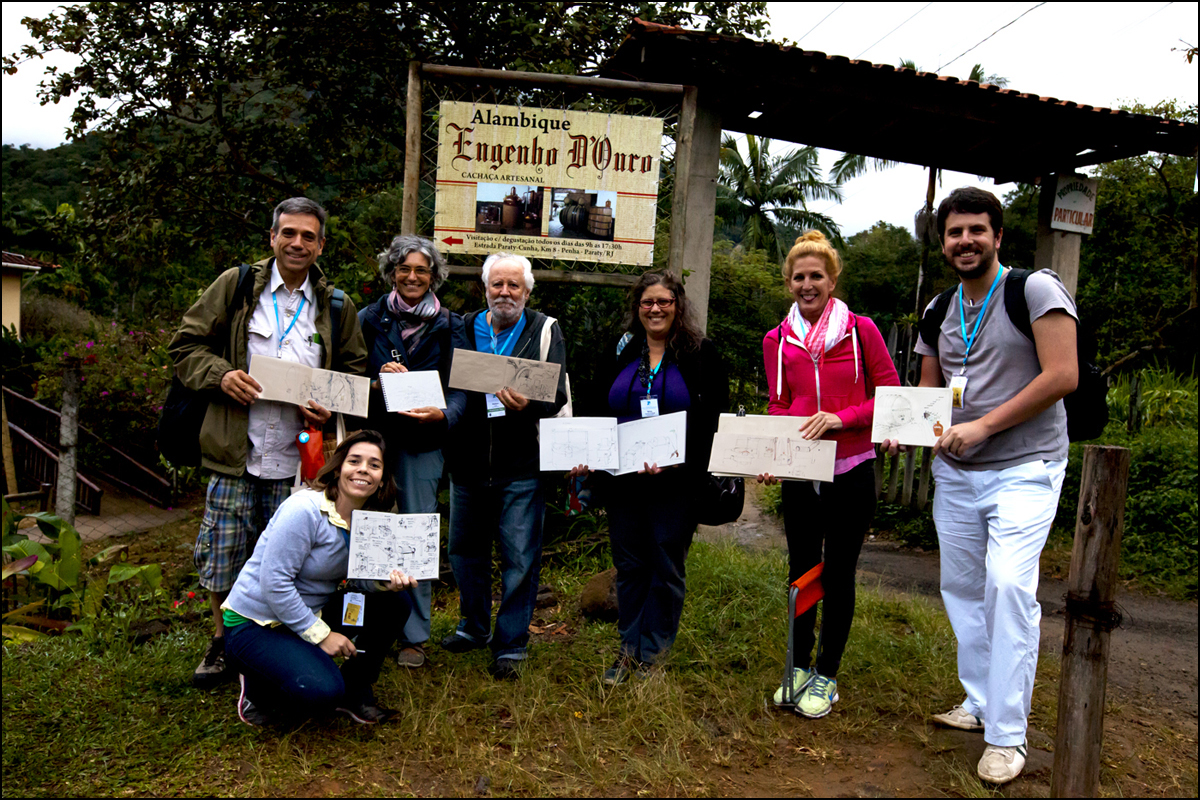
The Group Shot: This is the least ‘artful’ kind of shot – but come on, you need one of these. Years later, you want to know who was there.
Then fill it in with some ambiance – shots that include sketchers, and the subject matter, with some emphasis on people having fun.
That’s about it. Thanks for reading, and I hope more of us can bring photographer friends along to their sketchcrawls!


Art Now : Free Lecture Series
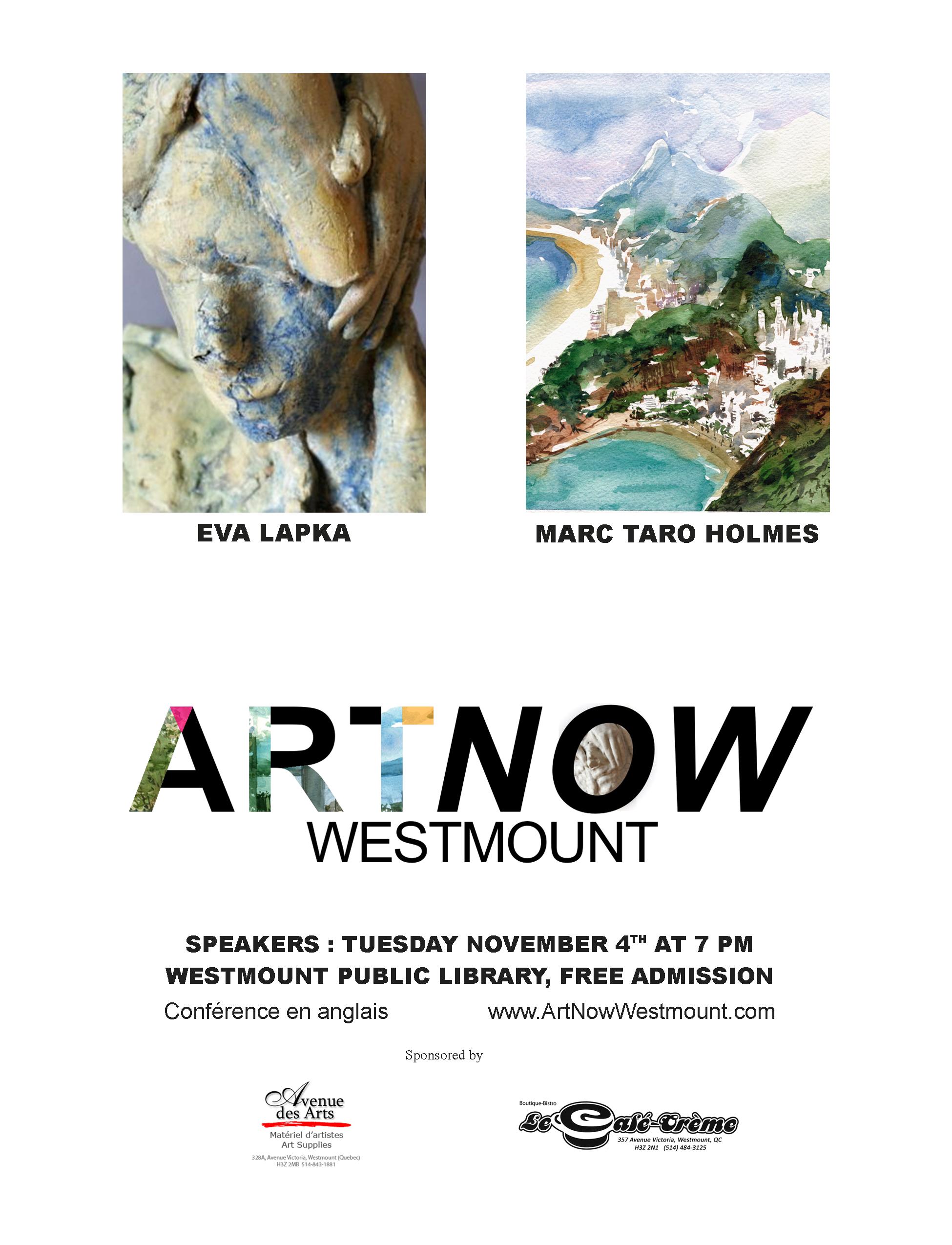
I’ve just come back from speaking about Urban Sketching at Art Now. Maybe a few of you were there?
I’m bringing it up, because I hadn’t heard of it before – probably you already know, but I’m the new guy in town.
Every First Tuesday, at 7PM at the Westmount Library here in Montreal, they have two artists give a slideshow talk about their work. There’s a gallery next door that might have a show to take in. We saw some wonderful oil paintings from Catherine Young Bates. Plus you can spend a few moments in the neat little conservatory/greenhouse attached to the library.
The event is sponsored by Avenue des Arts, my favorite art supply shop in Montreal. They’ll have the latest info on upcoming speakers.
There is no Cure for Grandmother : Sketching on Location for Science Quebec Magazine
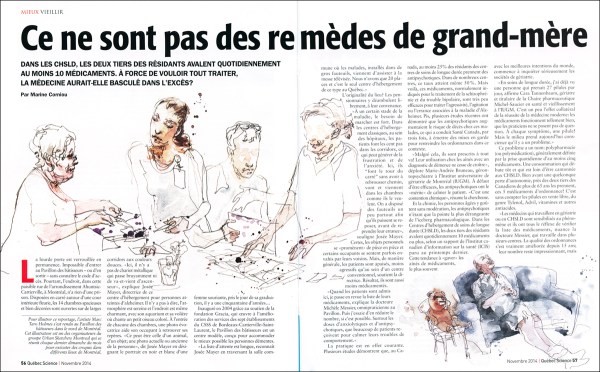
I’ve recently been drawing on location at a residential home for people with Alzheimer’s disease. I was there on behalf of Science Quebec Magazine, gathering drawings for their article There is no Cure for Grandmother. You can order the issue in e-format [here]. (In French).

I spent a day with the residents, sitting with them and seeing the daily routine. Most of the day are the normal things; having meals and taking medications. Getting a blood pressure checkup. Therapists visit at various times of the day, doing brain-training exercises that range from picture puzzles, to helping residents garden, or even visiting with pets.

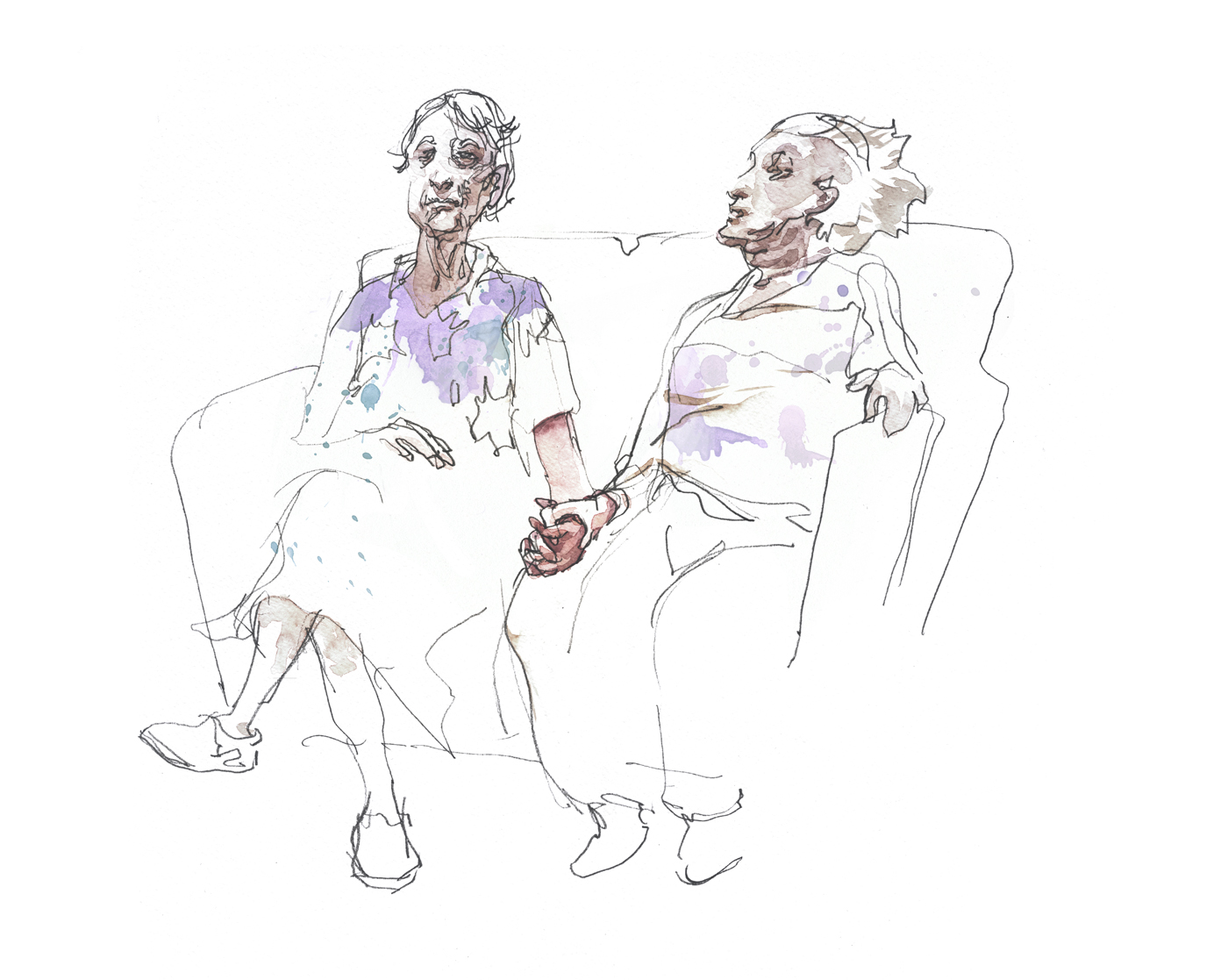
I sat in a sunny living room with the residents, while they napped, watched Celine Dion singing on DVD, and quietly moved around in their own little world. Only some of them seem to be aware of each other as people. Talking occasionally, even if their friend did not talk back. One lady would speak only in Spanish, one of the staff who was fluent would answer her when they were nearby.

The residents were interested in what I was doing, and of course I showed them my drawings, pointing out who I was sketching. But I couldn’t be sure how much they understood. One fellow was very happy to meet me, shaking hands and introducing himself, even though he only spoke French, and I only English.
The reality of their life was brought home, when he introduced himself to me again 10 minutes later and then again a third time. Just as happy to meet a new person each time.
I was left with the impression he was quite a salesman in his day. Had a charming handshake and hearty greeting.

One of the ladies enjoyed walking around the inner courtyard, and would casually take your arm and walk you around and around the loop. She knew I was a new visitor, as she refused to walk with the other staff while I was there.

For the artists who will likely ask – these are pencil sketches in a 11×14″ drawing pad, transferred by scan-and-printing to watercolor paper and painted in the studio. I did not do color on location, partially because they were for print, but mostly I didn’t want to bring paints and water into the house. I have done some color adjustments (fading back a bit), and added the thrown paint spots digitally.
The Urban Sketching Handbook, by Gabriel Campanario
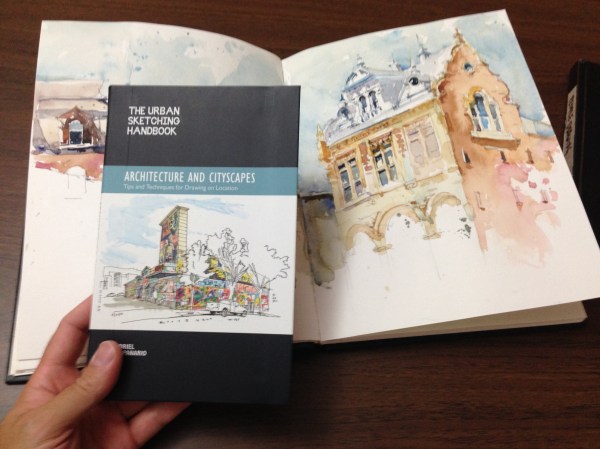
This arrived the other day. Gabriel Campanario‘s new book on Urban Sketching. It’s one of a pair of small format, sketchbook sized books. This volume on architecture and environment, is the companion to: The Urban Sketching Handbook: People and Motion: Tips and Techniques for Drawing on Location
It’s great to see my piece from this 2013 post on The Gradient of Interest included in the book.
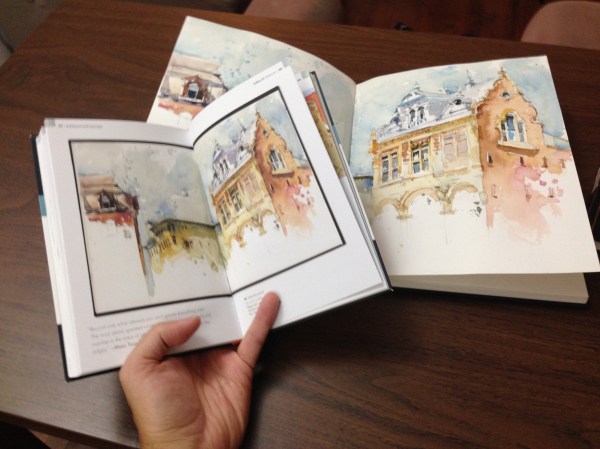
Gabriel Campanario is the founder of urbansketchers.org, and has been a tremendous (no, unparalleled) inspiration to our community of sketchers world wide. I think his unique position as a journalist, an artist, and a European in America made him a kind of human tipping point. He was thinking all the right things at just the right time and became the spark that ignited our international drawing phenomena.

The global nature of Urban Sketchers, and the great diversity of styles and approaches found among artists in the community are well represented in this ensemble volume.
You’ll find one or two favorite sketches, and one key idea, from each of 45 sketchers, tied together with Gabi’s own advice. I find when I take a workshop, I tend to come away with one great tip every time. It’s like, my brain can only learn one thing a day. So this feels a bit like carrying a USk symposium around in your pocket.
But it’s not just about the tips and tricks. The variety of drawing styles packed into this slim volume gave me a shot of inspiration. When you see someone pull off a great drawing, you just want to dive in and try it yourself!
I’m going to bring my copy to the next USk world wide symposium and see how many pages I can get signed by the artists :)


By the way – if you pick up your copy clicking over from my page, I get a little tip from the Amazon Affiliate program. So thanks! Even these little things help keep me blogging :)~m
In which Holmes Creates a Painting in the Rain, or: The Case of the Vanishing Castle

We arrived at Ithaca New York later than we had hoped, due to no greater misadventure than leaving Montreal too late in the day. Ongoing activities being so pressing, Holmes had been up to the wee hours inscribing books – which are even now being dispatched to the far corners of the earth.


After meeting our group of temporary Ithacans at the strictly functional Trip Hotel, and finding them a most congenial battalion of scribblers, we attempted a late night scouting mission. Despite the pitchest dark, and an unusual density of spiders clinging to the guard rail of the Thurston avenue bridge, we were able to confirm a suitable view of the Triphammer falls.
Imagine our dismay the following morning, after an insipid packaged breakfast at our inn, to find the day morosely overcast and insistently raining. Worse yet, the subject of our investigation, the ruined foundry, was not found to be artfully crumbling onto the gorge – but in fact – vanished without trace. No doubt spirited away by diligent engineers, myopically choosing public safety over what is eternal in art.

Not in the least dispirited by this turn of events, Holmes set to work with a briskly applied will, exclaiming that he had always meant to conduct an experiment watercoloring in the rain, and this vanished castle debacle was to be his opportunity.

I will leave it to you, dear readers, to determine – is the evidence of continual drizzle visible in the work? Holmes himself feels, even if it could be considered somewhat smeary by critics, the vicissitudes of nature do not detract in this document of the day.
It should also be said, the thorough soaking visited on the genuine cotton rag paper (provided by the Italian, Fabriano), allowed the work to be pressed below a stack of (inscribed) books overnight, granting a perfectly flat sheet by the second morning.

For the remainder of the expedition, Holmes continued to infuriate one and all with his antisocial manner and continual scratchings. Adding tirelessly to his encyclopedic collection of oddities found in leaf-strewn campus courtyards and dusty regional museums.


For whatever reason this unrelenting chore included a forced march one hour away (and another back) to observe the methods of the glass workers in Corning NY. A task I am unclear as to the value of, but which seemed satisfactory to the artist, for reasons he may disclose in the upcoming weeks.
Pre-Order Bonus signed copies of The Urban Sketcher with print : Sold Out! Thank you everyone!
I’m very pleased to say, we’ve shipped a huge stack of books. They’re going all over the US and Canada, but also to Spain, Italy, Australia, South Africa, and Singapore.
To everyone who ordered before Oct 22, I will be contacting all of you. At the time of this note I still have a lot of email to work through. Thank very much for your support, ordering the book in advance. It means a lot to me, seeing all the places in the world the book is going.
For all of you all over the world – here’s a view of Montreal in the winter, from the window of the art department at UQAM. (Where I go sometimes for life drawing). You can see why I want to visit you in all those nice warm countries.
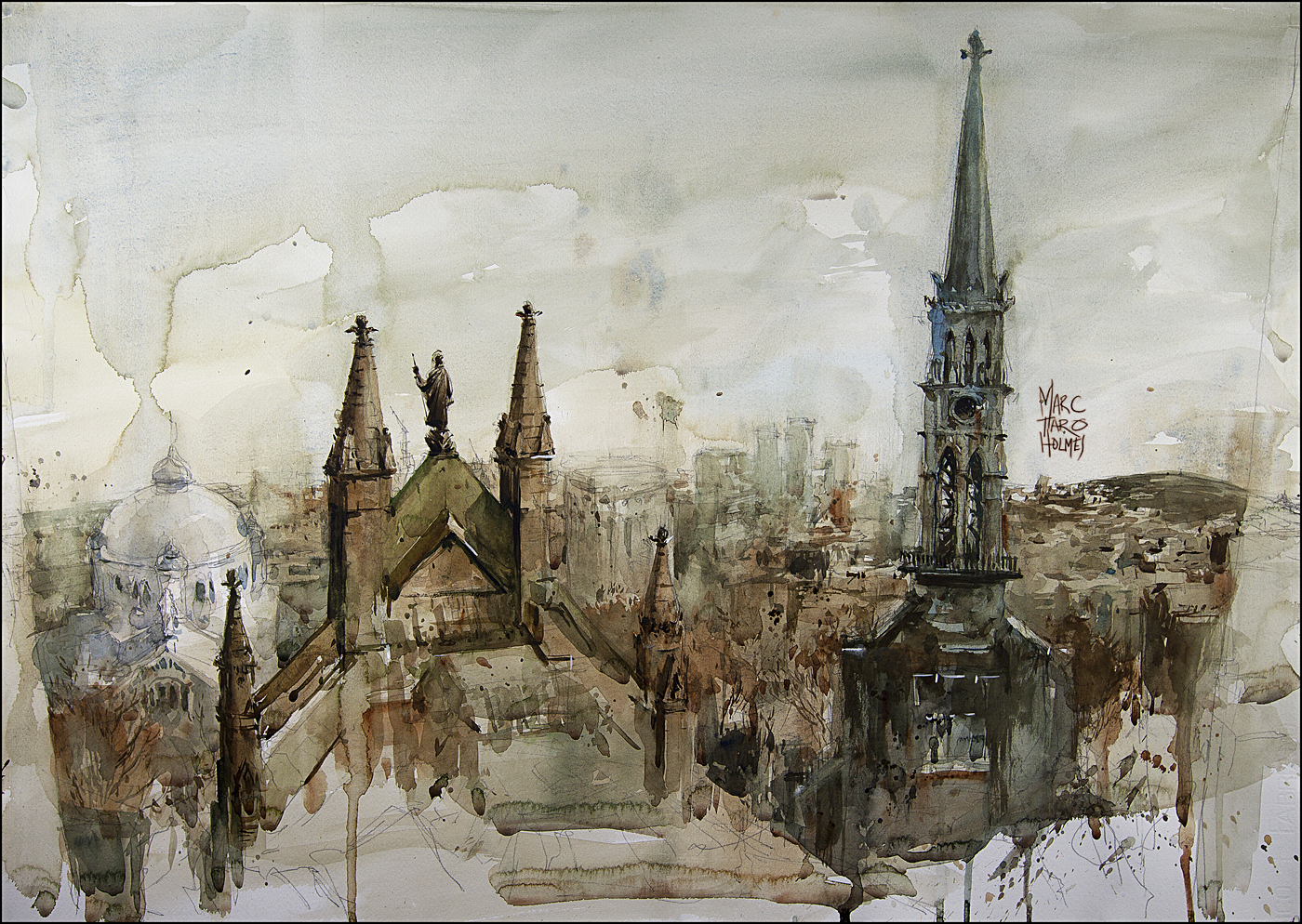
This was one of the last things I did for the book, and it didn’t actually make it in for various space and time reasons. But it did get a second chance at life – it’s hanging (soon) in the Canadian Society of Painters in Watercolor ‘Open Water’ show in Toronto. (Oct 28-Nov 21, John B. Aird Gallery, 900 Bay St., Toronto, Canada).
Please note: You may still order a signed copy of The Urban Sketcher! However my pre-order bonus deal (free shipping, and collector’s print) is now closed. We have shipped out 100 of these special copies.
If you would still enjoy a signed copy, from here onward, due to the practical realities of postage and my cost to order US books in Canadian dollars, it must be at full cover price plus shipping. Just email me and we’ll sort out the rates from Montreal to wherever you live.
One more thing – many people have asked, “Where should I order the book to give you (the author) the best value?” It’s tremendous so many people want to know this! In truth, I make the most profit if you buy the e-book from North Light. But, I’m sure you mostly want the paper copy – which can be found here [The Urban Sketcher]. But I also get a little bonus if you use this Affiliate Sales link on Amazon: [Order from Amazon

Ok – off to scan the images from Ithaca (well, and to go to the post office) ~ Marc
It’s fall in Montreal, but we’re going to Ithaca
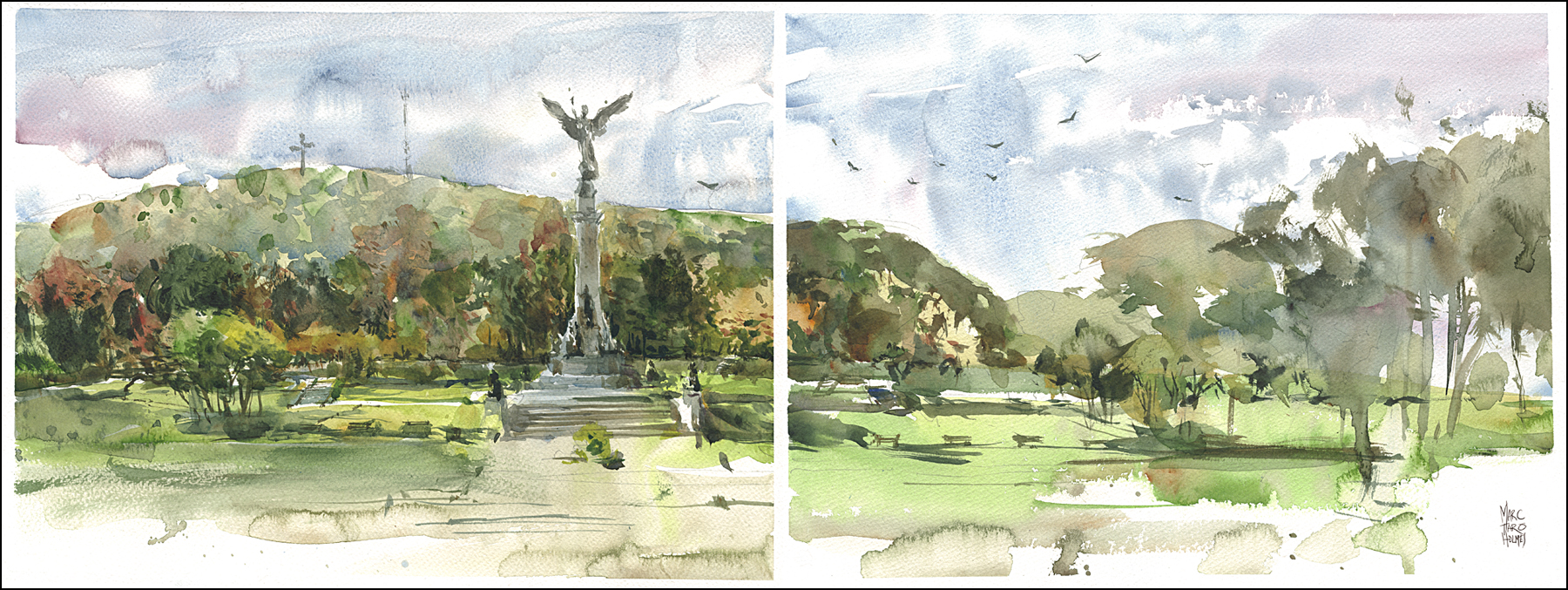
These are from a few days back, when the leaves were just turning. This was the last awesome day of the year. 25 degrees, sun and a light breeze. I had no choice but to ditch work and go painting. It’s very likely this was the last great painting day of the season.
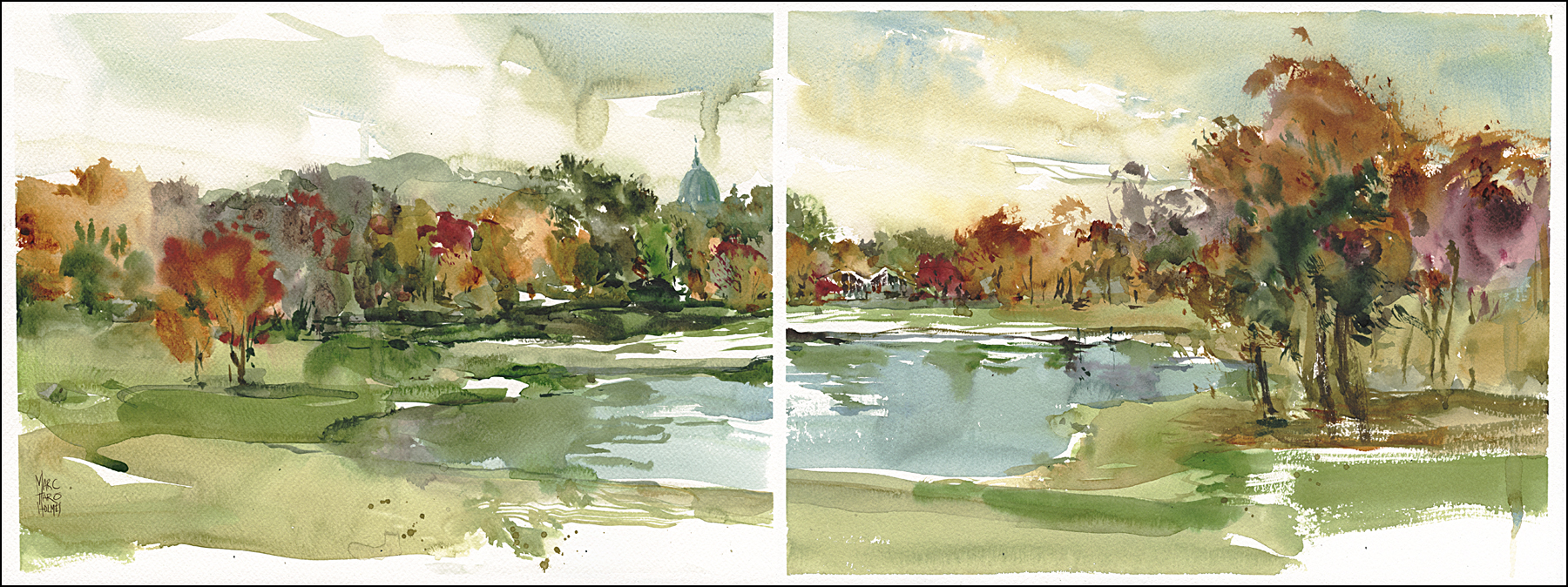
This weekend we’re headed to Ithaca NY for some more fall colors. There should be sketchers converging from NYC, Toronto, Montreal and Kitchener/Waterloo. If you’re anywhere near the area and you’d like to come painting, here’s a MAP showing where we will be, when.
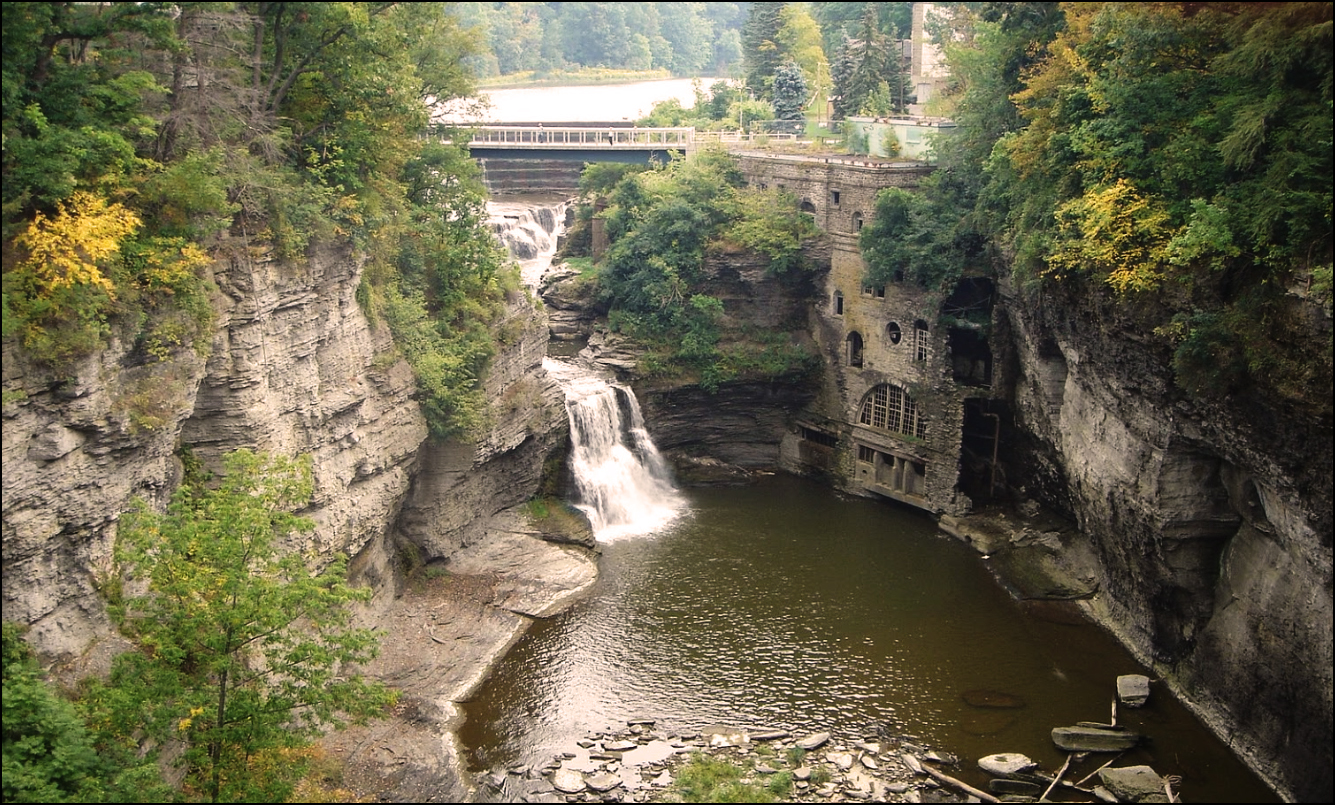
This is Triphammer Falls. One of the locations I hope to sketch while we’re there. Watch this space to see what we get!
Copies of The Urban Sketcher going out the door : About half way through my author copies

Hot off the presses. Tonight I’m signing books for the people that pre-ordered directly. Just mail me if you’d like a signed copy with artist print. Or – for the best price: Order from Amazon


 Citizen Sketcher
